Problem 7:
Case 1: LG Coordinator Questions
1. What are different types of motion perception.
1. How do we perceive movement? When do people perceive motion?
2. How does the duration of the object on the retina 2. What is Reichardt detector? How does it
affect object perception? function?
Tip: distinguish between different situations (3 3. Describes the corollary discharge theory. What
evidence supports this theory?
situations)
4. Describe Gibson’s ecological approach to
Case 2: LG perception. Be sure to explain the concepts optic
1. What is optic flow (motion parallax)? flow, focus of expansion and the reciprocal
2. How do we perceive movement while moving relation between perception and action.
ourselves? 5. Describe Lee and Aronson’s experiment with the
swinging room. What did they find? How can this
Tip: distinguish between situations (airplane/train)
be explained?
6. What is the aperture problem?
Source: Goldstein, 10th ed, chapter 7, pp 149-169
The Ecological Approach to Perception
Ecological validity: an ecologically valid experiment matches its stimuli, conditions, and
procedures to those present in the natural world.
Ecological approach to perception (Gibson): was named this because Gibson’s approach
focused on perception in natural context. A major goal of the ecological approach is to
determine how movement creates perceptual information that both guides further
movement and helps observers perceive the environment.
Optic flow: movement of an observer creates movement of objects and the scene relative
to the observer, is called optic flow.
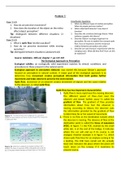
Optic flow has two important characteristics:
1. Optic flow is more rapid near the moving observer.
The different speed of flow—fast near the
observer and slower farther away—is called the
gradient of flow. The gradient of flow provides
information about how fast the observer is
moving. According to Gibson, the observer uses
the information provided by the gradient of flow
to determine his or her speed of movement.
2. There is no flow at the destination toward which
the observer is moving. The absence of flow at the
destination point is called the focus of expansion
(FOE). In figure 7.1 the FOE, marked by the small
white dot, is at the end of the bridge; it indicates
where the car will end up if its course is not
changed. Another example is in figure 7.2, which
shows optic flow lines for an airplane coming in for
a landing. The FOE here (small red (its actually
blue) dot) indicates the place where the plane will
touch down on the runway if it maintains its
present course.
, Invariant Information
Information that remains constant regardless of what the observer is doing or how the observer is
moving.
- Optic flow provides invariant information because the same flow information is present each
time the observer is moving through the environment in a particular way. E.g. the FOE always
occurs at the point toward which the observer is moving. If an observer changes direction, the
FOE shifts to a new location, but the FOE is still there. Thus, even when specific aspects of a scene
change, optic flow and the FOE continue to provide information about how fast a person is
moving and where they are heading.
Self-Produced Information
When a person makes a movement, that movement creates information, and this information, in
turn, is used to guide further movement. E.g. when a person is driving down the street, movement of
the car provides optic flow information, and the observer
then uses this flow information to help steer the car.
Observational study: closing the eyes did not affect the
performance of novice back-flippers as much as it affected
the performance of experts. Experts seem to learn to
coordinate their movements with their perceptions, a skill
that novices have not yet learned. Therefore, when the
novice closed their eyes, the loss of visual information had
less of an effect than it did for the experts. Thus,
somersaulting (backflips), like driving a car or piloting an
airplane, involves using information created by movement
to guide further movement.
The Senses do not work in isolation
Balance: your ability to stand up straight, and to keep your balance while standing still or walking,
depends on systems that enable you to sense the movement and position of your body relative to
gravity. These systems include the vestibular canals of your inner ear and receptors in the joints and
muscles. However, Gibson (and other) noted that information provided by vision also plays a role in
keeping your balance, a fact we can use to emphasize the way the senses work together. close eyes
while balancing on one foot lose balance vision provides a frame of reference that helps muscles
constantly make adjustments to help maintain balance.
Experiment:
- Swaying room (stationary floor, walls and ceiling swaying toward toddler). This
movement of the wall creates the optic flow pattern on the right. This pattern is
similar to the optic flow that occurs when moving forward, as when driving across
the bridge in figure 7.1.
- The optic flow pattern that the toddler observes creates the impression that he or
she is swaying forward. After all, the only natural circumstances in which the entire
world suddenly moves toward you is a situation in which you are moving (or falling)
forward. This perception causes the toddler to sway back to compensate. When the
room moves back, the optic flow pattern creates the impression of swaying
backward, so the toddler sways forward to compensate. 26% swayed, 23%
staggered, and 33% fell down.
- Even some adults were affected by the swinging room.
Case 1: LG Coordinator Questions
1. What are different types of motion perception.
1. How do we perceive movement? When do people perceive motion?
2. How does the duration of the object on the retina 2. What is Reichardt detector? How does it
affect object perception? function?
Tip: distinguish between different situations (3 3. Describes the corollary discharge theory. What
evidence supports this theory?
situations)
4. Describe Gibson’s ecological approach to
Case 2: LG perception. Be sure to explain the concepts optic
1. What is optic flow (motion parallax)? flow, focus of expansion and the reciprocal
2. How do we perceive movement while moving relation between perception and action.
ourselves? 5. Describe Lee and Aronson’s experiment with the
swinging room. What did they find? How can this
Tip: distinguish between situations (airplane/train)
be explained?
6. What is the aperture problem?
Source: Goldstein, 10th ed, chapter 7, pp 149-169
The Ecological Approach to Perception
Ecological validity: an ecologically valid experiment matches its stimuli, conditions, and
procedures to those present in the natural world.
Ecological approach to perception (Gibson): was named this because Gibson’s approach
focused on perception in natural context. A major goal of the ecological approach is to
determine how movement creates perceptual information that both guides further
movement and helps observers perceive the environment.
Optic flow: movement of an observer creates movement of objects and the scene relative
to the observer, is called optic flow.
Optic flow has two important characteristics:
1. Optic flow is more rapid near the moving observer.
The different speed of flow—fast near the
observer and slower farther away—is called the
gradient of flow. The gradient of flow provides
information about how fast the observer is
moving. According to Gibson, the observer uses
the information provided by the gradient of flow
to determine his or her speed of movement.
2. There is no flow at the destination toward which
the observer is moving. The absence of flow at the
destination point is called the focus of expansion
(FOE). In figure 7.1 the FOE, marked by the small
white dot, is at the end of the bridge; it indicates
where the car will end up if its course is not
changed. Another example is in figure 7.2, which
shows optic flow lines for an airplane coming in for
a landing. The FOE here (small red (its actually
blue) dot) indicates the place where the plane will
touch down on the runway if it maintains its
present course.
, Invariant Information
Information that remains constant regardless of what the observer is doing or how the observer is
moving.
- Optic flow provides invariant information because the same flow information is present each
time the observer is moving through the environment in a particular way. E.g. the FOE always
occurs at the point toward which the observer is moving. If an observer changes direction, the
FOE shifts to a new location, but the FOE is still there. Thus, even when specific aspects of a scene
change, optic flow and the FOE continue to provide information about how fast a person is
moving and where they are heading.
Self-Produced Information
When a person makes a movement, that movement creates information, and this information, in
turn, is used to guide further movement. E.g. when a person is driving down the street, movement of
the car provides optic flow information, and the observer
then uses this flow information to help steer the car.
Observational study: closing the eyes did not affect the
performance of novice back-flippers as much as it affected
the performance of experts. Experts seem to learn to
coordinate their movements with their perceptions, a skill
that novices have not yet learned. Therefore, when the
novice closed their eyes, the loss of visual information had
less of an effect than it did for the experts. Thus,
somersaulting (backflips), like driving a car or piloting an
airplane, involves using information created by movement
to guide further movement.
The Senses do not work in isolation
Balance: your ability to stand up straight, and to keep your balance while standing still or walking,
depends on systems that enable you to sense the movement and position of your body relative to
gravity. These systems include the vestibular canals of your inner ear and receptors in the joints and
muscles. However, Gibson (and other) noted that information provided by vision also plays a role in
keeping your balance, a fact we can use to emphasize the way the senses work together. close eyes
while balancing on one foot lose balance vision provides a frame of reference that helps muscles
constantly make adjustments to help maintain balance.
Experiment:
- Swaying room (stationary floor, walls and ceiling swaying toward toddler). This
movement of the wall creates the optic flow pattern on the right. This pattern is
similar to the optic flow that occurs when moving forward, as when driving across
the bridge in figure 7.1.
- The optic flow pattern that the toddler observes creates the impression that he or
she is swaying forward. After all, the only natural circumstances in which the entire
world suddenly moves toward you is a situation in which you are moving (or falling)
forward. This perception causes the toddler to sway back to compensate. When the
room moves back, the optic flow pattern creates the impression of swaying
backward, so the toddler sways forward to compensate. 26% swayed, 23%
staggered, and 33% fell down.
- Even some adults were affected by the swinging room.