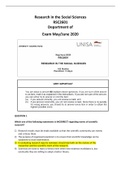
Research in the Social Sciences
RSC2601
Department of
Exam May/June 2020
QUESTION 1
Which one of the following statements is INCORRECT regarding norms of scientific
research?
1) Research results must be made available so that the scientific community can review
and criticise them.
2) The purpose of organised scepticism is to ensure that scientific knowledge can be
subjected to close examination.
3) In evaluating research reports reviewers should rely both on the stature of the
researcher and the scientific merit of the research.
4) Scientists are slow to reject a theory even when new evidence invalidates it, but
eventually they are willing to adopt a better theory.
, 5) The norms of scientific inquiry are only likely to be upheld if the institutional context in which
research takes place is conducive to it.
Answer:
Refer to the study guide Page 12:
Neuman (1997) writes of the norms of the scientific community. Norms are rules of conduct
in particular situations that are enforced by positive and negative sanctions. People are
rewarded if they act according to the norm (positive sanctions) and punished if they violate
the norm (negative sanctions). Just as behaviour in any human community is regulated by
social norms, so the scientific community is governed by those norms that researchers learn
and internalise as an essential part of their training. These norms differ from those in other
social institutions, and it is these norms that contribute to the unique role of the scientist.
The settings of research and the ways in which science is applied reinforces these norms.
Neuman (1997:8) presents these norms as follows:
Universalism. Irrespective of who conducts the research and regardless of where it was
conducted, the research is to be judged only on the basis of scientific merit.
Organised scepticism. Scientists should not accept new ideas or evidence in a carefree,
uncritical manner. Instead, all evidence should be challenged and questioned. Each
research study is subjected to intense criticism and scrutiny. The purpose of the criticism is
not to attack the individual; rather, it is to ensure that the research can stand up to close
examination.
Disinterestedness. Scientists must be neutral, impartial, receptive and open to unexpected
observations or new ideas. Scientists should not be rigidly wedded to a particular idea or
point of view. They should accept, even look for, evidence that runs against their positions
and should honestly accept all findings based on high-quality research.
Communalism. Scientific knowledge must be shared with others; it belongs to everyone.
Creating scientific knowledge is a public act and the findings are public property, available
for all to use. The way in which the research is conducted must be described in detail. New
knowledge is not formally accepted until other researchers have reviewed it and it has been
made publicly available in a special form and style.norms: rules of conduct (the “done
thing’’)
Honesty. This is a general cultural norm, but it is especially strong in scientific research.
Scientists demand honesty in all research; dishonesty or cheating in scientific research is a
major taboo.
QUESTION 2
Ms Ndlovu runs a health education programme on prevention of the spread of HIV each first
Monday of the month. During February, she educated the clients on the importance of
condom use. In April, she finds that the majority of the clients still do not use condoms. She
concludes that the clients show a lack of knowledge as well as a negative attitude towards
the prevention of the spread of HIV.
This is an example of …
RSC2601
Department of
Exam May/June 2020
QUESTION 1
Which one of the following statements is INCORRECT regarding norms of scientific
research?
1) Research results must be made available so that the scientific community can review
and criticise them.
2) The purpose of organised scepticism is to ensure that scientific knowledge can be
subjected to close examination.
3) In evaluating research reports reviewers should rely both on the stature of the
researcher and the scientific merit of the research.
4) Scientists are slow to reject a theory even when new evidence invalidates it, but
eventually they are willing to adopt a better theory.
, 5) The norms of scientific inquiry are only likely to be upheld if the institutional context in which
research takes place is conducive to it.
Answer:
Refer to the study guide Page 12:
Neuman (1997) writes of the norms of the scientific community. Norms are rules of conduct
in particular situations that are enforced by positive and negative sanctions. People are
rewarded if they act according to the norm (positive sanctions) and punished if they violate
the norm (negative sanctions). Just as behaviour in any human community is regulated by
social norms, so the scientific community is governed by those norms that researchers learn
and internalise as an essential part of their training. These norms differ from those in other
social institutions, and it is these norms that contribute to the unique role of the scientist.
The settings of research and the ways in which science is applied reinforces these norms.
Neuman (1997:8) presents these norms as follows:
Universalism. Irrespective of who conducts the research and regardless of where it was
conducted, the research is to be judged only on the basis of scientific merit.
Organised scepticism. Scientists should not accept new ideas or evidence in a carefree,
uncritical manner. Instead, all evidence should be challenged and questioned. Each
research study is subjected to intense criticism and scrutiny. The purpose of the criticism is
not to attack the individual; rather, it is to ensure that the research can stand up to close
examination.
Disinterestedness. Scientists must be neutral, impartial, receptive and open to unexpected
observations or new ideas. Scientists should not be rigidly wedded to a particular idea or
point of view. They should accept, even look for, evidence that runs against their positions
and should honestly accept all findings based on high-quality research.
Communalism. Scientific knowledge must be shared with others; it belongs to everyone.
Creating scientific knowledge is a public act and the findings are public property, available
for all to use. The way in which the research is conducted must be described in detail. New
knowledge is not formally accepted until other researchers have reviewed it and it has been
made publicly available in a special form and style.norms: rules of conduct (the “done
thing’’)
Honesty. This is a general cultural norm, but it is especially strong in scientific research.
Scientists demand honesty in all research; dishonesty or cheating in scientific research is a
major taboo.
QUESTION 2
Ms Ndlovu runs a health education programme on prevention of the spread of HIV each first
Monday of the month. During February, she educated the clients on the importance of
condom use. In April, she finds that the majority of the clients still do not use condoms. She
concludes that the clients show a lack of knowledge as well as a negative attitude towards
the prevention of the spread of HIV.
This is an example of …