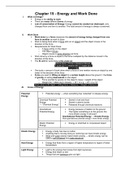
Chapter 15 - Energy and Work Done
I. What is Energy?
Energy is the ability to work
There are many different forms of energy
Law of conservation of Energy: Energy cannot be created nor destroyed, only
changed from one form to another. The total amount of energy is always conserved.
II. Work Done
Work done by a force measures the amount of energy being changed from one
form to another as work is done
Work is being done when a force acts on an object and the object moves in the
direction of the force
Requirements for Work Done:
o A force acting on the object
o The object moves
o Object moves in same direction as force
Work done by a force is equal to the force multiplied by the distance moved in the
direction of the force
The SI unit for work done is the Joule (J)
Work done = Force x Distance Moved
1 joule (J) = 1 newton (N) x 1 meter (m)
1 J = 1 Nm
One joule = amount of work done when a force of one newton moves an object by one
meter in the direction of the force
Force you exert in lifting an object to a certain height above the ground = the force
of gravity on acting downwards on the object
o Force exerted by gravity on the object’s mass = weight of the object
o Weight (N) = Mass (kg) x Gravity → W = m x g → W = m x 10
Work done to lift object = Lifting force x Distance = Weight x Distance
III. Forms of Energy
Potential Potential energy → when something has “potential” to release energy
Energy
Chemical Potential Stored in fuel and food
Energy Stored in atomic bonds
→ “Chemical Energy” Released through chemical reactions
Gravitational Energy because of relation to the ground
Potential Energy The higher something is to the ground, the
more kinetic energy it will exert
Gravitational Potential Energy → Kinetic Energy
More gravitational potential energy = more kinetic energy
Elastic Potential Energy in stretched or compressed object
Energy
Kinetic Energy Energy a body has due to motion
Anything that is moving (living or nonliving) can have kinetic energy
Wind and water energy make kinetic energy → kinetic energy can be
used to turn a turbine and make electricity
Heat Energy Energy that flows from a region of higher temperature to region of lower
temperature
Light Energy Light is the energy that comes from light ray/waves
Energy that helps us see
Things that are luminous give out light
I. What is Energy?
Energy is the ability to work
There are many different forms of energy
Law of conservation of Energy: Energy cannot be created nor destroyed, only
changed from one form to another. The total amount of energy is always conserved.
II. Work Done
Work done by a force measures the amount of energy being changed from one
form to another as work is done
Work is being done when a force acts on an object and the object moves in the
direction of the force
Requirements for Work Done:
o A force acting on the object
o The object moves
o Object moves in same direction as force
Work done by a force is equal to the force multiplied by the distance moved in the
direction of the force
The SI unit for work done is the Joule (J)
Work done = Force x Distance Moved
1 joule (J) = 1 newton (N) x 1 meter (m)
1 J = 1 Nm
One joule = amount of work done when a force of one newton moves an object by one
meter in the direction of the force
Force you exert in lifting an object to a certain height above the ground = the force
of gravity on acting downwards on the object
o Force exerted by gravity on the object’s mass = weight of the object
o Weight (N) = Mass (kg) x Gravity → W = m x g → W = m x 10
Work done to lift object = Lifting force x Distance = Weight x Distance
III. Forms of Energy
Potential Potential energy → when something has “potential” to release energy
Energy
Chemical Potential Stored in fuel and food
Energy Stored in atomic bonds
→ “Chemical Energy” Released through chemical reactions
Gravitational Energy because of relation to the ground
Potential Energy The higher something is to the ground, the
more kinetic energy it will exert
Gravitational Potential Energy → Kinetic Energy
More gravitational potential energy = more kinetic energy
Elastic Potential Energy in stretched or compressed object
Energy
Kinetic Energy Energy a body has due to motion
Anything that is moving (living or nonliving) can have kinetic energy
Wind and water energy make kinetic energy → kinetic energy can be
used to turn a turbine and make electricity
Heat Energy Energy that flows from a region of higher temperature to region of lower
temperature
Light Energy Light is the energy that comes from light ray/waves
Energy that helps us see
Things that are luminous give out light