BDE 214: Communities
Lecture One: Introduction
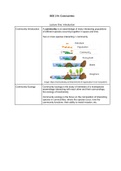
Community Introduction A community is an assemblage of many interacting populations
of different species occurring together in space and time.
Two or more species interacting = community.
Image: https://eschooltoday.com/learn/levels-of-organization-in-an-ecosystem/
Community Ecology Community ecology is the study of members of a multispecies
assemblage interacting with each other and their surroundings;
the ecology of biodiversity.
Community ecology is the focus on the composition of interacting
species in communities, where the species occur, how the
community functions. their ability to resist invasion, etc.
, Lecture Two: Earth Diversity
Definitions Taxonomy: The work of identifying different organisms,
classifying them into categories and naming them.
Extrapolation: Predicting an outcome using past experience.
Species on Earth The value of how many species are on Earth is unknown.
There are about 15 000 new species named each year (generally
invertebrates - most life on Earth is invertebrates).
The reason this number is unknown:
● Extreme environment types have not been explored yet.
● Organisms are too small for identification.
● Taxonomic expertise is not sufficient enough.
Estimated values are derived from experts who use ratios
between taxa and species ratios.
Methods to Determine Extrapolation
Species Number Researching species numbers via field work and deducting
information from the found data (estimation) is a method of
determining the total species for certain areas.
Using known:unknown ratios are used in this method.
Terry Erwin In 1982, Terry Erwin set out to estimate the diversity of Earth in a
scientific manner.
Method & Results
● He researched tropical rain forests (90% of species on
the planet found here) and analysed the diversity of
beetles on one tree species.
● He fogged the canopy and set up screens at the bottom
to collect the beetles that fell out of the canopy.
● He then identified the beatles as best as he could.
● He found 1200 beetles. 20% of these beetles were
specialized to the specific tree species.
● He then scaled up the data from the single tree to the
entire rainforest.
● He scaled up to estimate 12448 beetle species per
hectare and 31120 arthropod species per hectare.
Converging of Data The numbers between different studies appear to be converging
at similar estimates.
Even different approaches and biodiversity patterns used to
estimate species numbers result in similar values.
Mora et al. 2011.
● Method used to estimate species number was different to
, Erwin.
● Used taxonomic expertise.
● 8 750 000 +- 1 300 000 species predicted (only 1 244 360
catalogued)
It is estimated that 85% of species on Earth still need to be
discovered.
Protists & Bacteria Protists and bacteria were excluded from earlier research.
Some recent studies have begun to try to incorporate unicellular
protists and bacteria into estimates.
Important errors were incorporated/adjusted for.
● Existence of cryptic species (hidden diversity). There are
multiple distinct lineages in morphous species.
● Calculate diversity of obligate arthropod associated
organisms. For every beetle species, it was assumed
there was a single mite species present as well.
The incorporation of these species skyrocketed the total species
estimate.
The best estimate for eukaryotic species is 1.6 billion.
, Lecture Three: Species Richness
Definitions Species Diversity: The number of species and abundance of
each species that live in a certain area.
Species Richness & Species richness is the number of species in a community.
Abundance
Another characteristic used in biodiversity is the relative
abundance of species in the community.
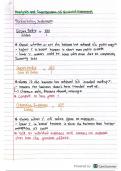
Relative Abundance Robert Whittaker was an established ecologist who developed
the relative abundance curve.
Image: Lecture Notes
Notes on Graph
● Most common species on the left
● Least common on the right
● This graph is used when looking at a community with
similar organisms.
● Pattern is called low evenness.
● Lognormal distribution.
Geometric Series
● There is a very low evenness.
● This is seen in eutrophied systems/polluted systems
where only few species can tolerate the unusual
conditions in an area.
Image: Lecture Notes
Lecture One: Introduction
Community Introduction A community is an assemblage of many interacting populations
of different species occurring together in space and time.
Two or more species interacting = community.
Image: https://eschooltoday.com/learn/levels-of-organization-in-an-ecosystem/
Community Ecology Community ecology is the study of members of a multispecies
assemblage interacting with each other and their surroundings;
the ecology of biodiversity.
Community ecology is the focus on the composition of interacting
species in communities, where the species occur, how the
community functions. their ability to resist invasion, etc.
, Lecture Two: Earth Diversity
Definitions Taxonomy: The work of identifying different organisms,
classifying them into categories and naming them.
Extrapolation: Predicting an outcome using past experience.
Species on Earth The value of how many species are on Earth is unknown.
There are about 15 000 new species named each year (generally
invertebrates - most life on Earth is invertebrates).
The reason this number is unknown:
● Extreme environment types have not been explored yet.
● Organisms are too small for identification.
● Taxonomic expertise is not sufficient enough.
Estimated values are derived from experts who use ratios
between taxa and species ratios.
Methods to Determine Extrapolation
Species Number Researching species numbers via field work and deducting
information from the found data (estimation) is a method of
determining the total species for certain areas.
Using known:unknown ratios are used in this method.
Terry Erwin In 1982, Terry Erwin set out to estimate the diversity of Earth in a
scientific manner.
Method & Results
● He researched tropical rain forests (90% of species on
the planet found here) and analysed the diversity of
beetles on one tree species.
● He fogged the canopy and set up screens at the bottom
to collect the beetles that fell out of the canopy.
● He then identified the beatles as best as he could.
● He found 1200 beetles. 20% of these beetles were
specialized to the specific tree species.
● He then scaled up the data from the single tree to the
entire rainforest.
● He scaled up to estimate 12448 beetle species per
hectare and 31120 arthropod species per hectare.
Converging of Data The numbers between different studies appear to be converging
at similar estimates.
Even different approaches and biodiversity patterns used to
estimate species numbers result in similar values.
Mora et al. 2011.
● Method used to estimate species number was different to
, Erwin.
● Used taxonomic expertise.
● 8 750 000 +- 1 300 000 species predicted (only 1 244 360
catalogued)
It is estimated that 85% of species on Earth still need to be
discovered.
Protists & Bacteria Protists and bacteria were excluded from earlier research.
Some recent studies have begun to try to incorporate unicellular
protists and bacteria into estimates.
Important errors were incorporated/adjusted for.
● Existence of cryptic species (hidden diversity). There are
multiple distinct lineages in morphous species.
● Calculate diversity of obligate arthropod associated
organisms. For every beetle species, it was assumed
there was a single mite species present as well.
The incorporation of these species skyrocketed the total species
estimate.
The best estimate for eukaryotic species is 1.6 billion.
, Lecture Three: Species Richness
Definitions Species Diversity: The number of species and abundance of
each species that live in a certain area.
Species Richness & Species richness is the number of species in a community.
Abundance
Another characteristic used in biodiversity is the relative
abundance of species in the community.
Relative Abundance Robert Whittaker was an established ecologist who developed
the relative abundance curve.
Image: Lecture Notes
Notes on Graph
● Most common species on the left
● Least common on the right
● This graph is used when looking at a community with
similar organisms.
● Pattern is called low evenness.
● Lognormal distribution.
Geometric Series
● There is a very low evenness.
● This is seen in eutrophied systems/polluted systems
where only few species can tolerate the unusual
conditions in an area.
Image: Lecture Notes