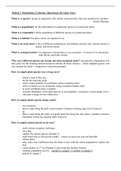
Module 7 (Population, Evolution, Inheritance) Revision Notes
What is a species? group of organisms with similar characteristics that can interbreed to produce
fertile offspring
What is a population? all the individuals of a particular species in a particular place
What is a community? all the population of different species in a particular place
What is a habitat? the place where an organism lives
What is an ecosystem? a mix of different communities and habitats and how they interact based on
abiotic and biotic factors
What is ecological niche? an organisms role/position in an ecosystem – in terms of its interaction
with abiotic and biotic factors
Why can 2 different species not occupy the same ecological niche? interspecific competition will
take place for the limiting factors/resources (abiotic & biotic factors) – better adapted species will
out compete the other = competitive exclusion principle
How to sample plant species over a large area?
obtain a map of the area
divide the map into grids
select a large number of coordinates using a running mean
select a random set of coordinates using a random number chart
in each coordinate place a quadrat
measure abundance of the plant species in each quadrat = frequency or percentage cover
calculate average for the whole area
How to sample plants species along a path?
use a transect
place a tape along the path, count number of plants touching tape (Line Transect)
or
place a tape along the path, at regular intervals along the tape place a quadrat, measure
abundance within the quadrat (Belt Transect)
How to sample animal species in an area?
mark-release-recapture technique
set a trap
capture the animal species [Sample 1]
mark them (tag or fluorescent marker – ensure its non-toxic and not harmful)
release them
after some time (sufficient time for them to mix with the whole population), replace the
trap
count number in 2nd set [Sample 2] and count the number marked
estimate population size by: number in sample 1 x number in sample 2
marked in sample 2
, Assumptions of Mark-release-recapture technique?
no births or deaths
no immigration or emigration
marked animals mix evenly with population
mark is not toxic
mark does not come off
large population
What are the 3 stages of population growth?
slow/lag phase: species becomes adapted to new environment
rapid/log phase: species adapted, abundant resources, doubling with reproduction,
birth rate>death rate
stationary phase: resources become limited, intraspecific competition occurs,
birth rate = death rate
How are resources/limiting factors grouped?
abiotic (non-living): light, temperature, water, O2/CO2, minerals, pH, living space
biotic (living): predator, prey, mates, competition, disease
What is competition? when organisms compete for resources (abiotic and biotic)
What are the 2 types of competition?
intraspecific: occurs between organisms of the same species, only occurs when resources
become limited, leads to natural selection and adaptation
interspecific: occurs between organisms of different species, can happen at any time
even if resources are not limited, leads to formation of climax communities
Describe the predator/prey relationship?
prey increases in number
more food available for predator
predator increases in number (more energy available for reproduction & growth)
predator eats more of the prey
prey decreases in number
less food available for predator
predator decreases in number
less of the prey are eaten
prey increases in number [cycle repeats]
What is succession? how an ecosystem changes over time (change in species diversity and habitat
What is a species? group of organisms with similar characteristics that can interbreed to produce
fertile offspring
What is a population? all the individuals of a particular species in a particular place
What is a community? all the population of different species in a particular place
What is a habitat? the place where an organism lives
What is an ecosystem? a mix of different communities and habitats and how they interact based on
abiotic and biotic factors
What is ecological niche? an organisms role/position in an ecosystem – in terms of its interaction
with abiotic and biotic factors
Why can 2 different species not occupy the same ecological niche? interspecific competition will
take place for the limiting factors/resources (abiotic & biotic factors) – better adapted species will
out compete the other = competitive exclusion principle
How to sample plant species over a large area?
obtain a map of the area
divide the map into grids
select a large number of coordinates using a running mean
select a random set of coordinates using a random number chart
in each coordinate place a quadrat
measure abundance of the plant species in each quadrat = frequency or percentage cover
calculate average for the whole area
How to sample plants species along a path?
use a transect
place a tape along the path, count number of plants touching tape (Line Transect)
or
place a tape along the path, at regular intervals along the tape place a quadrat, measure
abundance within the quadrat (Belt Transect)
How to sample animal species in an area?
mark-release-recapture technique
set a trap
capture the animal species [Sample 1]
mark them (tag or fluorescent marker – ensure its non-toxic and not harmful)
release them
after some time (sufficient time for them to mix with the whole population), replace the
trap
count number in 2nd set [Sample 2] and count the number marked
estimate population size by: number in sample 1 x number in sample 2
marked in sample 2
, Assumptions of Mark-release-recapture technique?
no births or deaths
no immigration or emigration
marked animals mix evenly with population
mark is not toxic
mark does not come off
large population
What are the 3 stages of population growth?
slow/lag phase: species becomes adapted to new environment
rapid/log phase: species adapted, abundant resources, doubling with reproduction,
birth rate>death rate
stationary phase: resources become limited, intraspecific competition occurs,
birth rate = death rate
How are resources/limiting factors grouped?
abiotic (non-living): light, temperature, water, O2/CO2, minerals, pH, living space
biotic (living): predator, prey, mates, competition, disease
What is competition? when organisms compete for resources (abiotic and biotic)
What are the 2 types of competition?
intraspecific: occurs between organisms of the same species, only occurs when resources
become limited, leads to natural selection and adaptation
interspecific: occurs between organisms of different species, can happen at any time
even if resources are not limited, leads to formation of climax communities
Describe the predator/prey relationship?
prey increases in number
more food available for predator
predator increases in number (more energy available for reproduction & growth)
predator eats more of the prey
prey decreases in number
less food available for predator
predator decreases in number
less of the prey are eaten
prey increases in number [cycle repeats]
What is succession? how an ecosystem changes over time (change in species diversity and habitat