Module 1 (Biological Molecules) Revision Notes
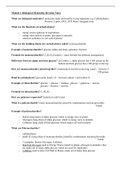
What are biological molecules? molecules made and used by living organisms e.g. Carbohydrates,
Proteins, Lipids, DNA, ATP, Water, Inorganic Ions
What are the functions of carbohydrates?
energy source (glucose in respiration)
energy store (starch in plants, glycogen in animals)
structure (cellulose in cell wall of plants)
What are the building blocks for carbohydrates called? monosaccharides
Example of monosaccharides? glucose (alpha and beta), galactose, fructose
Formula for monosaccharides? C6H12O6 (isomers = same formula but different arrangement)
Difference between alpha and beta glucose? on Carbon 1, alpha glucose has a OH group on the
bottom and beta glucose has a OH group on the top
How are monosaccharides joined together? condensation reaction (removing water) – between 2
OH groups
Bond in carbohydrate? glycosidic bond (1,4 – between carbon 1 and carbon 4)
Example of disaccharides? glucose + glucose = maltose, glucose + galactose = lactose,
glucose + fructose = sucrose
Formula for disaccharides? C12H22O11
How are polymers separated? hydrolysis (add water)
What is a polysaccharide? many monosacharrides joined by condensation reaction/glycosidic
bonds
Example of polysaccharides?
Starch (long chain of alpha glucose) which is energy store in plants
Glycogen (long chain of alpha glucose) which is energy store in animals
Cellulose (long chain of beta glucose) which makes cell wall in plants
What are Polysaccharides?
carbohydrates
made of a long chain of monosaccharides joined by condensation reaction/glycosidic
bonds
3 examples: Starch, Glycogen, Cellulose
Starch & Glycogen used as Energy Stores (starch in plants, glycogen in animals), they
are made out of many alpha glucose which are used for respiration
Cellulose used to form Cell Wall in Plants, made out of many beta glucose
, Structure of Starch?
made from Amylose and Amylopectin
Amylose = long straight chain of alpha-glucose which is coiled
Amylopectin = straight chain of alpha-glucose with side branches (1,6-glycosidic bond)
Structure of Glycogen?
straight chain of alpha-glucose (1,4-glycosidic bond) with side branches (1,6-glycosidic bond)
Properties of Starch and Glycogen as energy stores?
Insoluble = do not affect water potential of the cell, do not diffuse out of the cell
Coiled/Branched = compact, more can fit into a cell
Branched/Chained = glucose removed from the end
Structure of Cellulose?
β-glucose arranged in a straight chain (each alternative β-glucose is rotated 180 degrees)
= cellulose straight chain
many cellulose chains are cross linked by hydrogen bonds to form microfibrils
many microfibrils are cross linked to form marcrofibrils
forms structure of cell wall
strong material (prevents plant cell from bursting or shrinking)
Test for starch? add iodine, turns blue/black
Test for reducing sugar? heat with benedicts, turns brick red
Test for non-reducing sugar?
heat with benedicts – no change
therefore, add dilute hydrochloric acid (hydrolyses glycosidic bond)
then add sodium hydrogencarbonate (neutralises solution)
heat with benedict - turns brick red
What are 2 types of proteins? Globular and Fibrous
What are globular proteins? soluble proteins with a specific 3D shape e.g. enzymes, hormones,
antibodies, haemoglobin
What are fibrous proteins? strong/insoluble/inflexible material e.g. collagen and keratin
What are the building blocks for proteins? amino acids
Structure of amino acid? central carbon, carboxyl group to the right (COOH), amine group to
the left (NH2), hydrogen above and R group below
How do amino acids differ? have different R groups e.g. glycine has a hydrogen in its R group –
simplest amino acid
How are amino acids joined together? by condensation reaction between the carboxyl group of
What are biological molecules? molecules made and used by living organisms e.g. Carbohydrates,
Proteins, Lipids, DNA, ATP, Water, Inorganic Ions
What are the functions of carbohydrates?
energy source (glucose in respiration)
energy store (starch in plants, glycogen in animals)
structure (cellulose in cell wall of plants)
What are the building blocks for carbohydrates called? monosaccharides
Example of monosaccharides? glucose (alpha and beta), galactose, fructose
Formula for monosaccharides? C6H12O6 (isomers = same formula but different arrangement)
Difference between alpha and beta glucose? on Carbon 1, alpha glucose has a OH group on the
bottom and beta glucose has a OH group on the top
How are monosaccharides joined together? condensation reaction (removing water) – between 2
OH groups
Bond in carbohydrate? glycosidic bond (1,4 – between carbon 1 and carbon 4)
Example of disaccharides? glucose + glucose = maltose, glucose + galactose = lactose,
glucose + fructose = sucrose
Formula for disaccharides? C12H22O11
How are polymers separated? hydrolysis (add water)
What is a polysaccharide? many monosacharrides joined by condensation reaction/glycosidic
bonds
Example of polysaccharides?
Starch (long chain of alpha glucose) which is energy store in plants
Glycogen (long chain of alpha glucose) which is energy store in animals
Cellulose (long chain of beta glucose) which makes cell wall in plants
What are Polysaccharides?
carbohydrates
made of a long chain of monosaccharides joined by condensation reaction/glycosidic
bonds
3 examples: Starch, Glycogen, Cellulose
Starch & Glycogen used as Energy Stores (starch in plants, glycogen in animals), they
are made out of many alpha glucose which are used for respiration
Cellulose used to form Cell Wall in Plants, made out of many beta glucose
, Structure of Starch?
made from Amylose and Amylopectin
Amylose = long straight chain of alpha-glucose which is coiled
Amylopectin = straight chain of alpha-glucose with side branches (1,6-glycosidic bond)
Structure of Glycogen?
straight chain of alpha-glucose (1,4-glycosidic bond) with side branches (1,6-glycosidic bond)
Properties of Starch and Glycogen as energy stores?
Insoluble = do not affect water potential of the cell, do not diffuse out of the cell
Coiled/Branched = compact, more can fit into a cell
Branched/Chained = glucose removed from the end
Structure of Cellulose?
β-glucose arranged in a straight chain (each alternative β-glucose is rotated 180 degrees)
= cellulose straight chain
many cellulose chains are cross linked by hydrogen bonds to form microfibrils
many microfibrils are cross linked to form marcrofibrils
forms structure of cell wall
strong material (prevents plant cell from bursting or shrinking)
Test for starch? add iodine, turns blue/black
Test for reducing sugar? heat with benedicts, turns brick red
Test for non-reducing sugar?
heat with benedicts – no change
therefore, add dilute hydrochloric acid (hydrolyses glycosidic bond)
then add sodium hydrogencarbonate (neutralises solution)
heat with benedict - turns brick red
What are 2 types of proteins? Globular and Fibrous
What are globular proteins? soluble proteins with a specific 3D shape e.g. enzymes, hormones,
antibodies, haemoglobin
What are fibrous proteins? strong/insoluble/inflexible material e.g. collagen and keratin
What are the building blocks for proteins? amino acids
Structure of amino acid? central carbon, carboxyl group to the right (COOH), amine group to
the left (NH2), hydrogen above and R group below
How do amino acids differ? have different R groups e.g. glycine has a hydrogen in its R group –
simplest amino acid
How are amino acids joined together? by condensation reaction between the carboxyl group of