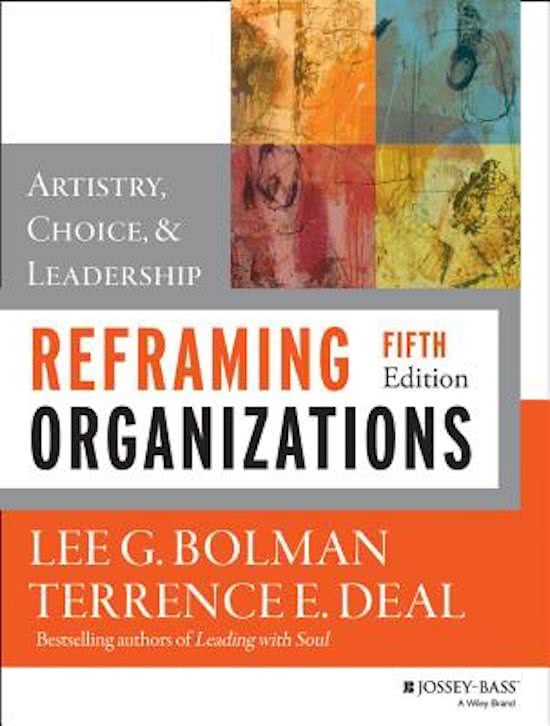
Bolman and Deal – Reframing Organizations Ch. 1/14
Part 1: Making Sense of Organizations
Chapter 1: Introduction - The Power of Reframing
Reframing requires an ability to understand and use multiple perspectives, to think
about the same thing in more than one way (in a dynamic, globally, changing
world).
Virtues and drawbacks of organized activity
We are hard pressed to manage organizations so that benefits regularly exceed
costs, why should this be?
The curse of cluelessness
''self-destructive intelligence syndrome'' - Feinberg & Tarrant (1995)
When managers don't know what to do, they do more of what they know.
Strategies for improving organizations: the track record
Managers are supposed to have the big picture and look out for their organization's
overall health and productivity. When this doesn't succeed, they tend to hire
consultants. When managers and consultants fail, government frequently jumps in
with legislation policies and regulations (X).
Theory base: frames and reframing
Frame: is a set of ideas or assumptions you carry in your head. It helps you
understand and negotiate a particular ''territory''.
The structural frame: emphasizes goals, specialized roles, and formal
relationships. Structures - commonly depicted by organization charts - are designed
to fit an organization's environment and technology. Organizations allocate
responsibilities to participants. They then create rules, policies, procedures, and
hierarchies to coordinate diverse activities into a unified strategy. Problems arise
when structure is poorly aligned with current circumstances. At that point, some
form of reorganization or redesign is needed to remedy the mismatch.
The human resource frame: sees an organization as much like an extended
family, made up of individuals with needs, feelings, prejudices, skills and limitations
(psychological scene).
The political frame (machiavelli): sees organizations as arenas, contests, or
jungles. Parochial interests compete for power and scarce resources. Conflict is
rampant because of enduring differences in needs, perspectives, and lifestyles
among competing individuals and groups. Bargaining, negotiation, coercion, and
compromise are a natural part of life. Coalitions form around specific interests and
change as issues come and go. Problems arise when power is concentrated in the
,wrong places or is so broadly dispersed that nothing gets done. Solutions arise from
political skill and acumen.
The symbolic frame (drawing on cultural change as the key to
organizational transformation): drawing on social and cultural anthropology,
treats organizations as tribes, theaters, or carnivals. It abandons assumptions of
rationality more prominent in other frames. It sees organizations as cultures,
propelled more by rituals, ceremonies, stories, heroes, and myths than by rules,
policies and manegerial authority. Organization is also theater: actors play their roles
in the organizational drama while audiences form impressions from what is seen
onstage. Problems arise when actors blow their parts, when symbols lose their
meaning, or when ceremonies and rituals lose their potency. We rebuild the
expressive or spiritual side of organizations through the use of symbol, myth and
magic.
Managers take advantage of the frames. They reframe until they understand the
situation at hand. They do this by using more than one frame, or perspective to
develop both a diagnosis of what they are up against and strategies moving forward.
''Mindlessnes'' (Langer 1989) - (lack of imagination) - cause of the shortfall between
the reach and the grasp of many organizations.
--> effective managers need multiple tools, the skill to use each of them, and the
wisdom to match frames to situations.
Conclusion
Organizations have become difficult to understand and manage (dynamic). There
are four frames managed:
1. the structural frame: focuses on the architecture of organization - the design of
units and subunits, rules and roles, goals and policies - that shape and channel
decisions and activities.
2. the human resource frame: emphasizes an understanding of people, with their
strengths and foibles, reason and emotion, desire and fears.
3. the politica lframe: sees organizations as competitive arenas characterized by
scarce resources, competing interests, and struggles for power and advantage.
4. the symbolic frame: focuses on issues of meaning and faith. It puts ritual,
ceremony, story, play, and culture at the heart of organizational life.
Collectively, they make it possible to reframe. To view the same thing from multiple
perspectives.
Part 1: Making Sense of Organizations
Chapter 2: Simple Ideas, Complex Organizations
, Properties of Organizations
- Organizations are complex: they are populated by people whose behavior is hard
to understand and predict. Interactions among diverse individuals and groups make
organizations even more complicated. The complexity is compounded with
transactions across multiple organizations (& external factors - stock market,
demanding creditors, etc.).
- Organizations are surprising: What you expect is often dramatically different from
what happens.
- Organizations are deceptive: They defy expectations and then camouflage
surprises.
- Organizations are ambiguous: The sum of complexity, unpredictability and
deception is rampant ambiguity. Figuring out what is really happening in business,
hospitals, schools, or public agencies is difficult.
Ambiguity originates from a number of sources. Sometimes information is
incomplete or vague. The same information may be interpreted in a variety of ways.
At other times ambiguity is deliberately created to hide problems or avoid conflict.
Much of the time, events and processes are so complex, scattered, and
uncoordinated no one can fully understand - let alone control - what is happening.
Sources of Ambiguity (McCaskey 1982)
1. We are not sure what the problem is: definitions are vague or competing, and any
given problem is interwined with other messy problems.
2. We are not sure what is really happening: information is incomplete, ambiguous,
and unreliable. People disagree on how to interpret information that is available.
3. We are not sure what we want. We all have multiple goals that are unclear of
conflicting. Different people want different things: this leads to political and
emotional conflict.
4. We do not have the resources we need: shortages of time, attention, or money
make difficult situations even more chaotic.
5. We are not sure who is supposed to do what: roles are unclear, there is
disagreement about who is responsible for what, and things keep shifting as players
come and go.
6. We are not sure how to get what we want: even if we agree on what we want, we
are not sure (or we disagree) about how to make it happen.
7. We are not sure how to determine if we have succeeded: we are not sure what
criteria to use to evaluate succes. Or if we do know the criteria, we are not sure how
to measure the outcome.
Usually, short-time improvements have (-) long-term consequences.
Part 1: Making Sense of Organizations
Chapter 1: Introduction - The Power of Reframing
Reframing requires an ability to understand and use multiple perspectives, to think
about the same thing in more than one way (in a dynamic, globally, changing
world).
Virtues and drawbacks of organized activity
We are hard pressed to manage organizations so that benefits regularly exceed
costs, why should this be?
The curse of cluelessness
''self-destructive intelligence syndrome'' - Feinberg & Tarrant (1995)
When managers don't know what to do, they do more of what they know.
Strategies for improving organizations: the track record
Managers are supposed to have the big picture and look out for their organization's
overall health and productivity. When this doesn't succeed, they tend to hire
consultants. When managers and consultants fail, government frequently jumps in
with legislation policies and regulations (X).
Theory base: frames and reframing
Frame: is a set of ideas or assumptions you carry in your head. It helps you
understand and negotiate a particular ''territory''.
The structural frame: emphasizes goals, specialized roles, and formal
relationships. Structures - commonly depicted by organization charts - are designed
to fit an organization's environment and technology. Organizations allocate
responsibilities to participants. They then create rules, policies, procedures, and
hierarchies to coordinate diverse activities into a unified strategy. Problems arise
when structure is poorly aligned with current circumstances. At that point, some
form of reorganization or redesign is needed to remedy the mismatch.
The human resource frame: sees an organization as much like an extended
family, made up of individuals with needs, feelings, prejudices, skills and limitations
(psychological scene).
The political frame (machiavelli): sees organizations as arenas, contests, or
jungles. Parochial interests compete for power and scarce resources. Conflict is
rampant because of enduring differences in needs, perspectives, and lifestyles
among competing individuals and groups. Bargaining, negotiation, coercion, and
compromise are a natural part of life. Coalitions form around specific interests and
change as issues come and go. Problems arise when power is concentrated in the
,wrong places or is so broadly dispersed that nothing gets done. Solutions arise from
political skill and acumen.
The symbolic frame (drawing on cultural change as the key to
organizational transformation): drawing on social and cultural anthropology,
treats organizations as tribes, theaters, or carnivals. It abandons assumptions of
rationality more prominent in other frames. It sees organizations as cultures,
propelled more by rituals, ceremonies, stories, heroes, and myths than by rules,
policies and manegerial authority. Organization is also theater: actors play their roles
in the organizational drama while audiences form impressions from what is seen
onstage. Problems arise when actors blow their parts, when symbols lose their
meaning, or when ceremonies and rituals lose their potency. We rebuild the
expressive or spiritual side of organizations through the use of symbol, myth and
magic.
Managers take advantage of the frames. They reframe until they understand the
situation at hand. They do this by using more than one frame, or perspective to
develop both a diagnosis of what they are up against and strategies moving forward.
''Mindlessnes'' (Langer 1989) - (lack of imagination) - cause of the shortfall between
the reach and the grasp of many organizations.
--> effective managers need multiple tools, the skill to use each of them, and the
wisdom to match frames to situations.
Conclusion
Organizations have become difficult to understand and manage (dynamic). There
are four frames managed:
1. the structural frame: focuses on the architecture of organization - the design of
units and subunits, rules and roles, goals and policies - that shape and channel
decisions and activities.
2. the human resource frame: emphasizes an understanding of people, with their
strengths and foibles, reason and emotion, desire and fears.
3. the politica lframe: sees organizations as competitive arenas characterized by
scarce resources, competing interests, and struggles for power and advantage.
4. the symbolic frame: focuses on issues of meaning and faith. It puts ritual,
ceremony, story, play, and culture at the heart of organizational life.
Collectively, they make it possible to reframe. To view the same thing from multiple
perspectives.
Part 1: Making Sense of Organizations
Chapter 2: Simple Ideas, Complex Organizations
, Properties of Organizations
- Organizations are complex: they are populated by people whose behavior is hard
to understand and predict. Interactions among diverse individuals and groups make
organizations even more complicated. The complexity is compounded with
transactions across multiple organizations (& external factors - stock market,
demanding creditors, etc.).
- Organizations are surprising: What you expect is often dramatically different from
what happens.
- Organizations are deceptive: They defy expectations and then camouflage
surprises.
- Organizations are ambiguous: The sum of complexity, unpredictability and
deception is rampant ambiguity. Figuring out what is really happening in business,
hospitals, schools, or public agencies is difficult.
Ambiguity originates from a number of sources. Sometimes information is
incomplete or vague. The same information may be interpreted in a variety of ways.
At other times ambiguity is deliberately created to hide problems or avoid conflict.
Much of the time, events and processes are so complex, scattered, and
uncoordinated no one can fully understand - let alone control - what is happening.
Sources of Ambiguity (McCaskey 1982)
1. We are not sure what the problem is: definitions are vague or competing, and any
given problem is interwined with other messy problems.
2. We are not sure what is really happening: information is incomplete, ambiguous,
and unreliable. People disagree on how to interpret information that is available.
3. We are not sure what we want. We all have multiple goals that are unclear of
conflicting. Different people want different things: this leads to political and
emotional conflict.
4. We do not have the resources we need: shortages of time, attention, or money
make difficult situations even more chaotic.
5. We are not sure who is supposed to do what: roles are unclear, there is
disagreement about who is responsible for what, and things keep shifting as players
come and go.
6. We are not sure how to get what we want: even if we agree on what we want, we
are not sure (or we disagree) about how to make it happen.
7. We are not sure how to determine if we have succeeded: we are not sure what
criteria to use to evaluate succes. Or if we do know the criteria, we are not sure how
to measure the outcome.
Usually, short-time improvements have (-) long-term consequences.