Pre-master BA – Strategy & Organization
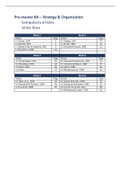
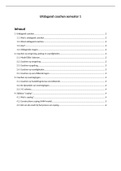
Compulsory articles
Victor Roos
Week 1 Week 2
Article Page Article Page
1.1 Porter, 1979 2 2.1 Hedley, 1977 17
1.2 Barney, 1991 5 2.2 Porter, 1987 19
1.3 Baden-Fuller & Stopford, 1992 8 2.3 Prahalad & Hamel, 1990 22
1.4 Stoelhorst, 2008 10
Week 3 Week 4
Article Page Article Page
3.1 Hax & Majluf, 1991 25 4.1 Eisenhardt & Zbaracki, 1992 34
3.2 Mintzberg, 1994 28 4.2 Hambrick & Mason, 1984 37
3.3 Grant, 2003 30 4.3 Quinn, 1989 40
3.4 Video 33 4.4 Mintzberg et al., 1989 42
Week 5 Week 6
Article Page Article Page
5.1 Miles et al., 1978 44 6.1 Kaplan & Norton, 2000 53
5.2 Romanelli & Tushman, 1994 48 6.2 Bourgeois & Brodwin, 1984 55
5.3 Luo & Rui, 2009 50 6.3 Van de Ven & Sun, 2011 58
6.4 Mintzberg & Lampel, 1999 62
,Strategy & Organization – Pre-master BA – Compulsory articles
1.1 – Porter, 1979; How competitive forces shape strategy
Author: Michael E. Porter
Year: 1979
1. What is the main idea of the article?
→ Abstract – Introduction – Conclusion– 3/4 sentences
The main idea of Porter (1979) is that the essence of strategy formulation is coping with competition.
Competition takes place in an industry and is related to five forces: the threat of new entrants, the
bargaining power of customers/buyers, the bargaining power of suppliers, the threat of substitute
products or services and the rivalry among existing contestants. A company must understand how they
work in its industry and how they affect the company. After that, he can make a plan of action to
address them that may include positioning the company, influencing the balance and exploiting
industry change.
2. Why is their message valuable?
→ Introduction - Conclusion
2.1 Research gap/purpose
It is very easy to view competition too narrowly and too pessimistically. Porter proposes the five forces
to better understand the nature and degree of competition in an industry.
2.2 Implications (practical + theoretical)
The essence of strategy formulation is coping with competition. Awareness of the five forces helps a
company choose a position in its industry that make it less vulnerable to attack. Companies can the
five forces to establish a strategic agenda.
3. How are the authors trying to convince you?
→ Main part of the article
3.1 Type of research
Conceptual study.
3.2 Results
The state of competition in an industry
depends on five basic forces: the threat of
new entrants, the bargaining power of
customers/buyers, the bargaining power of
suppliers, the threat of substitute products or
services and the rivalry among existing
contestants. The collective strength of these
five forces determine the ultimate profit
potential of an industry. It depends on the
type of industry how high the return on
investment is. Companies must understand
how they work in its industry and how they
affect the company in its particular situation. Their goal is to find a position in the industry where the
company can best defend itself against these forces or can influence them in its favor.
2
Victor Roos
,Strategy & Organization – Pre-master BA – Compulsory articles
Threat of new entrants: new entrants to an industry. There are six major sources of barriers to entry:
1. Economics of scale: you either entry on a large scale or accept a cost disadvantage.
2. Product differentiation: brand identification forces entrants to spend heavily to overcome
customer loyalty.
3. Capital requirements.
4. Cost disadvantages independent of size.
5. Access to distribution channels: the more limited the wholesale or retail channels are, the
more the existing competitors have tied these up, which tougher it is to entry.
6. Government policy.
From a strategic standpoint there are two additional points about the threat of new entrants: changing
conditions and the fact that strategic decisions involving a large segment of an industry can have a
major impact on the conditions determining the threat of entry.
Bargaining power of customers/buyers: a buyer group is powerful if:
1. It is concentrated or purchases in large volumes.
2. The products it purchases from the industry are standard or undifferentiated.
3. The products it purchases from the industry form a component of its product and represent a
significant fraction of its costs.
4. It earns low profits, which create great incentive to lower its purchasing costs.
5. The industry’s product is unimportant to the quality of the buyers’ products or services. This
means that quality is not so important, but price is even more so.
6. The industry’s product does not save the buyer money.
7. The buyers pose a threat of integrating backward to make the industry’s product.
Consumers tend to be more price sensitive if they are purchasing products that are undifferentiated,
expensive relative to their incomes, and when quality is not very important. A company can sell to
powerful buyers if the company is a low-cost producer or has unusual features.
Bargaining power of suppliers: a supplier group is powerful if:
1. It is dominated by a few companies and is more concentrated than the industry it sells to.
2. Its product is unique or at least differentiated, or if it has costs when firms want to change
suppliers (switching costs).
3. It is not obliged to contend with other products for sale to the industry (e.g. aluminum and
steel companies both selling to the can industry).
4. It poses a credible threat of integrating forward into the industry’s business.
5. The industry is not an important customer of the supplier group.
A company can improve its strategic posture by finding suppliers who process the least power to
influence it adversely.
Threat of substitute products or services: substitute products that (strategically) deserve the most
attention are: (1) subject to trends improving their price-performance trade-off with the industry’s
product, and (2) produced by industries earning high profits.
3
Victor Roos
, Strategy & Organization – Pre-master BA – Compulsory articles
Rivalry among existing contestants: there are 7 factors related to intense rivalry:
1. Competitors are numerous or are roughly equal in size and power.
2. Industry growth is slow.
3. The product or service lacks differentiation or switching costs, which locks in buyers.
4. Fixed costs are high, or the product is perishable (niet lang houdbaar), creating strong
temptation to cut prices.
5. Capacity is normally augmented in large increments.
6. Exit barriers are high.
7. The rivals are diverse in strategies, origins, and personalities.
Once the company’s strategist has assessed the forces affecting competition in his industry and their
underlying causes, he can (1) identify the company’s strengths and weaknesses. After that, he can (2)
make a plan of action to address them. It may include:
- Positioning the company: positioning it in such a way that the company’s capabilities provide the
best defense against the competitive forces.
- Influencing the balance: influence the balance of the forces through strategic moves, thereby
improving the company’s position.
- Exploiting industry change: anticipating shifts in the factors underlying the forces and responding
to them, with the hope of exploiting change by choosing a strategy appropriate for the new
competitive balance before opponents recognize it.
The strongest competitive force/forces determine the probability of an industry and are therefore very
important in strategy formulation. In every industry, there will be different forces that are the most
important (e.g. ocean-going tanker industry = bargaining power of buyers; steel industry = threat of
substitute products or services & rivalry among existing competitors). This theory is for both products
and services. The same general principles apply to all types of businesses.
4. Key constructs
-
5. Limitations + Future research
No limitations are mentioned in the article, but Baden-Fuller & Stopford critiqued this view in their
1992-article: The firm matters, not the industry.
4
Victor Roos
Compulsory articles
Victor Roos
Week 1 Week 2
Article Page Article Page
1.1 Porter, 1979 2 2.1 Hedley, 1977 17
1.2 Barney, 1991 5 2.2 Porter, 1987 19
1.3 Baden-Fuller & Stopford, 1992 8 2.3 Prahalad & Hamel, 1990 22
1.4 Stoelhorst, 2008 10
Week 3 Week 4
Article Page Article Page
3.1 Hax & Majluf, 1991 25 4.1 Eisenhardt & Zbaracki, 1992 34
3.2 Mintzberg, 1994 28 4.2 Hambrick & Mason, 1984 37
3.3 Grant, 2003 30 4.3 Quinn, 1989 40
3.4 Video 33 4.4 Mintzberg et al., 1989 42
Week 5 Week 6
Article Page Article Page
5.1 Miles et al., 1978 44 6.1 Kaplan & Norton, 2000 53
5.2 Romanelli & Tushman, 1994 48 6.2 Bourgeois & Brodwin, 1984 55
5.3 Luo & Rui, 2009 50 6.3 Van de Ven & Sun, 2011 58
6.4 Mintzberg & Lampel, 1999 62
,Strategy & Organization – Pre-master BA – Compulsory articles
1.1 – Porter, 1979; How competitive forces shape strategy
Author: Michael E. Porter
Year: 1979
1. What is the main idea of the article?
→ Abstract – Introduction – Conclusion– 3/4 sentences
The main idea of Porter (1979) is that the essence of strategy formulation is coping with competition.
Competition takes place in an industry and is related to five forces: the threat of new entrants, the
bargaining power of customers/buyers, the bargaining power of suppliers, the threat of substitute
products or services and the rivalry among existing contestants. A company must understand how they
work in its industry and how they affect the company. After that, he can make a plan of action to
address them that may include positioning the company, influencing the balance and exploiting
industry change.
2. Why is their message valuable?
→ Introduction - Conclusion
2.1 Research gap/purpose
It is very easy to view competition too narrowly and too pessimistically. Porter proposes the five forces
to better understand the nature and degree of competition in an industry.
2.2 Implications (practical + theoretical)
The essence of strategy formulation is coping with competition. Awareness of the five forces helps a
company choose a position in its industry that make it less vulnerable to attack. Companies can the
five forces to establish a strategic agenda.
3. How are the authors trying to convince you?
→ Main part of the article
3.1 Type of research
Conceptual study.
3.2 Results
The state of competition in an industry
depends on five basic forces: the threat of
new entrants, the bargaining power of
customers/buyers, the bargaining power of
suppliers, the threat of substitute products or
services and the rivalry among existing
contestants. The collective strength of these
five forces determine the ultimate profit
potential of an industry. It depends on the
type of industry how high the return on
investment is. Companies must understand
how they work in its industry and how they
affect the company in its particular situation. Their goal is to find a position in the industry where the
company can best defend itself against these forces or can influence them in its favor.
2
Victor Roos
,Strategy & Organization – Pre-master BA – Compulsory articles
Threat of new entrants: new entrants to an industry. There are six major sources of barriers to entry:
1. Economics of scale: you either entry on a large scale or accept a cost disadvantage.
2. Product differentiation: brand identification forces entrants to spend heavily to overcome
customer loyalty.
3. Capital requirements.
4. Cost disadvantages independent of size.
5. Access to distribution channels: the more limited the wholesale or retail channels are, the
more the existing competitors have tied these up, which tougher it is to entry.
6. Government policy.
From a strategic standpoint there are two additional points about the threat of new entrants: changing
conditions and the fact that strategic decisions involving a large segment of an industry can have a
major impact on the conditions determining the threat of entry.
Bargaining power of customers/buyers: a buyer group is powerful if:
1. It is concentrated or purchases in large volumes.
2. The products it purchases from the industry are standard or undifferentiated.
3. The products it purchases from the industry form a component of its product and represent a
significant fraction of its costs.
4. It earns low profits, which create great incentive to lower its purchasing costs.
5. The industry’s product is unimportant to the quality of the buyers’ products or services. This
means that quality is not so important, but price is even more so.
6. The industry’s product does not save the buyer money.
7. The buyers pose a threat of integrating backward to make the industry’s product.
Consumers tend to be more price sensitive if they are purchasing products that are undifferentiated,
expensive relative to their incomes, and when quality is not very important. A company can sell to
powerful buyers if the company is a low-cost producer or has unusual features.
Bargaining power of suppliers: a supplier group is powerful if:
1. It is dominated by a few companies and is more concentrated than the industry it sells to.
2. Its product is unique or at least differentiated, or if it has costs when firms want to change
suppliers (switching costs).
3. It is not obliged to contend with other products for sale to the industry (e.g. aluminum and
steel companies both selling to the can industry).
4. It poses a credible threat of integrating forward into the industry’s business.
5. The industry is not an important customer of the supplier group.
A company can improve its strategic posture by finding suppliers who process the least power to
influence it adversely.
Threat of substitute products or services: substitute products that (strategically) deserve the most
attention are: (1) subject to trends improving their price-performance trade-off with the industry’s
product, and (2) produced by industries earning high profits.
3
Victor Roos
, Strategy & Organization – Pre-master BA – Compulsory articles
Rivalry among existing contestants: there are 7 factors related to intense rivalry:
1. Competitors are numerous or are roughly equal in size and power.
2. Industry growth is slow.
3. The product or service lacks differentiation or switching costs, which locks in buyers.
4. Fixed costs are high, or the product is perishable (niet lang houdbaar), creating strong
temptation to cut prices.
5. Capacity is normally augmented in large increments.
6. Exit barriers are high.
7. The rivals are diverse in strategies, origins, and personalities.
Once the company’s strategist has assessed the forces affecting competition in his industry and their
underlying causes, he can (1) identify the company’s strengths and weaknesses. After that, he can (2)
make a plan of action to address them. It may include:
- Positioning the company: positioning it in such a way that the company’s capabilities provide the
best defense against the competitive forces.
- Influencing the balance: influence the balance of the forces through strategic moves, thereby
improving the company’s position.
- Exploiting industry change: anticipating shifts in the factors underlying the forces and responding
to them, with the hope of exploiting change by choosing a strategy appropriate for the new
competitive balance before opponents recognize it.
The strongest competitive force/forces determine the probability of an industry and are therefore very
important in strategy formulation. In every industry, there will be different forces that are the most
important (e.g. ocean-going tanker industry = bargaining power of buyers; steel industry = threat of
substitute products or services & rivalry among existing competitors). This theory is for both products
and services. The same general principles apply to all types of businesses.
4. Key constructs
-
5. Limitations + Future research
No limitations are mentioned in the article, but Baden-Fuller & Stopford critiqued this view in their
1992-article: The firm matters, not the industry.
4
Victor Roos