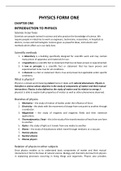
PHYSICS FORM ONE
CHAPTER ONE
INTRODUCTION TO PHYSICS
Science in our lives
Scientists are people trained in science and who practice the knowledge of science. We
require people in industries to work as engineers, technicians, researchers, in hospitals as
doctors, nurses and technologists. Science gives us powerful ideas, instruments and
methods which affect us in our daily lives.
Scientific methods
1. A laboratory is a building specifically designed for scientific work and may contain
many pieces of apparatus and materials for use.
2. A hypothesis is a scientific fact or statement that has not been proven or experimented.
3. A law or principle is a scientific fact or statement that has been proven and
experimented to be true for all conditions.
4. A theorem is a fact or statement that is true and proven but applicable under specific
conditions.
What is physics?
Physics is a Greek word meaning nature hence it deals with natural phenomena. Physics is
therefore a science whose objective is the study of components of matter and their mutual
interactions. Physics is also defined as the study of matter and its relation to energy.A
physicist is able to explain bulk properties of matter as well as other phenomena observed.
Branches of physics
1. Mechanics – the study of motion of bodies under the influence of force.
2. Electricity – this deals with the movement of charge from one point to another through
a conductor.
3. Magnetism – the study of magnets and magnetic fields and their extensive
applications.
4. Thermodynamics / heat – this is the study of the transformation of heat from one form
to another.
5. Optics –the study of light as it travels from one media to another
6. Waves – the study of disturbances which travel through mediums or a vacuum.
7. Particle physics
8. Nuclear physics
9. Plasma physics
Relation of physics to other subjects
Since physics enables us to understand basic components of matter and their mutual
interactions it forms the base of natural science. Biology and chemistry borrow from physics
in explaining processes occurring in living things and organisms. Physics also provides
,techniques which are applied almost every area of pure and applied science i.e. meteorology,
astronomy etc.
Career opportunities in physics
1. Engineering – civil
- Electrical
- Mechanical
- Agricultural
- Environmental
- Chemical
- Computer
2. Meteorology
3. Surveying
4. Geology
5. Astronomy
NOTE: - all science based careers i.e. doctors, nurses, technologists, engineers,
pharmacists etc. need physics as a true foundation.
Basic laboratory safety rules
1. Proper dressing must be observed, no loose clothing, hair and closed shoes must be
worn.
2. Identify the location of electricity switches, fire-fighting equipment, first aid kit, gas and
water supply systems.
3. Keep all windows open whenever working in the laboratory.
4. Follow all instructions carefully and never attempt anything in doubt.
5. No eating or drinking allowed in the laboratory.
6. Ensure that all electrical switches, gas and water taps are turned off when not in use.
7. Keep floors and working surfaces dry. Any spillage must be wiped off immediately.
8. All apparatus must be cleaned and returned in the correct location of storage after use.
9. Hands must be washed before leaving the laboratory.
10. Any accidents must be reported to the teacher immediately.
,CHAPTER TWO
MEASUREMENT I
In order to measure we need to know or define the quantity to be measured and the units
for measuring it. In 1971 a system known as the International System of Units (Systeme’
Internationale) and seven basic units were agreed upon as follows. Other quantities can be
obtained from these basic quantities and are referred to as derived quantities.
Basic quantity SI units Symbols
Length Metre m
Mass Kilogram kg
Time Second s
Electric current Ampere A
Thermodynamic Kelvin K
temperature
Luminous intensity Candela Cd
Amount of substance Mole mol
Length
This is the measure of distance between two points in space. The SI unit for length is the metre
(m).Therefore 1 km = 1000 m
1 Hm = 100 m
1 Dm= 10 m
1 mm = 0.001 m
Length is measured using a metre rule (100 cm), tape measure (100 m, 300 m, 500 m)
Area
This is the measure of the extent of a surface. It is a derived quantity of length. Its SI units
are square metres (m2). Other units are cm2, km2, etc. Formulas are used to determine
areas of regular bodies while for irregular bodies an approximation of area is used.
Volume
This is the amount of space occupied by matter. The SI units for volume is cubic metre (m3).
Other sub-multiples are cm3, mm3 and l. Hence 1 m3 = 1,000,000 cm3 and 1l= 1,000 cm3.
Volume can be measured using a measuring cylinder, eureka can, pipette, burette,
volumetric flask, beaker, etc.
Mass
This is the quantity of matter contained in a substance. Matter is anything that occupies
space and has weight. The SI unit for mass is the Kilogram (kg). Other sub-multiples used are
, grams (g), milligrams (mg) and tonnes (t). 1 kg = 1,000 g = 1,000,000 mg=100 tonnes. A beam
balance is used to measure mass.
Density
This is mass per unit volume of a substance. It is symbolized by rho (ρ) and its SI units are
kg/m3. Density = mass / volume.
Examples
1. A block of glass of mass 187.5 g is 5.0 cm long, 2.0 cm thick and 7.5 cm high. Calculate
the density of the glass in kgm-3.
Solution
Density = mass / volume = (187.5 /1000) /(2.0 × 7.5 × 5.0 /1,000,000) = 2,500 kgm -3.
2. The density of concentrated sulphuric acid is 1.8 g/cm3. Calculate the volume of 3.1 kg
of the acid.
Solution
Volume = mass / density = 3,.8 = 1,722 cm3 or 0.001722 m3.
The following is a list of densities of some common substances
Substance Density (g/cm3) Density (kg/m3)
Platinum 21.4 21,400
Gold 19.3 19,300
Lead 11.3 11,300
Silver 10.5 10,500
Copper 8.93 8,930
Iron 7.86 7,860
Aluminium 2.7 2,700
Glass 2.5 2,500
Ice 0.92 920
Mercury 13.6 13,600
Sea water 1.03 1,030
Water 1.0 1,000
Kerosene 0.80 800
Alcohol 0.79 790
Carbon (iv) oxide 0.00197 1.97
Air 0.00131 1.31
Hydrogen 0.000089 0.089
Example
The mass of an empty density bottle is 20 g. Its mass when filled with water is 40.0 g and
CHAPTER ONE
INTRODUCTION TO PHYSICS
Science in our lives
Scientists are people trained in science and who practice the knowledge of science. We
require people in industries to work as engineers, technicians, researchers, in hospitals as
doctors, nurses and technologists. Science gives us powerful ideas, instruments and
methods which affect us in our daily lives.
Scientific methods
1. A laboratory is a building specifically designed for scientific work and may contain
many pieces of apparatus and materials for use.
2. A hypothesis is a scientific fact or statement that has not been proven or experimented.
3. A law or principle is a scientific fact or statement that has been proven and
experimented to be true for all conditions.
4. A theorem is a fact or statement that is true and proven but applicable under specific
conditions.
What is physics?
Physics is a Greek word meaning nature hence it deals with natural phenomena. Physics is
therefore a science whose objective is the study of components of matter and their mutual
interactions. Physics is also defined as the study of matter and its relation to energy.A
physicist is able to explain bulk properties of matter as well as other phenomena observed.
Branches of physics
1. Mechanics – the study of motion of bodies under the influence of force.
2. Electricity – this deals with the movement of charge from one point to another through
a conductor.
3. Magnetism – the study of magnets and magnetic fields and their extensive
applications.
4. Thermodynamics / heat – this is the study of the transformation of heat from one form
to another.
5. Optics –the study of light as it travels from one media to another
6. Waves – the study of disturbances which travel through mediums or a vacuum.
7. Particle physics
8. Nuclear physics
9. Plasma physics
Relation of physics to other subjects
Since physics enables us to understand basic components of matter and their mutual
interactions it forms the base of natural science. Biology and chemistry borrow from physics
in explaining processes occurring in living things and organisms. Physics also provides
,techniques which are applied almost every area of pure and applied science i.e. meteorology,
astronomy etc.
Career opportunities in physics
1. Engineering – civil
- Electrical
- Mechanical
- Agricultural
- Environmental
- Chemical
- Computer
2. Meteorology
3. Surveying
4. Geology
5. Astronomy
NOTE: - all science based careers i.e. doctors, nurses, technologists, engineers,
pharmacists etc. need physics as a true foundation.
Basic laboratory safety rules
1. Proper dressing must be observed, no loose clothing, hair and closed shoes must be
worn.
2. Identify the location of electricity switches, fire-fighting equipment, first aid kit, gas and
water supply systems.
3. Keep all windows open whenever working in the laboratory.
4. Follow all instructions carefully and never attempt anything in doubt.
5. No eating or drinking allowed in the laboratory.
6. Ensure that all electrical switches, gas and water taps are turned off when not in use.
7. Keep floors and working surfaces dry. Any spillage must be wiped off immediately.
8. All apparatus must be cleaned and returned in the correct location of storage after use.
9. Hands must be washed before leaving the laboratory.
10. Any accidents must be reported to the teacher immediately.
,CHAPTER TWO
MEASUREMENT I
In order to measure we need to know or define the quantity to be measured and the units
for measuring it. In 1971 a system known as the International System of Units (Systeme’
Internationale) and seven basic units were agreed upon as follows. Other quantities can be
obtained from these basic quantities and are referred to as derived quantities.
Basic quantity SI units Symbols
Length Metre m
Mass Kilogram kg
Time Second s
Electric current Ampere A
Thermodynamic Kelvin K
temperature
Luminous intensity Candela Cd
Amount of substance Mole mol
Length
This is the measure of distance between two points in space. The SI unit for length is the metre
(m).Therefore 1 km = 1000 m
1 Hm = 100 m
1 Dm= 10 m
1 mm = 0.001 m
Length is measured using a metre rule (100 cm), tape measure (100 m, 300 m, 500 m)
Area
This is the measure of the extent of a surface. It is a derived quantity of length. Its SI units
are square metres (m2). Other units are cm2, km2, etc. Formulas are used to determine
areas of regular bodies while for irregular bodies an approximation of area is used.
Volume
This is the amount of space occupied by matter. The SI units for volume is cubic metre (m3).
Other sub-multiples are cm3, mm3 and l. Hence 1 m3 = 1,000,000 cm3 and 1l= 1,000 cm3.
Volume can be measured using a measuring cylinder, eureka can, pipette, burette,
volumetric flask, beaker, etc.
Mass
This is the quantity of matter contained in a substance. Matter is anything that occupies
space and has weight. The SI unit for mass is the Kilogram (kg). Other sub-multiples used are
, grams (g), milligrams (mg) and tonnes (t). 1 kg = 1,000 g = 1,000,000 mg=100 tonnes. A beam
balance is used to measure mass.
Density
This is mass per unit volume of a substance. It is symbolized by rho (ρ) and its SI units are
kg/m3. Density = mass / volume.
Examples
1. A block of glass of mass 187.5 g is 5.0 cm long, 2.0 cm thick and 7.5 cm high. Calculate
the density of the glass in kgm-3.
Solution
Density = mass / volume = (187.5 /1000) /(2.0 × 7.5 × 5.0 /1,000,000) = 2,500 kgm -3.
2. The density of concentrated sulphuric acid is 1.8 g/cm3. Calculate the volume of 3.1 kg
of the acid.
Solution
Volume = mass / density = 3,.8 = 1,722 cm3 or 0.001722 m3.
The following is a list of densities of some common substances
Substance Density (g/cm3) Density (kg/m3)
Platinum 21.4 21,400
Gold 19.3 19,300
Lead 11.3 11,300
Silver 10.5 10,500
Copper 8.93 8,930
Iron 7.86 7,860
Aluminium 2.7 2,700
Glass 2.5 2,500
Ice 0.92 920
Mercury 13.6 13,600
Sea water 1.03 1,030
Water 1.0 1,000
Kerosene 0.80 800
Alcohol 0.79 790
Carbon (iv) oxide 0.00197 1.97
Air 0.00131 1.31
Hydrogen 0.000089 0.089
Example
The mass of an empty density bottle is 20 g. Its mass when filled with water is 40.0 g and