

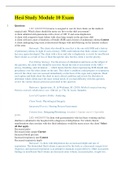
Hesi Study Module 10 Exam Questions 1. ID: 8482493994 A nurse is assigned to care for four clients on the medical - surgical unit. Which client should the nurse see first on the shift assessment? A client admitted with pneumonia with a fever of 100° F and some diaphoresis A client with congestive heart failure with clear lung sounds on the previous shift A client with new -onset of shortness of breath (SOB) and a history of pulmonary edema Correct A client undergoing long -term corticosteroid therapy with mil d bruising on the anterior surfaces of the arms Rationale: The client who should be seen first is the one with SOB and a history of pulmonary edema . In light of such a history, SOB could indicate that fluid -volume overload has once again developed. The client with a fever and who is diaphoretic is at risk for insufficient fluid volume as a result of loss of fluid through the skin, but this client is not the priority. Test-Taking Strategy: Use the process of elimination and focus on the subject of the question, the client who should be seen first. Recall the rule of assessment of the ABCs — airway, breathing, and circulation — which means that the client experiencing SOB should take precedence over the other clients on the unit. This client’s condition could progress to respiratory arrest if the client were not assessed immediately on the basis of the signs and symptoms. Read each option and think about the client in most critical condition and review the disorders to determine which clients have the mos t critical needs. If you had difficulty with this question, review the various disease processes presented in this question. Reference: Ignatavicius, D., & Workman, M. (2010). Medical -surgical nursing: Patient -centered collaborative care. (6th ed., p. 176). St. Louis: Saunders. Level of Cognitive Ability: Analyzing Client Needs: Physiological Integrity Integrated Process: Nursing Process/Assessment points. Content Area: Delegating/Prioritizing Awarded 1.0 points out of 1.0 possible 2. ID: 8482500733 A client with gastroenteritis who has been vomiting and has diarrhea is admitted to the hospital with a diagnosis of dehydration. For which clinical manifestations that correlate with this fluid imbalance woul d the nurse assess the client? Select all that apply. Decreased pulse Decreased urine output Correct Increased blood pressure Increased respiratory rate Correct Decreased respiratory depth Rationale: A client with dehydration has an increased depth and rate of respirations. The diminished fluid volume is perceived by the body as a decreased oxygen level (hypoxia), and increased respiration is an attempt to maintain oxygen delivery. Other assessment findings in insufficient fluid volume are decreased urine volume, increased pulse, weight loss, poor skin turgor, dry mucous membranes, concentrated urine with increased specific gravity, increased hematocrit, and altered level of consciousness. Increased blood pressure, decreased pulse, and increased urine output occur with fluid -volume overload. Test-Taking Strategy: Use the process of elimination and focus on the subject, dehydration (deficient fluid volume). Think about the pathophysiology of deficient fluid volume. Remember that the body will increase the respiratory rate in an attempt to maintain the oxygen level. If you had difficulty with this question, review the signs of insufficient fluid volume. Reference: Ignatavicius, D., & Workman, M. (2010). Medical -surgical nursing: Patient -centered collaborative care (6th ed., p. 179). St. Louis: Saunders. Level of Cognitive Ability: Analyzing Client Needs: Physiological Integrity Integrated Process: Nursing Process/Assessment points. Content Area: Fluid and Electrolytes Awarded 2.0 points out of 2.0 possible 3. ID: 8482497531 A nurse is reviewing the medical records of the clients to whom she is assigned on the 7 am–7 pm shift. Which client will the nurse monitor most closely for excessive fluid volume? A 48-year-old client receiving diuretics to treat hypertension A 35-year old client who is vomiting undigested food after eating An 85-year-old client receiving intravenous (IV) therapy at a rate of 100 mL/hr Correct A 65 -year-old client with a nasogastric tube attached to low suction following partial gastrectomy Rationale: The older adult client receiving IV therapy at 100 mL/hr is at the greatest risk for excessive fluid volume because of the diminished cardiovascular and renal function that occur with aging. Other causes of excessive fluid volume include renal failure, heart failure, liver disorders, excessive use of hypotonic IV fluids to replace isotonic losses, excessive irrigation of body fluids, and excessive ingestion of table salt. A client who is receiving diuretics, vomiting, or has a nasogastric tube attached to suction is at risk for deficient fluid volume. Test-Taking Strategy: Read the question carefully, noting that it asks for the client at risk for excessive fluid volume. Read each option and think about the fluid imbalance that could occur in each situation; in the case of the incorrect options, it is fluid -volume deficiency; the only option reflecting conditions that could result in an ex cess is the correct option. If you had difficulty with this question, review the causes of excessive fluid volume. References: Black, J., & Hawks, J. (2009). Medical -surgical nursing: Clinical management for positive outcomes (8th ed., p. 2202). St. Louis: Saunders. Ignatavicius, D., & Workman, M. (2010). Medical -surgical nursing: Patient - centered collaborative care (6th ed., p. 183). St. Louis: Saunders.
Examen
Hesi Study Module 10 Exam Questions And Answers Plus Rationales ( Complete Solution Rated A)
Puntuación
Vendido
-
Páginas
15
Grado
A+
Subido en
01-08-2021
Escrito en
2021/2022
Hesi Study Module 10 Exam Questions 1. ID: 4A nurse is assigned to care for four clients on the medical- surgical unit. Which client should the nurse see first on the shift assessment? A client admitted with pneumonia with a fever of 100° F and some diaphoresis A client with congestive heart failure with clear lung sounds on the previous shift A client with new-onset of shortness of breath (SOB) and a history of pulmonary edema Correct A client undergoing long-term corticosteroid therapy with mild bruising on the anterior surfaces of the arms Rationale: The client who should be seen first is the one with SOB and a history of pulmonary edema. In light of such a history, SOB could indicate that fluid-volume overload has once again developed. The client with a fever and who is diaphoretic is at risk for insufficient fluid volume as a result of loss of fluid through the skin, but this client is not the priority. Test-Taking Strategy: Use the process of elimination and focus on the subject of the question, the client who should be seen first. Recall the rule of assessment of the ABCs — airway, breathing, and circulation — which means that the client experiencing SOB should take precedence over the other clients on the unit. This client’s condition could progress to respiratory arrest if the client were not assessed immediately on the basis of the signs and symptoms. Read each option and think about the client in most critical condition and review the disorders to determine which clients have the most critical needs. If you had difficulty with this question, review the various disease processes presented in this question. Reference: Ignatavicius, D., & Workman, M. (2010). Medical-surgical nursing: Patient-centered collaborative care. (6th ed., p. 176). St. Louis: Saunders. Level of Cognitive Ability: Analyzing Client Needs: Physiological Integrity Integrated Process: Nursing Process/Assessment points. Content Area: Delegating/Prioritizing Awarded 1.0 points out of 1.0 possible 2. ID: 3A client with gastroenteritis who has been vomiting and has diarrhea is admitted to the hospital with a diagnosis of dehydration. For which clinical manifestations that correlate with this fluid imbalance would the nurse assess the client? Select all that apply. Decreased pulse Decreased urine output Correct Increased blood pressure Increased respiratory rate Correct Decreased respiratory depth Show Less
Mostrar más
Leer menos
Institución
Grado
Vista previa del contenido
Escuela, estudio y materia
- Institución
- Chamberlain College Of Nursing
- Grado
- NURSING 2362 Module 10 Exam
Información del documento
- Subido en
- 1 de agosto de 2021
- Número de páginas
- 15
- Escrito en
- 2021/2022
- Tipo
- Examen
- Contiene
- Preguntas y respuestas
Temas
-
hesi study module 10 exam questions and answers plus rationales complete solution rated a
-
a nurse is assigned to care for four clients on the medical surgical unit which client should the nurse s
$16.79
Accede al documento completo:
¿Documento equivocado? Cámbialo gratis
Dentro de los 14 días posteriores a la compra y antes de descargarlo, puedes elegir otro documento. Puedes gastar el importe de nuevo.
Escrito por estudiantes que aprobaron
Inmediatamente disponible después del pago
Leer en línea o como PDF

Documento también disponible en un lote
Package deal
Hesi Study Module 1 Questions And Answers Plus Rationales ( Complete Solution Rated A), Hesi Study Module 3 Exam Questions And Answers Plus Rationales, Hesi Study Module 3 Exam Questions And Answers Plus Rationales, Hesi Study Module 5 Exam Questions And
8
2021
$ 23.79
Más información
