Polina Lobacheva
Anatomy of Respiratory System links to the cardiovascular system “cardiorespiratory physiology”
- Main function of gas exchange: exchange of O2 and CO2 between an organism and the external environment
- Uses O2 within cells (internal or cellular respiration)
- Plays a role in acid-base balance (pH)
Airways: series of tubes that air flows through
Inspiration: movement of air into an organism
Expiration: movement of air out of an organism
Respiratory cycle: one inspiration and one expiration
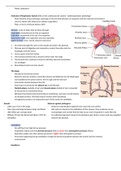
Upper airways: nose, mouth, pharynx and larynx
1. Air enters through the nose or the mouth and enters the pharynx
2. Pharynx (part of digestive and respiratory system) branches into the
esophagus and the larynx
3. Larynx opens into the trachea
4. The trachea branches into 2 bronchi which enter the lungs
5. The bronchi then continue to branch until they become bronchioles
(no cartilage)
6. Bronchioles branch out into alveoli
The lungs:
- Situated in the thorax (chest)
- Bound to neck by muscles, connective tissues and abdomen by the diaphragm
- Surrounded by the spinal column, the rib cage and the sternum
- Intercostal muscles between the ribs
- Each lung is enclosed by the pleural sac (a membrane)
- Parietal pleura (outside of sac) and visceral pleura (inside of sac) connected
to structures via connective tissue
- Between the parietal and visceral pleura membranes, we have a small volume
of intrapleural fluid. This fluid reduces friction when breathing
- Intrapleural pressure is an important part of the control of ventilation
Alveoli: Defense against pathogens:
- Little sacs of air in the lungs - Airborne material gets trapped in the nasal and oral cavities
- Site of gas exchange between lungs and blood - Cilia cells are found on the epithelium of the airways; they produces mucus,
- 300 million per average adult macrophages and secrete fluid to help mucus move (impaired in cystic fibrosis)
- Diffuses O2 into the blood and takes in CO2 for - Co-ordinated approach means that substances get stuck in mucus and are propelled
exhalation towards the pharynx
Ventilation:
- Air will flow from high to low pressure
- Inspiration makes sure that alveolar pressure (Palv) is lower than atmospheric pressure (Patm)
- Expiration makes sure that alveolar pressure is higher than atmospheric pressure
- Processes happening during ventilation change the pressure gradient between the alveoli and the external
environment
Equations:
, Polina Lobacheva
- The flow of air into and out of the the lungs is determined by the pressure gradient between the alveoli and the
external environment and/or any resistance to airflow: flow = change in pressure / resistance OR flow = (Palv - Patm) /
resistance
- Negative (Palv - Patm) = inspiration
- Positive (Palv - Patm) = expiration
Boyle’s Law: (changing pressure in the lungs): Lungs are similar
to balloons; lungs don’t have any muscle attached to them to
help change their volume so this is caused by other factors:
Transpulmonary pressure (Ptp): difference in pressure between
the inside and outside of the lung
Pressure inside the lung is pressure within the alveoli. Pressure outside the lung is exerted by the intrapleural fluid
(transmural, across the wall, pressure). Ptp = Palv - Pip (intrapleural fluid pressure), if Pip falls Ptp becomes positive, which
increases lung volume and decreases alveolar pressure.
Atmospheric pressure: 760mmHg at sea level: all pressure values are made relative to atmospheric pressure. ‘Zero’ means
the pressure is the same as atmospheric pressure
Pneumothorax: when the intrapleural cavity is pierced Pip increases so the lung collapses
At rest (between breaths) Palv = 0 mmHg and Pip = -4 mmHg so transpulmonary pressure is +4 mmHg, because
Palv - Pip = 0 - (-4) = +4
This positive pressure difference ensures that the lungs remain inflated.
Inspiration Expiration
1. Contraction of diaphragm and intercostal muscles 1. Relaxation of diaphragm and intercostal muscles
2. Expansion of the thorax 2. Chest wall recoils
3. Reduction in intrapleural pressure 3. Intrapleural pressure returns to normal
4. Increase in intrapulmonary pressure 4. Intrapulmonary pressure returns to normal
5. Lung expansion 5. Lung recoils
6. Reduction in alveolar pressure 6. Increase in alveolar pressure
7. Air moves from external environment to alveoli 7. Air moves from alveoli to external environment
Anatomy of Respiratory System links to the cardiovascular system “cardiorespiratory physiology”
- Main function of gas exchange: exchange of O2 and CO2 between an organism and the external environment
- Uses O2 within cells (internal or cellular respiration)
- Plays a role in acid-base balance (pH)
Airways: series of tubes that air flows through
Inspiration: movement of air into an organism
Expiration: movement of air out of an organism
Respiratory cycle: one inspiration and one expiration
Upper airways: nose, mouth, pharynx and larynx
1. Air enters through the nose or the mouth and enters the pharynx
2. Pharynx (part of digestive and respiratory system) branches into the
esophagus and the larynx
3. Larynx opens into the trachea
4. The trachea branches into 2 bronchi which enter the lungs
5. The bronchi then continue to branch until they become bronchioles
(no cartilage)
6. Bronchioles branch out into alveoli
The lungs:
- Situated in the thorax (chest)
- Bound to neck by muscles, connective tissues and abdomen by the diaphragm
- Surrounded by the spinal column, the rib cage and the sternum
- Intercostal muscles between the ribs
- Each lung is enclosed by the pleural sac (a membrane)
- Parietal pleura (outside of sac) and visceral pleura (inside of sac) connected
to structures via connective tissue
- Between the parietal and visceral pleura membranes, we have a small volume
of intrapleural fluid. This fluid reduces friction when breathing
- Intrapleural pressure is an important part of the control of ventilation
Alveoli: Defense against pathogens:
- Little sacs of air in the lungs - Airborne material gets trapped in the nasal and oral cavities
- Site of gas exchange between lungs and blood - Cilia cells are found on the epithelium of the airways; they produces mucus,
- 300 million per average adult macrophages and secrete fluid to help mucus move (impaired in cystic fibrosis)
- Diffuses O2 into the blood and takes in CO2 for - Co-ordinated approach means that substances get stuck in mucus and are propelled
exhalation towards the pharynx
Ventilation:
- Air will flow from high to low pressure
- Inspiration makes sure that alveolar pressure (Palv) is lower than atmospheric pressure (Patm)
- Expiration makes sure that alveolar pressure is higher than atmospheric pressure
- Processes happening during ventilation change the pressure gradient between the alveoli and the external
environment
Equations:
, Polina Lobacheva
- The flow of air into and out of the the lungs is determined by the pressure gradient between the alveoli and the
external environment and/or any resistance to airflow: flow = change in pressure / resistance OR flow = (Palv - Patm) /
resistance
- Negative (Palv - Patm) = inspiration
- Positive (Palv - Patm) = expiration
Boyle’s Law: (changing pressure in the lungs): Lungs are similar
to balloons; lungs don’t have any muscle attached to them to
help change their volume so this is caused by other factors:
Transpulmonary pressure (Ptp): difference in pressure between
the inside and outside of the lung
Pressure inside the lung is pressure within the alveoli. Pressure outside the lung is exerted by the intrapleural fluid
(transmural, across the wall, pressure). Ptp = Palv - Pip (intrapleural fluid pressure), if Pip falls Ptp becomes positive, which
increases lung volume and decreases alveolar pressure.
Atmospheric pressure: 760mmHg at sea level: all pressure values are made relative to atmospheric pressure. ‘Zero’ means
the pressure is the same as atmospheric pressure
Pneumothorax: when the intrapleural cavity is pierced Pip increases so the lung collapses
At rest (between breaths) Palv = 0 mmHg and Pip = -4 mmHg so transpulmonary pressure is +4 mmHg, because
Palv - Pip = 0 - (-4) = +4
This positive pressure difference ensures that the lungs remain inflated.
Inspiration Expiration
1. Contraction of diaphragm and intercostal muscles 1. Relaxation of diaphragm and intercostal muscles
2. Expansion of the thorax 2. Chest wall recoils
3. Reduction in intrapleural pressure 3. Intrapleural pressure returns to normal
4. Increase in intrapulmonary pressure 4. Intrapulmonary pressure returns to normal
5. Lung expansion 5. Lung recoils
6. Reduction in alveolar pressure 6. Increase in alveolar pressure
7. Air moves from external environment to alveoli 7. Air moves from alveoli to external environment