Polina Lobacheva
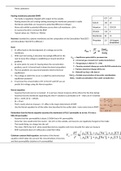
Resting membrane potential (RMP)
- The inside is negatively charged with respect to the outside
- Resting means the cell is doing nothing meaning the membrane potential is stable
- Membrane potentials are measured as potential difference (voltage)
- Many cells exhibit a potential difference across their cell membrane - ΔVm
- In neurons the ΔVm is termed the RMP
- Typical values are -70ΔVm to -90ΔVm
Neurons: bounded by a plasma membrane and the composition of the Extracellular Fluid (ECF)
and Intracellular Fluid (ICF) is different >
Next:
1. K+ efflux leads to the development of a voltage across the
membrane
2. With each ion leaving, it becomes increasingly difficult for the
next to leave (the voltage is establishing an inward electrical
gradient)
3. At some point, for every K+ leaving down the concentration
gradient, one K+ is forced back in down the electrical gradient
4. The two gradients are equal and opposite (electrochemical
equilibrium)
5. The voltage at which this occurs is called the electrochemical
equilibrium potential
6. If we know the concentration of K+ in the ICF and ECF we can
predict this voltage using the Nernst equation
Nernst equation:
- Assumes that only one ion is involved - it is we have chosen to ignore all the others (for the time being)
- Assumes that the membrane separating the two K+ solutions is permeable to K+ - there are K+ channels
- [K+]o = 4mM, [K+]i = 139mM
- Ek = 97mV
- That’s nearly what we measure - K+ efflux is the major determinant of RMP
- Use the Nernst equation for all the other ions described in the earlier table - none come close to RMP!
Remember that the Nernst equation assumes the membrane is FULLY permeable to an ion. If it was a
little bit permeable:
- Assume that Na+ permeability is about 1/100th that of K+ permeability
- Some Na+ ions would enter the neuron - lots of it on the outside, and neurons are negatively charged on the inside
- That would bring +ve charge into the cell
- The value -90mV due to K+ alone would become less negative and move towards the value we measure
- RMP is primarily due to K+ efflux plus a small Na+ influx
Goldman constant field equation: derivative of the Nernst
equation which takes into account the concentrations of ALL ions
and their permeability (relative to K+ permeability)
, Polina Lobacheva
Action potentials (AP)
- Communication
- Membrane phenomenon
- Transitory reversal of the membrane potential (1ms)
- Conduction of information along nerve cells (frequent coding of
information)
Intracellular recording of an AP in a neuron:
1. depolarization : a decrease in membrane potential ex. membrane
potential becomes less negative
2. Hyperpolarization: an increase in membrane potential ex. membrane
potential becomes more negative
3. Repolarization: membrane potential returning to RMP following an AP
Ionic basis of the AP:
- Increased Na+ permeability: remove Na+ form the ECF = no AP
- That the peak of the AP is almost the same value as the Na+
electrochemical equilibrium potential for Na+ (as defined by Nernst) indicates increased Na+ permeability is essential
- Na+ moves because voltage gated Na+ channels open
What triggers the AP:
- Depolarisation to threshold by local currents. This must occur before the AP can be
generated by inputs from other neurons or sensory activation
- This initial depolarization has to bring the membrane at the axon hillock to threshold =
generally 15-30mV above the RMP
At the threshold the AP peaks:
- Reversal of membrane potential from -60mV to +40mV
- Inactivation of Na+ channels; voltage regulated gated begin to close when membrane
potential approaches +30mV and can’t open until membrane is repolarised
- Now the K+ channels open
AP returns to rest:
- K+ move out of the cell along the electrochemical gradient by passive movement which results in repolarisation
- Membrane potential begins to return to resting level
- Brief period of hyperpolarization
- K+ channels close
- Sodium-potassium pump restores intracellular and extracellular ion concentrations to prestimulation levels
Next AP: Refractory period (RP) is the period of time after an initial AP has been generated where it is impossible or difficult
to generate a second AP:
1. Absolute RP: from time Na+ channels open at threshold until Na+ channels inactivated ( membrane totally
inexcitable), which lasts 0.4-1.0msec
2. Relative RP: begins when Na+ channels regain their normal resting condition and lasts until membrane potential
stabilises at resting levels. Membrane can be excited if stronger than threshold stimulus is applied - membrane is
repolarizing/hyperpolarized - inward flow of positive charge has to win
Resting membrane potential (RMP)
- The inside is negatively charged with respect to the outside
- Resting means the cell is doing nothing meaning the membrane potential is stable
- Membrane potentials are measured as potential difference (voltage)
- Many cells exhibit a potential difference across their cell membrane - ΔVm
- In neurons the ΔVm is termed the RMP
- Typical values are -70ΔVm to -90ΔVm
Neurons: bounded by a plasma membrane and the composition of the Extracellular Fluid (ECF)
and Intracellular Fluid (ICF) is different >
Next:
1. K+ efflux leads to the development of a voltage across the
membrane
2. With each ion leaving, it becomes increasingly difficult for the
next to leave (the voltage is establishing an inward electrical
gradient)
3. At some point, for every K+ leaving down the concentration
gradient, one K+ is forced back in down the electrical gradient
4. The two gradients are equal and opposite (electrochemical
equilibrium)
5. The voltage at which this occurs is called the electrochemical
equilibrium potential
6. If we know the concentration of K+ in the ICF and ECF we can
predict this voltage using the Nernst equation
Nernst equation:
- Assumes that only one ion is involved - it is we have chosen to ignore all the others (for the time being)
- Assumes that the membrane separating the two K+ solutions is permeable to K+ - there are K+ channels
- [K+]o = 4mM, [K+]i = 139mM
- Ek = 97mV
- That’s nearly what we measure - K+ efflux is the major determinant of RMP
- Use the Nernst equation for all the other ions described in the earlier table - none come close to RMP!
Remember that the Nernst equation assumes the membrane is FULLY permeable to an ion. If it was a
little bit permeable:
- Assume that Na+ permeability is about 1/100th that of K+ permeability
- Some Na+ ions would enter the neuron - lots of it on the outside, and neurons are negatively charged on the inside
- That would bring +ve charge into the cell
- The value -90mV due to K+ alone would become less negative and move towards the value we measure
- RMP is primarily due to K+ efflux plus a small Na+ influx
Goldman constant field equation: derivative of the Nernst
equation which takes into account the concentrations of ALL ions
and their permeability (relative to K+ permeability)
, Polina Lobacheva
Action potentials (AP)
- Communication
- Membrane phenomenon
- Transitory reversal of the membrane potential (1ms)
- Conduction of information along nerve cells (frequent coding of
information)
Intracellular recording of an AP in a neuron:
1. depolarization : a decrease in membrane potential ex. membrane
potential becomes less negative
2. Hyperpolarization: an increase in membrane potential ex. membrane
potential becomes more negative
3. Repolarization: membrane potential returning to RMP following an AP
Ionic basis of the AP:
- Increased Na+ permeability: remove Na+ form the ECF = no AP
- That the peak of the AP is almost the same value as the Na+
electrochemical equilibrium potential for Na+ (as defined by Nernst) indicates increased Na+ permeability is essential
- Na+ moves because voltage gated Na+ channels open
What triggers the AP:
- Depolarisation to threshold by local currents. This must occur before the AP can be
generated by inputs from other neurons or sensory activation
- This initial depolarization has to bring the membrane at the axon hillock to threshold =
generally 15-30mV above the RMP
At the threshold the AP peaks:
- Reversal of membrane potential from -60mV to +40mV
- Inactivation of Na+ channels; voltage regulated gated begin to close when membrane
potential approaches +30mV and can’t open until membrane is repolarised
- Now the K+ channels open
AP returns to rest:
- K+ move out of the cell along the electrochemical gradient by passive movement which results in repolarisation
- Membrane potential begins to return to resting level
- Brief period of hyperpolarization
- K+ channels close
- Sodium-potassium pump restores intracellular and extracellular ion concentrations to prestimulation levels
Next AP: Refractory period (RP) is the period of time after an initial AP has been generated where it is impossible or difficult
to generate a second AP:
1. Absolute RP: from time Na+ channels open at threshold until Na+ channels inactivated ( membrane totally
inexcitable), which lasts 0.4-1.0msec
2. Relative RP: begins when Na+ channels regain their normal resting condition and lasts until membrane potential
stabilises at resting levels. Membrane can be excited if stronger than threshold stimulus is applied - membrane is
repolarizing/hyperpolarized - inward flow of positive charge has to win