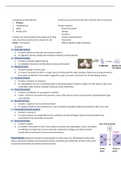
4 categories of biomolecules: Proteins account for more than 50% of the dry mass of most cells.
1. Proteins
2. Carbohydrates Protein functions:
3. Lipids - Structural support
4. Nucleic acids - Storage
- Transport
Proteins: the most abundant macromolecule in living - Cellular communications
cells, occurring in all cells and in all parts of cells. - Movement
Protos = First (greek) - Defense against foreign substances
Examples:
1. Enzymatic proteins
a. Function: selective acceleration of chemical reactions
b. Ex. digestive enzymes catalyse the hydrolysis of bonds in food molecules
2. Defensive proteins
a. Function: protection against disease
b. Ex. antibodies inactivate and help destroy viruses and bacteria
3. Storage proteins
a. Function: storage of amino acids
b. Ex. Casein, the protein of milk, is a major source of amino acids for baby mammals. Plants have storage proteins in
their seeds. Ovalbumin is the protein of egg white, used as an amino acid source for the developing embryo.
4. Transport proteins
a. Function: transport of substances
b. Ex. haemoglobin, the iron-containing protein of vertebrate blood, transports oxygen from the lungs to other parts
of the body. Other proteins transport molecules across membranes.
5. Hormonal proteins
a. Function: coordination of an organism's activities
b. Insulin, a hormone secreted by the pancreas, causes other tissues to take up glucose thus regulating blood sugar
concentration
6. Receptor proteins
a. function : response of cell to chemical stimuli
b. Ex. receptors built into the membrane of a nerve cell detect signalling molecules released by other nerve cells
7. Contractile and motor proteins
a. Function: movement
b. Ex. motor proteins are responsible for the undulations of cilia and flagella. Actin and myosin proteins are
responsible for the contraction of muscles
8. Structural proteins
a. Function: support
b. Ex. keratin is the protein of hair, horns, feathers and other skin appendages. Insects and spiders
use silk fibers to make their cocoons and webs, respectively. Collagen and elastin proteins
provide fibrous framework in animal connective tissues.
Macromolecules (polymers) formed by polymerisation of amino acids (aa). 20 (standard) amino acids
make up all known proteins, from bacteria to humans. Assembly and combination of these amino acids
account for the diversity of proteins and their function.
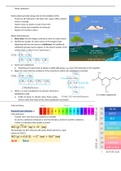
, At pH 7, the carboxyl group of an amino acid is in its conjugate base form and the amino group in its conjugate acid form.
The R-group is responsible for dictating the chemical properties.
Nonpolar side chains: hydrophobic
Polar side chains: hydrophilic
Electrically charged side chains: hydrophilic
(no need to memorise the proteins on the right)
Bioactive amino acids = several amino acids have important biological roles in addition to being
essential to protein construction:
1. Tryptophan: a precursor of the serotonin neurotransmitter
2. Tyrosine: a precursor of the dopamine neurotransmitter
3. Aspartate, glutamine, glycine: precursors of nucleotides
4. Arginine: precursor of nitric oxide
Precursor: a substance from which another is formed, especially by
metabolic reaction
Peptide bonds: binding occurs between the amino group of one amino acid
and the carboxyl group from another amino acid = this happens by a
condensation reaction or dehydration of synthesis
Amino acid residues with free amino groups is called the N-terminal and is
written to the left. The free carboxyl group is on the C-terminal residue and
appears to the right.
1. Proteins
2. Carbohydrates Protein functions:
3. Lipids - Structural support
4. Nucleic acids - Storage
- Transport
Proteins: the most abundant macromolecule in living - Cellular communications
cells, occurring in all cells and in all parts of cells. - Movement
Protos = First (greek) - Defense against foreign substances
Examples:
1. Enzymatic proteins
a. Function: selective acceleration of chemical reactions
b. Ex. digestive enzymes catalyse the hydrolysis of bonds in food molecules
2. Defensive proteins
a. Function: protection against disease
b. Ex. antibodies inactivate and help destroy viruses and bacteria
3. Storage proteins
a. Function: storage of amino acids
b. Ex. Casein, the protein of milk, is a major source of amino acids for baby mammals. Plants have storage proteins in
their seeds. Ovalbumin is the protein of egg white, used as an amino acid source for the developing embryo.
4. Transport proteins
a. Function: transport of substances
b. Ex. haemoglobin, the iron-containing protein of vertebrate blood, transports oxygen from the lungs to other parts
of the body. Other proteins transport molecules across membranes.
5. Hormonal proteins
a. Function: coordination of an organism's activities
b. Insulin, a hormone secreted by the pancreas, causes other tissues to take up glucose thus regulating blood sugar
concentration
6. Receptor proteins
a. function : response of cell to chemical stimuli
b. Ex. receptors built into the membrane of a nerve cell detect signalling molecules released by other nerve cells
7. Contractile and motor proteins
a. Function: movement
b. Ex. motor proteins are responsible for the undulations of cilia and flagella. Actin and myosin proteins are
responsible for the contraction of muscles
8. Structural proteins
a. Function: support
b. Ex. keratin is the protein of hair, horns, feathers and other skin appendages. Insects and spiders
use silk fibers to make their cocoons and webs, respectively. Collagen and elastin proteins
provide fibrous framework in animal connective tissues.
Macromolecules (polymers) formed by polymerisation of amino acids (aa). 20 (standard) amino acids
make up all known proteins, from bacteria to humans. Assembly and combination of these amino acids
account for the diversity of proteins and their function.
, At pH 7, the carboxyl group of an amino acid is in its conjugate base form and the amino group in its conjugate acid form.
The R-group is responsible for dictating the chemical properties.
Nonpolar side chains: hydrophobic
Polar side chains: hydrophilic
Electrically charged side chains: hydrophilic
(no need to memorise the proteins on the right)
Bioactive amino acids = several amino acids have important biological roles in addition to being
essential to protein construction:
1. Tryptophan: a precursor of the serotonin neurotransmitter
2. Tyrosine: a precursor of the dopamine neurotransmitter
3. Aspartate, glutamine, glycine: precursors of nucleotides
4. Arginine: precursor of nitric oxide
Precursor: a substance from which another is formed, especially by
metabolic reaction
Peptide bonds: binding occurs between the amino group of one amino acid
and the carboxyl group from another amino acid = this happens by a
condensation reaction or dehydration of synthesis
Amino acid residues with free amino groups is called the N-terminal and is
written to the left. The free carboxyl group is on the C-terminal residue and
appears to the right.