3 Domains of Life
Biological diversity (biodiversity): refers to all of the variety of life that exists on Earth Unity in the diversity of life:
- The science of classifying organisms is called taxonomy, which helps understand - Cell is the basic structural and functional unit of
the evolutionary history of life on Earth all organisms
- Linnaean Classification: all modern classification systems have their roots in the - DNA is the universal genetic language common to
Linnaean classification system. It was developed by Swedish botanist Carolus all organisms
Linnaeus in the 1700s. It consists of a hierarchy of grouping, called taxa. - Unity is evident in many features of cell structure
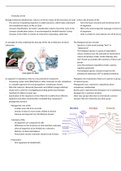
An example of unity underlying the diversity of life: the architecture of cilia in The biological species concept:
eukaryotes - Species is a Latin word meaning “kind” or
“appearance”
- The biological species is a group of populations
whose members have the potential to interbreed in
nature and produce viable, fertile offspring; they
don’t breed successfully with members of other such
groups
- Gene flow between populations holds a species
together genetically.
- The biological species concept is based on the
potential to interbreed, NOT on physical similarity
An organism’s evolutionary history is documented in its genome: Phylogeny: the evolutionary history of a species or group
- Comparing nucleic acids (DNA/RNA) or other molecules to infer relatedness of related species
is a valuable approach for tracing organisms’ evolutionary history Phylogenetic tree: represents a hypothesis about
- DNA that codes for ribosomal ribonucleic acid (rRNA) changes relatively evolutionary relationships
slowly and is useful for investigating branching points that diverged Branch point: represents the divergence of 2 evolutionary
hundreds of millions of years ago. lineages from a common ancestor
- Examination of the sequences of the rRNA (the 16s RNA) from different Sister taxa: groups that share an immediate common
organisms and other characteristics concluded they comprised 3 ancestor that isn’t shared by any other group
phylogenetic domains
Phylogenetic tree of life:
- Includes every life form on Earth
- Domain Archaea is more closely related to domain
Eukarya and separate from the Bacteria domain
3 domains of life:
- All organisms are composed of cells
- Differences in the structures of cells and their molecules
allow all organisms to be divided into 3 domains:
Bacteria, Archaea and Eukarya
- Prokaryotes include 2 domains: Bacteria and Archaea
Prokaryotes:
- First organisms to inhabit Earth
, - Thrive almost everywhere, including places too acidic, salty, cold or hot for most other
organisms
- Most are unicellular, although some species form colonies
- Most are 0.5-5um, much smaller than most eukaryotic cells
- Have a variety of shapes
- 3 most common shapes are spheres (cocci), rods (bacilli) and spirals.
Bacteria: most bacterial cell walls contain peptidoglycan, a network of sugar polymers cross-
linked by polypeptides
Archaea:
- Share certain traits with bacteria and other traits with eukaryotes
- Contain polysaccharides and proteins but lack peptidoglycan
- Some live in extreme environments and are called extremophiles: extreme halophiles (live in highly saline
environments) and extreme thermophiles (thrive in very hot environments)
Domain Eukarya: includes protists and 3 kingdoms
1. Plants, which produce their own food by photosynthesis
2. Fungi, which absorbs nutrients
3. Animals, which ingest their food
Protists:
- Exhibit more structural and functional diversity than any other group of eukaryotes
- These are most single-celled organisms
- Some protists are less closely related than they are to plants, animals and fungi
- Some protists reproduce asexually, while other reproduce sexually, or by the sexual processes of meiosis and
fertilisation
Genome size: Number of genes:
- Genomes of most bacteria and archaea range from 1 - 6 million base pairs (Mb), - Free-living bacteria and archaea = 1500 to 7500
which is mostly within this size range, eukaryotic genomes tend to be bigger - Unicellular fungi = 5000 genes
- Most plants and animals have genomes greater than 100Mb; humans have - Multicellular eukaryotes = at least 40000 genes
3000Mb - Number of genes is not correlated to genome size
- Within each domain there’s no systematic relationship between genome size
and phenotype
Genome characteristics of organisms in 3 domains:
Bacteria Archaea Eukarya
Genome size Most are 1 - 6Mb Most are 10 - 4000Mb, but a few are much larger
Number of genes 1500 - 7500 Most are 5000 - 45000
Gene diversity Higher than in eukaryotes Lower than in prokaryotes (within eukaryotes, but only in
some genes of unicellular eukaryotes)
Introns None in protein-coding Present in some genes Present in most genes of multicellular eukaryotes, but only
genes in some genes of unicellular eukaryotes
Biological diversity (biodiversity): refers to all of the variety of life that exists on Earth Unity in the diversity of life:
- The science of classifying organisms is called taxonomy, which helps understand - Cell is the basic structural and functional unit of
the evolutionary history of life on Earth all organisms
- Linnaean Classification: all modern classification systems have their roots in the - DNA is the universal genetic language common to
Linnaean classification system. It was developed by Swedish botanist Carolus all organisms
Linnaeus in the 1700s. It consists of a hierarchy of grouping, called taxa. - Unity is evident in many features of cell structure
An example of unity underlying the diversity of life: the architecture of cilia in The biological species concept:
eukaryotes - Species is a Latin word meaning “kind” or
“appearance”
- The biological species is a group of populations
whose members have the potential to interbreed in
nature and produce viable, fertile offspring; they
don’t breed successfully with members of other such
groups
- Gene flow between populations holds a species
together genetically.
- The biological species concept is based on the
potential to interbreed, NOT on physical similarity
An organism’s evolutionary history is documented in its genome: Phylogeny: the evolutionary history of a species or group
- Comparing nucleic acids (DNA/RNA) or other molecules to infer relatedness of related species
is a valuable approach for tracing organisms’ evolutionary history Phylogenetic tree: represents a hypothesis about
- DNA that codes for ribosomal ribonucleic acid (rRNA) changes relatively evolutionary relationships
slowly and is useful for investigating branching points that diverged Branch point: represents the divergence of 2 evolutionary
hundreds of millions of years ago. lineages from a common ancestor
- Examination of the sequences of the rRNA (the 16s RNA) from different Sister taxa: groups that share an immediate common
organisms and other characteristics concluded they comprised 3 ancestor that isn’t shared by any other group
phylogenetic domains
Phylogenetic tree of life:
- Includes every life form on Earth
- Domain Archaea is more closely related to domain
Eukarya and separate from the Bacteria domain
3 domains of life:
- All organisms are composed of cells
- Differences in the structures of cells and their molecules
allow all organisms to be divided into 3 domains:
Bacteria, Archaea and Eukarya
- Prokaryotes include 2 domains: Bacteria and Archaea
Prokaryotes:
- First organisms to inhabit Earth
, - Thrive almost everywhere, including places too acidic, salty, cold or hot for most other
organisms
- Most are unicellular, although some species form colonies
- Most are 0.5-5um, much smaller than most eukaryotic cells
- Have a variety of shapes
- 3 most common shapes are spheres (cocci), rods (bacilli) and spirals.
Bacteria: most bacterial cell walls contain peptidoglycan, a network of sugar polymers cross-
linked by polypeptides
Archaea:
- Share certain traits with bacteria and other traits with eukaryotes
- Contain polysaccharides and proteins but lack peptidoglycan
- Some live in extreme environments and are called extremophiles: extreme halophiles (live in highly saline
environments) and extreme thermophiles (thrive in very hot environments)
Domain Eukarya: includes protists and 3 kingdoms
1. Plants, which produce their own food by photosynthesis
2. Fungi, which absorbs nutrients
3. Animals, which ingest their food
Protists:
- Exhibit more structural and functional diversity than any other group of eukaryotes
- These are most single-celled organisms
- Some protists are less closely related than they are to plants, animals and fungi
- Some protists reproduce asexually, while other reproduce sexually, or by the sexual processes of meiosis and
fertilisation
Genome size: Number of genes:
- Genomes of most bacteria and archaea range from 1 - 6 million base pairs (Mb), - Free-living bacteria and archaea = 1500 to 7500
which is mostly within this size range, eukaryotic genomes tend to be bigger - Unicellular fungi = 5000 genes
- Most plants and animals have genomes greater than 100Mb; humans have - Multicellular eukaryotes = at least 40000 genes
3000Mb - Number of genes is not correlated to genome size
- Within each domain there’s no systematic relationship between genome size
and phenotype
Genome characteristics of organisms in 3 domains:
Bacteria Archaea Eukarya
Genome size Most are 1 - 6Mb Most are 10 - 4000Mb, but a few are much larger
Number of genes 1500 - 7500 Most are 5000 - 45000
Gene diversity Higher than in eukaryotes Lower than in prokaryotes (within eukaryotes, but only in
some genes of unicellular eukaryotes)
Introns None in protein-coding Present in some genes Present in most genes of multicellular eukaryotes, but only
genes in some genes of unicellular eukaryotes