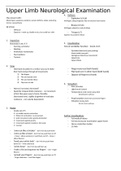
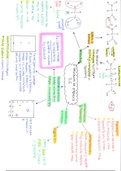
Upper Limb Neurological Examination
4. Reflexes
May present with: - Supinator (c5/c6)
Altered gait, weakness, paralysis, sensory deficits, ataxia, posturing, Hit fingers along imaginary line on forearm from thumb
tremor, paraesthesia
- Biceps (c5/c6)
W.I.P.E.E Hit fingers placed in crook of elbow
- Sitting up
- Exposure = waist up, ideally no bra, but could be t-shirt - Triceps (c7)
Superior to posterior elbow
1. Inspection
Remember S.W.I.F.T! 5. Coordination
- Scarring, symmetry Test of cerebellar function – D.A.N.I.S.H.
- Wasting
Dysdiadochokineasia (past pointing)
- Involuntary movements
Ataxia (wide base gait)
- Fasciculations Nystagmus (lateral eye movement)
- Tremors Hypertonia
Hyperreflexia
2. Tone
- Hold hand of patient in a similar way you’d shake - Finger-nose test (both hands)
their hand and go through all movements - Flip hand over in other hand (both hands)
1) Flex fingers - Oppose all fingers to thumb
2) Flex and extend wrist
3) Flex and extend elbow
4) Flap arms at side
6. Sensation*
- Pain (neurotip)
- Normal, increased, decreased? - Light touch (cotton)
- Spasticity (clasped knife resistance – no movement - Temperature (cold metal tuning fork)
at first then gives way to force), flaccidity Spinothalamic pathway
(decreased tone), rigidity (cogwheel or lead-pipe
resistance – not velocity dependent) - Proprioception (close eyes and move finger)
- Vibration (tuning fork)
Dorsal column pathway
3. Power
- Grade out of 5
0 = no visible muscle contraction
1 = flicker of contraction, no movement Further investigations
2 = joint movement when gravity eliminated - Full medical history
3 = movement against gravity - Full neurovascular examination upper/lower
4 = movement against resistance, but weak - Nerve conduction studies
5 = normal
- CT/MRI
- ‘arms out like a chicken’ – don’t let me push down
- ‘arms up like a boxer’, don’t let me push them in (C7
– tricep = elbow extensors) / pull them out (C5 – bicep =
elbow flexors)
- ‘bend your wrists back’ – don’t let me push them
down (C6 – wrist extensors)
- ‘wrists down’ – don’t let me pull them up
- ‘make a fist and squeeze my fingers’ – (C8 – finger
flexors)
- ‘spread your fingers’ – don’t let me push them in (T1
– finger abductors – test little finger)
4. Reflexes
May present with: - Supinator (c5/c6)
Altered gait, weakness, paralysis, sensory deficits, ataxia, posturing, Hit fingers along imaginary line on forearm from thumb
tremor, paraesthesia
- Biceps (c5/c6)
W.I.P.E.E Hit fingers placed in crook of elbow
- Sitting up
- Exposure = waist up, ideally no bra, but could be t-shirt - Triceps (c7)
Superior to posterior elbow
1. Inspection
Remember S.W.I.F.T! 5. Coordination
- Scarring, symmetry Test of cerebellar function – D.A.N.I.S.H.
- Wasting
Dysdiadochokineasia (past pointing)
- Involuntary movements
Ataxia (wide base gait)
- Fasciculations Nystagmus (lateral eye movement)
- Tremors Hypertonia
Hyperreflexia
2. Tone
- Hold hand of patient in a similar way you’d shake - Finger-nose test (both hands)
their hand and go through all movements - Flip hand over in other hand (both hands)
1) Flex fingers - Oppose all fingers to thumb
2) Flex and extend wrist
3) Flex and extend elbow
4) Flap arms at side
6. Sensation*
- Pain (neurotip)
- Normal, increased, decreased? - Light touch (cotton)
- Spasticity (clasped knife resistance – no movement - Temperature (cold metal tuning fork)
at first then gives way to force), flaccidity Spinothalamic pathway
(decreased tone), rigidity (cogwheel or lead-pipe
resistance – not velocity dependent) - Proprioception (close eyes and move finger)
- Vibration (tuning fork)
Dorsal column pathway
3. Power
- Grade out of 5
0 = no visible muscle contraction
1 = flicker of contraction, no movement Further investigations
2 = joint movement when gravity eliminated - Full medical history
3 = movement against gravity - Full neurovascular examination upper/lower
4 = movement against resistance, but weak - Nerve conduction studies
5 = normal
- CT/MRI
- ‘arms out like a chicken’ – don’t let me push down
- ‘arms up like a boxer’, don’t let me push them in (C7
– tricep = elbow extensors) / pull them out (C5 – bicep =
elbow flexors)
- ‘bend your wrists back’ – don’t let me push them
down (C6 – wrist extensors)
- ‘wrists down’ – don’t let me pull them up
- ‘make a fist and squeeze my fingers’ – (C8 – finger
flexors)
- ‘spread your fingers’ – don’t let me push them in (T1
– finger abductors – test little finger)