10.1 reaction rates
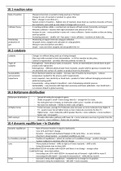
Rate of reaction - Measures how fast a reactant is being used up or formed.
- Change in conc of reactant or product in a given time
- Rate = change in conc/time in s.
- Fastest at start of reaction – highest conc of reactant, slows down as reaction proceeds as Theres
less reactants, once used up conc doesn’t change and ror is at 0.
Collision theory - 2 reacting particles collide = reaction but can bounce off and remain chemically unchanged.
- Affective collisions = reaction with right orientation and amount of E (Ea).
- Increase in conc – more particles in same vol = more collisions = faster reaction as they are being
used up quicker.
- Increasing pressure – smaller vol = less space = more collisions = reactions at faster rate.
Monitoring - Monitoring at regular intervals using gas collection.
production of - On graph: draw a tangent and calculate ror using gradient.
gas - Measure mass lost (before and after).
- Graph – mass over time, tangent and use gradient for ror
10.2 catalysts
catalysts - Changes ror without being used up or being changed.
- May react with reactant to form intermediate – or SA for reaction to take place.
- Catalyst is regenerated – provides alternate pathway to lower Ea
Types of - Homogenous - Same physical state as reactants – forms an intermediate to break down to give
catalysts product and regenerates
- Heterogenous – different physical state from reactants, usually solid for gaseous reactants that
are absorbed onto surface of catalyst so product leaves by desorption.
Sustainability - 0% of chemical material use catalyst – increase rate of reaction by lowering Ea – reduces
and economic temperature needed for the process and E requirements.
importance - Less E required = less electricity or fossil fuels = product is faster without damaging environment
whilst increasing profit.
- Economically – using catalyst is beneficial > cost of developing catalytic process.
- Sustainability – use processes with high atom economy and fewer pollutants = less fossil fuels =
cut emission linked to global warming.
10.3 Boltzmann distribution
Boltzmann distribution - Spread of molecular energies in gases.
- Shade on graph is small = more energy than Ea – enough for E to react.
- No molecules have 0 energy, so molecules under curve = number of molecules.
- No max E for molecule – infinity to meet x axis at high E.
At higher temp - Temp increases, average E of molecules also increases so more molecules have higher E.
- T2 – peak is lower but at higher temp as more molecules overcome Ea than T1
- Higher temp – more molecules with E greater than Ea = more collisions = more reactions =
faster rate + increased E.
With catalyst - Provides alternative pathway with lower Ea = more molecules now have E greater than the
lower Ea = more collisions = faster rate of reaction.
10.4 dynamic equilibrium + le Chatelier
Dynamic equilibrium - Rate of forward reaction is equal to backwards.
- Conc of R and P don’t change.
- Dynamic – forward and backward happen at the same time – so conc remains.
- Must be in closed system – so standard conditions are met.
Le chateliers principle - Position of equilibrium = extent of reaction so if conditions change – position changes.
- System readjusts to minimise effect of change.
conc - More products formed – shifts to right so if more reactants – shift to left.
- Using dichromate ions to show shift.
1) add yellow K2CrO4 to beaker with H2SO4 until there is no change – orange colour
2) add NaOH (aq) - turns back yellow.
- Increasing conc of H+ with H2SO4 = increased rate of forward = right shift for more P.
- Increasing OH with NaOH – increases R removed by H – shifts left for more R.
temp - Increase in temp shifts equilibrium – endothermic so change in H is positive.
- Decrease in temp for endothermic – left shift = more reactants.
Rate of reaction - Measures how fast a reactant is being used up or formed.
- Change in conc of reactant or product in a given time
- Rate = change in conc/time in s.
- Fastest at start of reaction – highest conc of reactant, slows down as reaction proceeds as Theres
less reactants, once used up conc doesn’t change and ror is at 0.
Collision theory - 2 reacting particles collide = reaction but can bounce off and remain chemically unchanged.
- Affective collisions = reaction with right orientation and amount of E (Ea).
- Increase in conc – more particles in same vol = more collisions = faster reaction as they are being
used up quicker.
- Increasing pressure – smaller vol = less space = more collisions = reactions at faster rate.
Monitoring - Monitoring at regular intervals using gas collection.
production of - On graph: draw a tangent and calculate ror using gradient.
gas - Measure mass lost (before and after).
- Graph – mass over time, tangent and use gradient for ror
10.2 catalysts
catalysts - Changes ror without being used up or being changed.
- May react with reactant to form intermediate – or SA for reaction to take place.
- Catalyst is regenerated – provides alternate pathway to lower Ea
Types of - Homogenous - Same physical state as reactants – forms an intermediate to break down to give
catalysts product and regenerates
- Heterogenous – different physical state from reactants, usually solid for gaseous reactants that
are absorbed onto surface of catalyst so product leaves by desorption.
Sustainability - 0% of chemical material use catalyst – increase rate of reaction by lowering Ea – reduces
and economic temperature needed for the process and E requirements.
importance - Less E required = less electricity or fossil fuels = product is faster without damaging environment
whilst increasing profit.
- Economically – using catalyst is beneficial > cost of developing catalytic process.
- Sustainability – use processes with high atom economy and fewer pollutants = less fossil fuels =
cut emission linked to global warming.
10.3 Boltzmann distribution
Boltzmann distribution - Spread of molecular energies in gases.
- Shade on graph is small = more energy than Ea – enough for E to react.
- No molecules have 0 energy, so molecules under curve = number of molecules.
- No max E for molecule – infinity to meet x axis at high E.
At higher temp - Temp increases, average E of molecules also increases so more molecules have higher E.
- T2 – peak is lower but at higher temp as more molecules overcome Ea than T1
- Higher temp – more molecules with E greater than Ea = more collisions = more reactions =
faster rate + increased E.
With catalyst - Provides alternative pathway with lower Ea = more molecules now have E greater than the
lower Ea = more collisions = faster rate of reaction.
10.4 dynamic equilibrium + le Chatelier
Dynamic equilibrium - Rate of forward reaction is equal to backwards.
- Conc of R and P don’t change.
- Dynamic – forward and backward happen at the same time – so conc remains.
- Must be in closed system – so standard conditions are met.
Le chateliers principle - Position of equilibrium = extent of reaction so if conditions change – position changes.
- System readjusts to minimise effect of change.
conc - More products formed – shifts to right so if more reactants – shift to left.
- Using dichromate ions to show shift.
1) add yellow K2CrO4 to beaker with H2SO4 until there is no change – orange colour
2) add NaOH (aq) - turns back yellow.
- Increasing conc of H+ with H2SO4 = increased rate of forward = right shift for more P.
- Increasing OH with NaOH – increases R removed by H – shifts left for more R.
temp - Increase in temp shifts equilibrium – endothermic so change in H is positive.
- Decrease in temp for endothermic – left shift = more reactants.