NUR 2407-Pharm Test One Study Guide
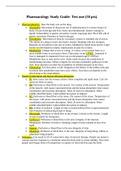
NUR 2407-Pharm Test One Study Guide Pharmacology Study Guide- Test one (50 pts). Pharmacokinetics: How the body acts on the drug. o Absorption: Movement of drug from site of administration to various tissues of body. Occurs in the gut and liver. Entry into bloodstream. Enteric coating vs. liquid. Vulnerability to gastric secretions. Gastric emptying time. Ph of RX. pH of gastric secretions. Presence of food in the gut. o Distribution: Movement of drug by circulatory system to intended site of action. The ability of a drug to move into body’s tissues. Bonding with key receptors. Depends on circulation to the site of action. Inhibited by blood brain barrier. Lipid barrier not developed in infants. Implications of pain Rx in labor. o Metabolism: Change that occurs in a drug- to a more or less potent form; to a more soluble form; to an inactive form. Takes place in the LIVER. Impaired if liver is damaged. Is impaired if liver not yet developed (age is a factor). Metabolites may or may not be toxic. Some meds increase the production of metabolizing enzymes. Others compete for enzymes (metabolic pathways) in the liver. Poor nutrition can alter the availability of needed enzymes in the liver. o Elimination: Exit thru urine or bile. Happens in the kidney. If the kidney fails and excretion fails metabolites may have toxic effects. Excretion can depend on the pH of urine in the renal tubules. Routes of absorption and factors affecting absorption: o IV: direct entry into the venous system. Most complete and rapid route. Can’t be retrieved. Risk of sepsis. o IM: Perfusion or blood flow to the muscle. Fat content of the muscle. Temperature of the muscle: cold causes vasoconstriction and decreases absorption; heat causes vasodilation and increases absorption. Takes 20 mins for absorption. Water soluble absorbed better. Lipid soluble best given in adipose. o SC: Perfusion or blood flow to the tissue. Fat content of the tissue. Temperature of the tissue: cold causes vasoconstriction and decreases absorption; heat causes vasodilation and increases absorption. Takes 20 mins for absorption. Water soluble absorbed better. Lipid soluble best given in adipose. o PO: Acidity of stomach. Length of time in stomach.Blood flow to gastrointestinal tract.Presence of interacting foods or drugs. o PR (rectal): Perfusion or blood flow to the rectum. Lesions in the rectum. Length of time retained for absorption. o SL/Buccal: Perfusion or blood flow to the area. Integrity of the mucous Membranes. Presence of food or smoking.Length of time retained in area.Very rapid. o Topical: Perfusion or blood flow to the area.Integrity of skin. o Inhalation: Perfusion or blood flow to the area. Integrity of lung lining. Ability to administer drug properly. Tolerance: Can result in 10-14 consecutive days of narcotic therapy. People can mount a counter-reactive response to a medicine when the body tried to create stability. Over time people need larger doses of tranquilizers or opiates to find relief because the body develops a habitual push back response. Withdrawal occurs when the push back response in un-tempered by the Rx. Tolerance doesn’t mean that a person is addicted. ***First-pass: Refers to the process that occurs when an oral medication is processed through the liver before entering general circulation. Nursing Process: —a decision-making, problem-solving process—to provide efficient and effective care. o Assessment Past hx (drug use, allergies, OTC, alternative therapies, chronic conditions). Physical examination. o Diagnosis- a statement of a pt’s status from the nursing perspective. o Implementation Proper drug administration (drug, storage, route, dose, preparation, time, recording). Comfort measures Pt/family teaching o Evaluation- used by nurses to determine the effects of interventions. Loading and Maintenance: A “loading dose” is a higer than normal dose given at the beginning of a prescription to build up a therapeutic level of medication. Maintenance is keep taking it daily to keep the drug levels steady in the body. Example: Z-pack: 1st day is two pills (loading), 2nd day one pill for 5 days (maintenance). Adverse Effects: Unintended and unexpected effects that are more severe and can be life-threatening in nature. Are undesirable effects. We don’t want these to occur. Over- or under dosing of drugs is a common cause of adverse effects. For example: a pt experiences breathing difficulty after an injection of penicillin. Divided into three categories: o Primary: effects that are merely an extension of the desired effect. For example, an anticoagulant may act so effectively that the patient experiences excessive and spontaneous bleeding o Secondary: drug dose can be adjusted so that the desired effect is achieved without producing undesired secondary reactions. For example, many antihistamines are very effective in drying up secretions and helping breathing, but they also cause drowsiness. The patient who is taking antihistamines needs to know that driving a car or operating power tools or machinery should be avoided because the drowsiness could pose a serious problem. o Hypersensitivity (anaphylactic shock): Some patients are excessively responsive to either the primary or the secondary effects of a drug. Drug Allergy: when the body forms antibodies to a particular drug. Half-Life: The amount of time that a drug level takes to decrease to one half of its peak level in the blood. How long it takes before half of the medication is metabolized (and hopefully excreted). It usually takes 4 doses of a medication to achieve a steady state. Decrease in functioning of liver and kidneys increase half-life of drugs. OTC: OTC drugs have been deemed safe when used as directed and do not require a prescription or advice from a health care provider.OTC drugs can mask the signs and
Escuela, estudio y materia
- Institución
- Rasmussen College
- Grado
- NUR 2407
Información del documento
- Subido en
- 15 de julio de 2021
- Número de páginas
- 13
- Escrito en
- 2020/2021
- Tipo
- Examen
- Contiene
- Preguntas y respuestas
Temas
-
nur 2407
-
nur 2407 pharm test one study guide
-
pharm test one study guide

Documento también disponible en un lote