Waves can transfer energy and information without a net motion of the medium through which they
travel. They involve vibrations (oscillations) of some sort. Waves can be described as oscillations, or
vibrations about a rest position.
Sound waves cause air particles to vibrate back and forth. Ripples cause water particles to vibrate
up and down.
Oscillations- back and forth movement which repeats
Wave speed (v) – the speed at which the wave front passes a stationery observer
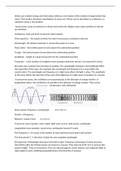
Wavelength- the distance between 2 consecutive peaks of a wave
Peak (crest) - the furthest point of wave above the undisturbed position
Trough - the furthest point of wave below the undisturbed position
Amplitude – height of a peak measured from the undisturbed position
Frequency – is the number of complete waves passing a point per second. It is measured in hertz.
All waves carry energy from one place to another. The wavelength, frequency and amplitude affect
the properties of the wave. For example, the wavelength and frequency of a sound affect the
sound’s pitch. The wavelength and frequency of a light wave affect the light’s colour. The amplitude
of the wave affects the intensity of the wave (the brightness of a light wave or loudness of a sound.)
In transverse waves, the oscillations are perpendicular to the direction of energy transfer. In
longitudinal waves, the oscillations are parallel to the direction of energy transfer. They can be
compressed and rarefracted.
Wave speed= frequency x wavelength m/s= Hz x m
Period= 1/frequency
Distance= speed x time m= m/s x s
Transverse wave example- water ripple, light wave such as radio waves, earthquake
Longitudinal wave example- sound wave, earthquake (seismic P wave)
The frequency, f, of a wave is the number of wave passing at each point each second.
The time period, T, is the times it takes for one complete wavelength.
EM spectrum- Wavelength decreases from left to right. Frequency and energy of waves increase
from left to right. All of these waves can travel in a vacuum. They travel at 3x10 8 m/s in vacuum (the
speed of light). They are transverse. They are electromagnetic waves (electric and magnetic fields at
right angles to each oscillating perpendicularly to the direction of energy)
travel. They involve vibrations (oscillations) of some sort. Waves can be described as oscillations, or
vibrations about a rest position.
Sound waves cause air particles to vibrate back and forth. Ripples cause water particles to vibrate
up and down.
Oscillations- back and forth movement which repeats
Wave speed (v) – the speed at which the wave front passes a stationery observer
Wavelength- the distance between 2 consecutive peaks of a wave
Peak (crest) - the furthest point of wave above the undisturbed position
Trough - the furthest point of wave below the undisturbed position
Amplitude – height of a peak measured from the undisturbed position
Frequency – is the number of complete waves passing a point per second. It is measured in hertz.
All waves carry energy from one place to another. The wavelength, frequency and amplitude affect
the properties of the wave. For example, the wavelength and frequency of a sound affect the
sound’s pitch. The wavelength and frequency of a light wave affect the light’s colour. The amplitude
of the wave affects the intensity of the wave (the brightness of a light wave or loudness of a sound.)
In transverse waves, the oscillations are perpendicular to the direction of energy transfer. In
longitudinal waves, the oscillations are parallel to the direction of energy transfer. They can be
compressed and rarefracted.
Wave speed= frequency x wavelength m/s= Hz x m
Period= 1/frequency
Distance= speed x time m= m/s x s
Transverse wave example- water ripple, light wave such as radio waves, earthquake
Longitudinal wave example- sound wave, earthquake (seismic P wave)
The frequency, f, of a wave is the number of wave passing at each point each second.
The time period, T, is the times it takes for one complete wavelength.
EM spectrum- Wavelength decreases from left to right. Frequency and energy of waves increase
from left to right. All of these waves can travel in a vacuum. They travel at 3x10 8 m/s in vacuum (the
speed of light). They are transverse. They are electromagnetic waves (electric and magnetic fields at
right angles to each oscillating perpendicularly to the direction of energy)