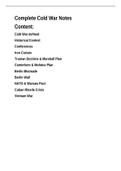
Complete Cold War Notes
Content:
Cold War defined
Historical Context
Conferences
Iron Curtain
Truman Doctrine & Marshall Plan
Cominform & Molotov Plan
Berlin Blockade
Berlin Wall
NATO & Warsaw Pact
Cuban Missile Crisis
Vietnam War
, The Cold War 1945-1989
Capitalism is where everything is owned privately and aims to produce profits. It involves a
Democratic government.
communism allows equal ownership and Commonwealth in a classless society. It involves
one party state an industry and agriculture controlled by the government.
The Cold War - this was a state of hostility between two nations, the USSR and the USA
with economic political and ideological struggles without physical fighting. It was fought
because of ideological differences uninvolved propaganda espionage assassinations and
the potential threat of a nuclear war.
Proxy wars – war fought on behalf of bigger countries as a civil war in a smaller country
Satellite states - countries directly influenced but not directly control buy another country
Global power hierarchy – regional power (country) > great power (britain) > superpower
(USA/USSR) > hegemon (roman empire) > hyper power
Historical Context
Mistrust between the USSR and the USA was caused because of different ideologies and
tensions between world superpowers.
In 1941 America, Russia and Britain formed a grand alliance to defeat Germany
However, this was just to end the war by defeating a common enemy and it resulted
in tensions between the different countries
USSR aided most defeats against Germany and felt that the USA did not help
The USA had an atomic bomb used in Hiroshima attacks which threatened the
USSR
USA ended the Lend Lease program which aided Soviets this applies
Conferences
Teheran conference - November 1943
the big three (Stalin Churchill and Roosevelt) met to discuss the end of World War 2
It limited the USAs participation, Encourage Stalin's power (red army invade) and
convinced the USSR to try and take power in Europe - mistrust and tensions built
Content:
Cold War defined
Historical Context
Conferences
Iron Curtain
Truman Doctrine & Marshall Plan
Cominform & Molotov Plan
Berlin Blockade
Berlin Wall
NATO & Warsaw Pact
Cuban Missile Crisis
Vietnam War
, The Cold War 1945-1989
Capitalism is where everything is owned privately and aims to produce profits. It involves a
Democratic government.
communism allows equal ownership and Commonwealth in a classless society. It involves
one party state an industry and agriculture controlled by the government.
The Cold War - this was a state of hostility between two nations, the USSR and the USA
with economic political and ideological struggles without physical fighting. It was fought
because of ideological differences uninvolved propaganda espionage assassinations and
the potential threat of a nuclear war.
Proxy wars – war fought on behalf of bigger countries as a civil war in a smaller country
Satellite states - countries directly influenced but not directly control buy another country
Global power hierarchy – regional power (country) > great power (britain) > superpower
(USA/USSR) > hegemon (roman empire) > hyper power
Historical Context
Mistrust between the USSR and the USA was caused because of different ideologies and
tensions between world superpowers.
In 1941 America, Russia and Britain formed a grand alliance to defeat Germany
However, this was just to end the war by defeating a common enemy and it resulted
in tensions between the different countries
USSR aided most defeats against Germany and felt that the USA did not help
The USA had an atomic bomb used in Hiroshima attacks which threatened the
USSR
USA ended the Lend Lease program which aided Soviets this applies
Conferences
Teheran conference - November 1943
the big three (Stalin Churchill and Roosevelt) met to discuss the end of World War 2
It limited the USAs participation, Encourage Stalin's power (red army invade) and
convinced the USSR to try and take power in Europe - mistrust and tensions built