Rebutting the Presumption
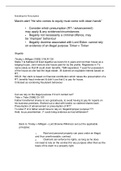
Maxim alert “He who comes to equity must come with clean hands”
Consider which presumption (RT / advancement)
may apply & any evidence/circumstances
Illegality not necessarily a criminal offence, may
be ‘improper’ behaviour
Illegality doctrine associated with Lord Eldon: cannot rely
on evidence of an illegal purpose Tinker v Tinker
Illegality
Tinsley v Milligan [1993] 3 WLR 126
Stella T & Kathleen M lived together as lovers for 4 years and ran their house as a
lodging house. Joint venture and house paid for by the profits. Registered in T’s
name solely so that M could claim benefits. T&M separated, T sued for possession
of the house as she had the legal estate , M claimed an equitable interest based on
RT.
HELD: Her claim is based on financial contribution which raises the presumption of a
RT, benefits fraud irrelevant & didn’t use that £ to pay for house.
Criticised as condoning fraudulent behaviour
Can we rely on the illegal purpose if it isn’t carried out?
Tribe v Tribe [1996] Ch 107:
Father transferred shares to son gratuitously, to avoid having to pay for repairs on
his business premises. Worked out a deal with landld, so claimed shares back.
Presumption of advancement or presumption of RT?
To rebut P of A father would have to rely on ‘illegal/improper purpose’???
Held: locus poenitentiae , F could bring evidence as had withdrawn!!
Back to Tinsley v Milligan—Lord Browne-Wilkinson set out the applicable
principles:
1. Real and personal property can pass under an illegal,
and thus unenforceable, contract.
2. Claimant can enforce his rights, as long as he does
not need to rely on the contract for any purpose other than as the
basis of his claim to a property right.
, 3. It is irrelevant whether the illegality emerged in
evidence or was pleaded, it is sufficient that the property
was acquired under the illegal contract.
Reliance principle
Adressed toSC
Law Commission report ‘The Illegality Defence’ but not implemented:
illegality should normally be ignored
Tinsley overruled & a simpler test introduced by Supreme Court Patel
v Mirza [2016] UKSC 1047
P agreed with M, that he, P would pay M £620,000 for ‘insider’ info to
trade on RBS shares. P paid but no info, so P wanted £ back.
Claim based on unjust enrichment &/or Quistclose type trust
First instance: wouldn’t apply Tribe, P hadn’t ‘withdrawn voluntarily’
Appeal CA: P successful. Rimer LJ no distinction with Tribe, RT at
time of transfer & nothing to rebut
SC: decision agreed, though 9 justices & different reasoning.
Overruled Tinsley & reliance principle. Claim here simply of unjust
enrichment under a contract where consideration had failed. No
policy issues as no bets placed. Mr P could reclaim £.
Lord Toulson:
Essence of illegality doctrine is that it is contrary to public
interest to enforce a claim if harmful to integrity of the legal
system
Consider all the circumstances including if denying claim
would be disproportionate to on party
Key: would the ‘unlawful purpose’ undermine the integrity
of the justice system? (rare). More flexible.
Constructive Trusts
• Introduce another type of implied trust: the constructive trust
Maxim alert “He who comes to equity must come with clean hands”
Consider which presumption (RT / advancement)
may apply & any evidence/circumstances
Illegality not necessarily a criminal offence, may
be ‘improper’ behaviour
Illegality doctrine associated with Lord Eldon: cannot rely
on evidence of an illegal purpose Tinker v Tinker
Illegality
Tinsley v Milligan [1993] 3 WLR 126
Stella T & Kathleen M lived together as lovers for 4 years and ran their house as a
lodging house. Joint venture and house paid for by the profits. Registered in T’s
name solely so that M could claim benefits. T&M separated, T sued for possession
of the house as she had the legal estate , M claimed an equitable interest based on
RT.
HELD: Her claim is based on financial contribution which raises the presumption of a
RT, benefits fraud irrelevant & didn’t use that £ to pay for house.
Criticised as condoning fraudulent behaviour
Can we rely on the illegal purpose if it isn’t carried out?
Tribe v Tribe [1996] Ch 107:
Father transferred shares to son gratuitously, to avoid having to pay for repairs on
his business premises. Worked out a deal with landld, so claimed shares back.
Presumption of advancement or presumption of RT?
To rebut P of A father would have to rely on ‘illegal/improper purpose’???
Held: locus poenitentiae , F could bring evidence as had withdrawn!!
Back to Tinsley v Milligan—Lord Browne-Wilkinson set out the applicable
principles:
1. Real and personal property can pass under an illegal,
and thus unenforceable, contract.
2. Claimant can enforce his rights, as long as he does
not need to rely on the contract for any purpose other than as the
basis of his claim to a property right.
, 3. It is irrelevant whether the illegality emerged in
evidence or was pleaded, it is sufficient that the property
was acquired under the illegal contract.
Reliance principle
Adressed toSC
Law Commission report ‘The Illegality Defence’ but not implemented:
illegality should normally be ignored
Tinsley overruled & a simpler test introduced by Supreme Court Patel
v Mirza [2016] UKSC 1047
P agreed with M, that he, P would pay M £620,000 for ‘insider’ info to
trade on RBS shares. P paid but no info, so P wanted £ back.
Claim based on unjust enrichment &/or Quistclose type trust
First instance: wouldn’t apply Tribe, P hadn’t ‘withdrawn voluntarily’
Appeal CA: P successful. Rimer LJ no distinction with Tribe, RT at
time of transfer & nothing to rebut
SC: decision agreed, though 9 justices & different reasoning.
Overruled Tinsley & reliance principle. Claim here simply of unjust
enrichment under a contract where consideration had failed. No
policy issues as no bets placed. Mr P could reclaim £.
Lord Toulson:
Essence of illegality doctrine is that it is contrary to public
interest to enforce a claim if harmful to integrity of the legal
system
Consider all the circumstances including if denying claim
would be disproportionate to on party
Key: would the ‘unlawful purpose’ undermine the integrity
of the justice system? (rare). More flexible.
Constructive Trusts
• Introduce another type of implied trust: the constructive trust