1
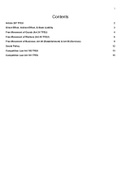
Contents
Article 267 TFEU 2
Direct Effect, Indirect Effect, & State Liability 3
Free Movement of Goods (Art 34 TFEU) 4
Free Movement of Workers (Art 45 TFEU) 6
Free Movement of Business: Art 49 (Establishment) & Art 56 (Services) 9
Social Policy 12
Competition Law Art 102 TFEU 13
Competition Law Art 101 TFEU 15
, 2
Article 267 TFEU
ECJ Guidelines & Authorities
- Art. 267 references ‘particularly useful’ when a question is of general importance for the uniform application of EU
law.
- Rheinmuhlen: Higher national court cannot prevent a lower national court making a reference.
- Foto-Frost: National courts cannot declare a piece of EU law invalid, only the ECJ can.
- Trinity Mirror: National courts should exercise self-restraint to prevent the ECJ being overwhelmed with references.
- Costa: ECJ cannot rule on national law or the way it interacts with EU law, only on purely EU law questions.
- Foglia: ECJ has no jurisdiction to give a ruling where there is no genuine dispute.
- Telemarsicabruzzo: ECJ cannot rule when given insufficient factual/legal background to a case.
- Kobler: courts of final instance can be sued under state liability for failing to make a reference to the ECJ.
, 3
Direct Effect, Indirect Effect, & State Liability
- Direct effect: Individuals may rely on EU rights set out in treaty articles and regulations before their national court.
Can be used as sword and shield in national court without the need for national implementation.
- Indirect effect: since directives only have vertical direct effect, individuals can rely on indirect effect to make
horizontal claims in national courts. Courts must interpret national legislation in line with EU directives as far as
possible.
- State liability: When states fail to implement EU directives, individuals can claim damages from the state itself.
Contents
Article 267 TFEU 2
Direct Effect, Indirect Effect, & State Liability 3
Free Movement of Goods (Art 34 TFEU) 4
Free Movement of Workers (Art 45 TFEU) 6
Free Movement of Business: Art 49 (Establishment) & Art 56 (Services) 9
Social Policy 12
Competition Law Art 102 TFEU 13
Competition Law Art 101 TFEU 15
, 2
Article 267 TFEU
ECJ Guidelines & Authorities
- Art. 267 references ‘particularly useful’ when a question is of general importance for the uniform application of EU
law.
- Rheinmuhlen: Higher national court cannot prevent a lower national court making a reference.
- Foto-Frost: National courts cannot declare a piece of EU law invalid, only the ECJ can.
- Trinity Mirror: National courts should exercise self-restraint to prevent the ECJ being overwhelmed with references.
- Costa: ECJ cannot rule on national law or the way it interacts with EU law, only on purely EU law questions.
- Foglia: ECJ has no jurisdiction to give a ruling where there is no genuine dispute.
- Telemarsicabruzzo: ECJ cannot rule when given insufficient factual/legal background to a case.
- Kobler: courts of final instance can be sued under state liability for failing to make a reference to the ECJ.
, 3
Direct Effect, Indirect Effect, & State Liability
- Direct effect: Individuals may rely on EU rights set out in treaty articles and regulations before their national court.
Can be used as sword and shield in national court without the need for national implementation.
- Indirect effect: since directives only have vertical direct effect, individuals can rely on indirect effect to make
horizontal claims in national courts. Courts must interpret national legislation in line with EU directives as far as
possible.
- State liability: When states fail to implement EU directives, individuals can claim damages from the state itself.