

NUR 254 EXAM 3 QUESTIONS & ANSWERS 2026-2027 | COMPREHENSI… EXAM
P R O F E S S I O N A L P R A C T I C E M AT E R I A L S
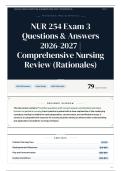
NUR 254 Exam 3
Questions & Answers
2026-2027 |
Comprehensive Nursing
Review (Rationales)
Verified Answers Exam Ready With Rationales
79 QUESTIONS
DOCUMENT OVERVIEW
This document contains 79 verified questions with correct answers and detailed rationales
focused on pediatric nursing. Each question is paired with a clear explanation of the underlying
concepts, making it suitable for exam preparation, course review, and certification study. It
serves as a comprehensive resource for nursing students aiming to enhance their understanding
and application of pediatric nursing principles.
CONTENTS
Pediatric Nursing Care Q1–Q11
Developmental Milestones Q12–Q22
Play and Communication Q23–Q34
Cardiac Conditions Q35–Q53
Page 1
,Respiratory Disorders Q54–Q64
Renal and Gastrointestinal Issues Q65–Q79
E XA M Q U EST I O N S
Q1 QUESTION 1 OF 79
Family Centered Care
CORRECT ANSWER
Aids in planning,delivery, & evaluation
1. Empowerment
2. Enabling
RATIONALE
Family-centered care emphasizes collaboration among healthcare providers, patients, and families,
enhancing the planning, delivery, and evaluation of care through shared decision-making and support.
This approach empowers families and enables them to actively participate in the health process,
improving outcomes and satisfaction.
Q2 QUESTION 2 OF 79
Atraumatic Care
CORRECT ANSWER
Do no Harm
1.Prevent or Minimize Separation
2. Promote Sense of Control
3. Prevent or Minimize bodily injury or pain
RATIONALE
Atraumatic care focuses on minimizing physical and psychological distress in patients, particularly
vulnerable populations like children, by preventing harm through strategies that promote autonomy and
reduce separation from caregivers. This approach fosters a supportive environment that enhances
healing and patient well-being, aligning with the principle of "do no harm.
Page 2
, Q3 QUESTION 3 OF 79
Role of pediatric Nurse
CORRECT ANSWER
Therapeutic relationship
Family advocacy & caring
Disease prevention & health promotion
Health Teaching
Injury Prevention
Support & Counseling
Coordination & Collaboration
Ethical Decision Making
RATIONALE
Establishing a therapeutic relationship and engaging in family advocacy are critical components of
pediatric nursing, as they foster trust and collaboration in care. Additionally, promoting health education,
injury prevention, and ethical decision-making supports the holistic development and well-being of
pediatric patients and their families.
Q4 QUESTION 4 OF 79
Weight Should be....
CORRECT ANSWER
2x birth weight @ 6 months
3x birth weight @ 12 months
RATIONALE
Infants typically double their birth weight by 6 months due to rapid growth and nutritional needs, and by
12 months, they triple their birth weight as they transition to solid foods and continue developing. This
weight progression reflects normal growth patterns essential for assessing infant health and
development.
Q5 QUESTION 5 OF 79
Pain Scales
Page 3
, CORRECT ANSWER
NIP < 2months
FLACC > 2 months to 7 years old
Wong Baker- Faces- 3 to 4 years old
Numeric Scales (0 to 10)- 8 years old to older
RATIONALE
Developmentally appropriate pain assessment tools are essential for accurately evaluating pain in
pediatric patients, as they align with cognitive and emotional maturity levels; the Neonatal Infant Pain
Scale (NIP) is suitable for infants under 2 months, while the FLACC scale serves a broader age range from
2 months to 7 years, and the Wong-Baker Faces and numeric scales cater to older children. This approach
ensures effective communication of pain experiences, guiding appropriate interventions.
Q6 QUESTION 6 OF 79
Red Flags call HCP
CORRECT ANSWER
Posterior fontanelle open after 2 months
Anterior fontanelle open after 18 months
Weight Gain < 2x @ 6 months
Weight gain <4x @ 12 months
Should babble @ 9 months
Fontanelle bulging or sunken in
RATIONALE
An open posterior fontanelle after 2 months indicates a potential developmental delay, as normal closure
occurs by 2 months, while an open anterior fontanelle after 18 months suggests abnormal growth
patterns. Additionally, insufficient weight gain and delayed babbling signal possible underlying health
issues, necessitating further evaluation by a healthcare provider.
Q7 QUESTION 7 OF 79
Pediatric Assessment
CORRECT ANSWER
Interact with parents
Child sits on parents lap
Equipment out of sight
Invasive last (BP, temp, ear exam)
Page 4
P R O F E S S I O N A L P R A C T I C E M AT E R I A L S
NUR 254 Exam 3
Questions & Answers
2026-2027 |
Comprehensive Nursing
Review (Rationales)
Verified Answers Exam Ready With Rationales
79 QUESTIONS
DOCUMENT OVERVIEW
This document contains 79 verified questions with correct answers and detailed rationales
focused on pediatric nursing. Each question is paired with a clear explanation of the underlying
concepts, making it suitable for exam preparation, course review, and certification study. It
serves as a comprehensive resource for nursing students aiming to enhance their understanding
and application of pediatric nursing principles.
CONTENTS
Pediatric Nursing Care Q1–Q11
Developmental Milestones Q12–Q22
Play and Communication Q23–Q34
Cardiac Conditions Q35–Q53
Page 1
,Respiratory Disorders Q54–Q64
Renal and Gastrointestinal Issues Q65–Q79
E XA M Q U EST I O N S
Q1 QUESTION 1 OF 79
Family Centered Care
CORRECT ANSWER
Aids in planning,delivery, & evaluation
1. Empowerment
2. Enabling
RATIONALE
Family-centered care emphasizes collaboration among healthcare providers, patients, and families,
enhancing the planning, delivery, and evaluation of care through shared decision-making and support.
This approach empowers families and enables them to actively participate in the health process,
improving outcomes and satisfaction.
Q2 QUESTION 2 OF 79
Atraumatic Care
CORRECT ANSWER
Do no Harm
1.Prevent or Minimize Separation
2. Promote Sense of Control
3. Prevent or Minimize bodily injury or pain
RATIONALE
Atraumatic care focuses on minimizing physical and psychological distress in patients, particularly
vulnerable populations like children, by preventing harm through strategies that promote autonomy and
reduce separation from caregivers. This approach fosters a supportive environment that enhances
healing and patient well-being, aligning with the principle of "do no harm.
Page 2
, Q3 QUESTION 3 OF 79
Role of pediatric Nurse
CORRECT ANSWER
Therapeutic relationship
Family advocacy & caring
Disease prevention & health promotion
Health Teaching
Injury Prevention
Support & Counseling
Coordination & Collaboration
Ethical Decision Making
RATIONALE
Establishing a therapeutic relationship and engaging in family advocacy are critical components of
pediatric nursing, as they foster trust and collaboration in care. Additionally, promoting health education,
injury prevention, and ethical decision-making supports the holistic development and well-being of
pediatric patients and their families.
Q4 QUESTION 4 OF 79
Weight Should be....
CORRECT ANSWER
2x birth weight @ 6 months
3x birth weight @ 12 months
RATIONALE
Infants typically double their birth weight by 6 months due to rapid growth and nutritional needs, and by
12 months, they triple their birth weight as they transition to solid foods and continue developing. This
weight progression reflects normal growth patterns essential for assessing infant health and
development.
Q5 QUESTION 5 OF 79
Pain Scales
Page 3
, CORRECT ANSWER
NIP < 2months
FLACC > 2 months to 7 years old
Wong Baker- Faces- 3 to 4 years old
Numeric Scales (0 to 10)- 8 years old to older
RATIONALE
Developmentally appropriate pain assessment tools are essential for accurately evaluating pain in
pediatric patients, as they align with cognitive and emotional maturity levels; the Neonatal Infant Pain
Scale (NIP) is suitable for infants under 2 months, while the FLACC scale serves a broader age range from
2 months to 7 years, and the Wong-Baker Faces and numeric scales cater to older children. This approach
ensures effective communication of pain experiences, guiding appropriate interventions.
Q6 QUESTION 6 OF 79
Red Flags call HCP
CORRECT ANSWER
Posterior fontanelle open after 2 months
Anterior fontanelle open after 18 months
Weight Gain < 2x @ 6 months
Weight gain <4x @ 12 months
Should babble @ 9 months
Fontanelle bulging or sunken in
RATIONALE
An open posterior fontanelle after 2 months indicates a potential developmental delay, as normal closure
occurs by 2 months, while an open anterior fontanelle after 18 months suggests abnormal growth
patterns. Additionally, insufficient weight gain and delayed babbling signal possible underlying health
issues, necessitating further evaluation by a healthcare provider.
Q7 QUESTION 7 OF 79
Pediatric Assessment
CORRECT ANSWER
Interact with parents
Child sits on parents lap
Equipment out of sight
Invasive last (BP, temp, ear exam)
Page 4

