

6202 Final Exam
Study online at https://quizlet.com/_fii3ef
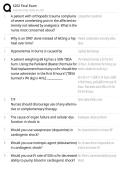
1. A patient with orthopedic trauma complains Compartment syndrome
of severe unrelenting pain in the affected ex-
tremity not relieved by analgesics. What is the
nurse most concerned about?
2. Why is an ORIF done instead of letting a hip Prevent complications and early ambu-
heal over time? lation
3. Hypovolemia in burns is caused by Capillary bed leakage
4. A patient weighing 68 kg has a 50% TBSA The Parkland Formula is for the first
burn. Using the Parkland (Baxter) formula for 24 hours. To determine the 8-hour, you
fluid replacement how many cc/hr should the need to divide the results by 2.
nurse administer in the first 8 hours? [TBSA
burned x Wt (kg) x 4mL] ___________ 68 x 50 x 4 = 13,600 in 24 hours, 6,800
in first 8 hours, and 6,800 in the next 16
hours. That works out to 850 cc/hr for
the first 8 hours.
5. T/F False (allow holistic care)
Nurses should discourage use of any alterna-
tive or complementary therapy.
6. The cause of organ failure and cellular dys- Inadequate cellular perfusion
function in shock is:
7. Would you use vasopressor (dopamine) in Yes. Vasoconstriction to increase BP
cardiogenic shock?
8. Would you use inotropic agent (dobutamine) Yes. Increase force of myocardial con-
in cardiogenic shock? traction to increase CO
9. Would you use IV rate of 500 cc/hr decreased No. There is a decreased ability to pump
ability to pump blood in cardiogenic shock? blood
, 6202 Final Exam
Study online at https://quizlet.com/_fii3ef
10. A pt arrives in the ED after an accident. What Airway
is the first thing you assess?
11. What is MODS? Multiple organ dysfunction syndrome
(failure of 2 or more organ systems)
12. Does anaphylactic shock cause symptoms No. Massive vasodilation, release of
due to increased peripheral resistance? mediators, increased capillary perme-
ability
13. Why is PEEP used in a patient with ARDS? To prevent alveolar collapse by keeping
lungs expanded during expiration
14. The most common cause of death in patients Infection
recovering from acute renal failure is?
15. What type of headache may be accompanied Migraine
by nausea, vomiting and irritability?
16. What symptoms would you expect to ob- Bradykinesia, rigidity, tremors
serve in a client with a suspected diagnosis
of Parkinson's Disease?
17. Which of the following nursing diagnoses are A. Alteration in comfort
included in the plan of care in the patient with C. Impaired bowel elimination
ALS? D. Potential for injury
A. Alteration in comfort E. Ineffective breathing pattern
B. Fluid volume, excess F. Ineffective coping strategies
C. Impaired bowel elimination
D. Potential for injury
E. Ineffective breathing pattern
F. Ineffective coping strategies
, 6202 Final Exam
Study online at https://quizlet.com/_fii3ef
18. What is a definition of symptom cluster in a >3 related symptoms that occur at the
cancer patient? same time
19. A lower motor neuron lesion will cause flac- Flaccidity
cidity or spasticity?
20. A patient with a complete cervical cord injury Autonomic dysreflexia
complains of a throbbing headache. What are
we concerned about?
21. What is a first step for bladder training in a Clamp the foley for 2 hours
paraplegic?
22. T/F True
A patient diagnosed with an epidural
hematoma is likely to need emergency
surgery.
23. IV Mannitol is an osmotic diuretic used to: Decrease ICP
24. At what point following a fracture does the C. The first 24-48 hours
nurse need to most carefully evaluate the pa-
tient for the development of a fat embolism?
A. The first 2-3 hours
B. The first 8 hours
C. The first 24-48 hours
D. For the first week following the injury
25. When caring for a patient with a fracture, the D. Severe, unrelenting pain in the af-
most common symptom and reliable clinical fected limb
indicator of compartment syndrome that the
nurse should be observing for is:
A. Paresthesia and skin pallor of affected
Study online at https://quizlet.com/_fii3ef
1. A patient with orthopedic trauma complains Compartment syndrome
of severe unrelenting pain in the affected ex-
tremity not relieved by analgesics. What is the
nurse most concerned about?
2. Why is an ORIF done instead of letting a hip Prevent complications and early ambu-
heal over time? lation
3. Hypovolemia in burns is caused by Capillary bed leakage
4. A patient weighing 68 kg has a 50% TBSA The Parkland Formula is for the first
burn. Using the Parkland (Baxter) formula for 24 hours. To determine the 8-hour, you
fluid replacement how many cc/hr should the need to divide the results by 2.
nurse administer in the first 8 hours? [TBSA
burned x Wt (kg) x 4mL] ___________ 68 x 50 x 4 = 13,600 in 24 hours, 6,800
in first 8 hours, and 6,800 in the next 16
hours. That works out to 850 cc/hr for
the first 8 hours.
5. T/F False (allow holistic care)
Nurses should discourage use of any alterna-
tive or complementary therapy.
6. The cause of organ failure and cellular dys- Inadequate cellular perfusion
function in shock is:
7. Would you use vasopressor (dopamine) in Yes. Vasoconstriction to increase BP
cardiogenic shock?
8. Would you use inotropic agent (dobutamine) Yes. Increase force of myocardial con-
in cardiogenic shock? traction to increase CO
9. Would you use IV rate of 500 cc/hr decreased No. There is a decreased ability to pump
ability to pump blood in cardiogenic shock? blood
, 6202 Final Exam
Study online at https://quizlet.com/_fii3ef
10. A pt arrives in the ED after an accident. What Airway
is the first thing you assess?
11. What is MODS? Multiple organ dysfunction syndrome
(failure of 2 or more organ systems)
12. Does anaphylactic shock cause symptoms No. Massive vasodilation, release of
due to increased peripheral resistance? mediators, increased capillary perme-
ability
13. Why is PEEP used in a patient with ARDS? To prevent alveolar collapse by keeping
lungs expanded during expiration
14. The most common cause of death in patients Infection
recovering from acute renal failure is?
15. What type of headache may be accompanied Migraine
by nausea, vomiting and irritability?
16. What symptoms would you expect to ob- Bradykinesia, rigidity, tremors
serve in a client with a suspected diagnosis
of Parkinson's Disease?
17. Which of the following nursing diagnoses are A. Alteration in comfort
included in the plan of care in the patient with C. Impaired bowel elimination
ALS? D. Potential for injury
A. Alteration in comfort E. Ineffective breathing pattern
B. Fluid volume, excess F. Ineffective coping strategies
C. Impaired bowel elimination
D. Potential for injury
E. Ineffective breathing pattern
F. Ineffective coping strategies
, 6202 Final Exam
Study online at https://quizlet.com/_fii3ef
18. What is a definition of symptom cluster in a >3 related symptoms that occur at the
cancer patient? same time
19. A lower motor neuron lesion will cause flac- Flaccidity
cidity or spasticity?
20. A patient with a complete cervical cord injury Autonomic dysreflexia
complains of a throbbing headache. What are
we concerned about?
21. What is a first step for bladder training in a Clamp the foley for 2 hours
paraplegic?
22. T/F True
A patient diagnosed with an epidural
hematoma is likely to need emergency
surgery.
23. IV Mannitol is an osmotic diuretic used to: Decrease ICP
24. At what point following a fracture does the C. The first 24-48 hours
nurse need to most carefully evaluate the pa-
tient for the development of a fat embolism?
A. The first 2-3 hours
B. The first 8 hours
C. The first 24-48 hours
D. For the first week following the injury
25. When caring for a patient with a fracture, the D. Severe, unrelenting pain in the af-
most common symptom and reliable clinical fected limb
indicator of compartment syndrome that the
nurse should be observing for is:
A. Paresthesia and skin pallor of affected

