

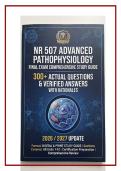
, NR 507 Advanced Pathophysiology Final Exam – 300+
Actual Questions & Verified Answers with Rationales
2026/2027 Update
Questions 1–50: Cellular Injury, Adaptation & Inflammation
1. A patient develops reversible cellular swelling after temporary
ischemia. Which mechanism is primarily responsible?
A. Increased protein synthesis
B. Failure of the sodium-potassium pump
C. Increased DNA replication
D. Lysosomal rupture
Answer: B
Rationale: ATP depletion impairs the Na⁺/K⁺-ATPase, causing
intracellular sodium and water accumulation.
2. Which cellular adaptation involves an increase in cell size?
A. Hyperplasia
B. Hypertrophy
C. Atrophy
D. Metaplasia
Answer: B
Rationale: Hypertrophy increases individual cell size, commonly in
skeletal and cardiac muscle.
3. Which process involves an increase in the number of cells?
A. Hyperplasia
B. Hypertrophy
C. Atrophy
D. Dysplasia
Answer: A
Rationale: Hyperplasia results from increased cellular proliferation.
,4. A chronic irritant causes bronchial columnar epithelium to be
replaced by stratified squamous epithelium. This is:
A. Dysplasia
B. Metaplasia
C. Hypertrophy
D. Necrosis
Answer: B
Rationale: Metaplasia is a reversible substitution of one differentiated
cell type for another.
5. Which form of cell death is characterized by cellular swelling,
membrane disruption, and inflammation?
A. Apoptosis
B. Necrosis
C. Autophagy
D. Senescence
Answer: B
Rationale: Necrosis causes membrane rupture and release of
intracellular contents, provoking inflammation.
6. Apoptosis is best described as:
A. Unregulated cell destruction
B. Programmed cell death
C. Ischemic tissue death only
D. Bacterial destruction of cells
Answer: B
Rationale: Apoptosis is regulated cell death involving caspase activation
and cellular fragmentation.
7. Which organelle is particularly important in initiating intrinsic
apoptosis?
A. Golgi apparatus
, B. Mitochondrion
C. Ribosome
D. Lysosome
Answer: B
Rationale: Mitochondrial cytochrome c release activates the intrinsic
apoptotic pathway.
8. Which inflammatory mediator causes vasodilation and increased
vascular permeability?
A. Histamine
B. Albumin
C. Hemoglobin
D. Insulin
Answer: A
Rationale: Histamine released by mast cells contributes to early
vasodilation and vascular permeability.
9. Which leukocyte is generally the predominant cell during acute
bacterial inflammation?
A. Neutrophil
B. Eosinophil
C. Lymphocyte
D. Plasma cell
Answer: A
Rationale: Neutrophils are the primary early responders in acute
inflammation.
10. Which leukocyte is especially associated with parasitic infections
and allergic responses?
A. Neutrophil
B. Eosinophil
C. Monocyte
Actual Questions & Verified Answers with Rationales
2026/2027 Update
Questions 1–50: Cellular Injury, Adaptation & Inflammation
1. A patient develops reversible cellular swelling after temporary
ischemia. Which mechanism is primarily responsible?
A. Increased protein synthesis
B. Failure of the sodium-potassium pump
C. Increased DNA replication
D. Lysosomal rupture
Answer: B
Rationale: ATP depletion impairs the Na⁺/K⁺-ATPase, causing
intracellular sodium and water accumulation.
2. Which cellular adaptation involves an increase in cell size?
A. Hyperplasia
B. Hypertrophy
C. Atrophy
D. Metaplasia
Answer: B
Rationale: Hypertrophy increases individual cell size, commonly in
skeletal and cardiac muscle.
3. Which process involves an increase in the number of cells?
A. Hyperplasia
B. Hypertrophy
C. Atrophy
D. Dysplasia
Answer: A
Rationale: Hyperplasia results from increased cellular proliferation.
,4. A chronic irritant causes bronchial columnar epithelium to be
replaced by stratified squamous epithelium. This is:
A. Dysplasia
B. Metaplasia
C. Hypertrophy
D. Necrosis
Answer: B
Rationale: Metaplasia is a reversible substitution of one differentiated
cell type for another.
5. Which form of cell death is characterized by cellular swelling,
membrane disruption, and inflammation?
A. Apoptosis
B. Necrosis
C. Autophagy
D. Senescence
Answer: B
Rationale: Necrosis causes membrane rupture and release of
intracellular contents, provoking inflammation.
6. Apoptosis is best described as:
A. Unregulated cell destruction
B. Programmed cell death
C. Ischemic tissue death only
D. Bacterial destruction of cells
Answer: B
Rationale: Apoptosis is regulated cell death involving caspase activation
and cellular fragmentation.
7. Which organelle is particularly important in initiating intrinsic
apoptosis?
A. Golgi apparatus
, B. Mitochondrion
C. Ribosome
D. Lysosome
Answer: B
Rationale: Mitochondrial cytochrome c release activates the intrinsic
apoptotic pathway.
8. Which inflammatory mediator causes vasodilation and increased
vascular permeability?
A. Histamine
B. Albumin
C. Hemoglobin
D. Insulin
Answer: A
Rationale: Histamine released by mast cells contributes to early
vasodilation and vascular permeability.
9. Which leukocyte is generally the predominant cell during acute
bacterial inflammation?
A. Neutrophil
B. Eosinophil
C. Lymphocyte
D. Plasma cell
Answer: A
Rationale: Neutrophils are the primary early responders in acute
inflammation.
10. Which leukocyte is especially associated with parasitic infections
and allergic responses?
A. Neutrophil
B. Eosinophil
C. Monocyte

