

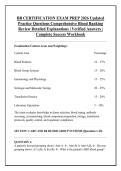
BB CERTIFICATION EXAM PREP 2026 Updated
Practice Questions Comprehensive Blood Banking
Review Detailed Explanations | Verified Answers |
Complete Success Workbook
Examination Content Areas and Weightings:
Content Area Percentage
Blood Products 10 – 15%
Blood Group Systems 15 – 20%
Immunology and Physiology 15 – 25%
Serologic and Molecular Testing 20 – 25%
Transfusion Practice 15 – 20%
Laboratory Operations 5 – 10%
The exam evaluates knowledge in donor selection, blood typing, antibody
screening, crossmatching, blood component preparation, storage, transfusion
protocols, quality control, and regulatory compliance.
SECTION 1: ABO AND Rh BLOOD GROUP SYSTEMS (Questions 1-20)
QUESTION 1:
A patient's forward grouping shows: Anti-A: 4+, Anti-B: 0, Anti-A,B: 4+. Reverse
grouping shows: A1 cells: 0, B cells: 4+. What is the patient's ABO blood group?
,A) Group A
B) Group B
C) Group O
D) Group AB
Answer: A) Group A
Rationale: Forward grouping (cell typing) detects antigens on the patient's red
blood cells. Anti-A: 4+ indicates A antigens are present. Anti-B: 0 indicates no B
antigens. Reverse grouping (serum typing) detects antibodies in the patient's
serum. A1 cells: 0 indicates no anti-A antibodies are present (expected in Group
A). B cells: 4+ indicates anti-B antibodies are present (expected in Group A).
Therefore, the patient is Group A. ABO discrepancies may occur in newborns,
elderly patients, or those with certain disease states.
QUESTION 2:
A patient types as A positive. Which of the following donor red blood cell units
can this patient safely receive?
A) A positive and O positive only
B) A positive, A negative, O positive, and O negative
C) A positive and AB positive only
D) A positive only
Answer: B) A positive, A negative, O positive, and O negative
Rationale: A positive patients have A antigens and D (Rh) antigens. They can
receive red blood cells from donors who are:
• A positive (compatible)
• A negative (compatible; Rh compatibility is important for Rh-negative
females, but A positive patients can receive Rh-negative blood)
• O positive (O is the universal donor for RBCs)
• O negative (universal donor)
,They cannot receive B or AB blood because they have anti-B antibodies that would
attack B antigens.
QUESTION 3:
A patient's forward grouping shows: Anti-A: 0, Anti-B: 0, Anti-A,B: 0. Reverse
grouping shows: A1 cells: 4+, B cells: 4+. What is the patient's ABO blood group?
A) Group A
B) Group B
C) Group O
D) Group AB
Answer: C) Group O
Rationale: Forward grouping shows no A or B antigens (Anti-A: 0, Anti-B: 0,
Anti-A,B: 0). Reverse grouping shows anti-A antibodies (A1 cells: 4+) and anti-B
antibodies (B cells: 4+). This is consistent with Group O, which has no A or B
antigens on the red cells and both anti-A and anti-B antibodies in the serum.
QUESTION 4:
The Rh blood group system is encoded by genes on which chromosome?
A) Chromosome 1
B) Chromosome 9
C) Chromosome 1p36
D) Chromosome 6
Answer: C) Chromosome 1p36
Rationale: The Rh blood group system is encoded by two closely linked genes,
RHD and RHCE, located on chromosome 1p36. The RHD gene encodes the D
antigen, while the RHCE gene encodes the C/c and E/e antigens. The Rh system is
one of the most complex and clinically significant blood group systems, second
only to ABO in transfusion medicine.
, QUESTION 5:
A patient is typed as O negative. Which of the following antibody specificities
would you EXPECT to find in this patient's serum?
A) Anti-A and anti-B only
B) Anti-A, anti-B, and anti-D
C) Anti-A only
D) No antibodies
Answer: A) Anti-A and anti-B only
Rationale: A Group O individual has neither A nor B antigens on their red cells
and will have anti-A and anti-B antibodies in their serum. However, an O negative
individual (lacking the D antigen) will NOT necessarily have anti-D unless they
have been immunized through transfusion or pregnancy. Anti-D is an immune
antibody, not a naturally occurring antibody like anti-A and anti-B.
QUESTION 6:
Which of the following Rh phenotypes is the MOST common in the Caucasian
population?
A) D-positive, C-positive, E-negative
B) D-positive, C-negative, E-positive
C) D-negative, C-positive, E-negative
D) D-negative, C-negative, E-negative
Answer: A) D-positive, C-positive, E-negative
Rationale: The most common Rh phenotype in the Caucasian population is D-
positive, C-positive, E-negative (approximately 70%). The most common Rh-
negative phenotype is dce/dce (also written as rr). Understanding Rh phenotype
frequencies is important for antigen-negative blood sourcing for patients with
multiple Rh antibodies.
Practice Questions Comprehensive Blood Banking
Review Detailed Explanations | Verified Answers |
Complete Success Workbook
Examination Content Areas and Weightings:
Content Area Percentage
Blood Products 10 – 15%
Blood Group Systems 15 – 20%
Immunology and Physiology 15 – 25%
Serologic and Molecular Testing 20 – 25%
Transfusion Practice 15 – 20%
Laboratory Operations 5 – 10%
The exam evaluates knowledge in donor selection, blood typing, antibody
screening, crossmatching, blood component preparation, storage, transfusion
protocols, quality control, and regulatory compliance.
SECTION 1: ABO AND Rh BLOOD GROUP SYSTEMS (Questions 1-20)
QUESTION 1:
A patient's forward grouping shows: Anti-A: 4+, Anti-B: 0, Anti-A,B: 4+. Reverse
grouping shows: A1 cells: 0, B cells: 4+. What is the patient's ABO blood group?
,A) Group A
B) Group B
C) Group O
D) Group AB
Answer: A) Group A
Rationale: Forward grouping (cell typing) detects antigens on the patient's red
blood cells. Anti-A: 4+ indicates A antigens are present. Anti-B: 0 indicates no B
antigens. Reverse grouping (serum typing) detects antibodies in the patient's
serum. A1 cells: 0 indicates no anti-A antibodies are present (expected in Group
A). B cells: 4+ indicates anti-B antibodies are present (expected in Group A).
Therefore, the patient is Group A. ABO discrepancies may occur in newborns,
elderly patients, or those with certain disease states.
QUESTION 2:
A patient types as A positive. Which of the following donor red blood cell units
can this patient safely receive?
A) A positive and O positive only
B) A positive, A negative, O positive, and O negative
C) A positive and AB positive only
D) A positive only
Answer: B) A positive, A negative, O positive, and O negative
Rationale: A positive patients have A antigens and D (Rh) antigens. They can
receive red blood cells from donors who are:
• A positive (compatible)
• A negative (compatible; Rh compatibility is important for Rh-negative
females, but A positive patients can receive Rh-negative blood)
• O positive (O is the universal donor for RBCs)
• O negative (universal donor)
,They cannot receive B or AB blood because they have anti-B antibodies that would
attack B antigens.
QUESTION 3:
A patient's forward grouping shows: Anti-A: 0, Anti-B: 0, Anti-A,B: 0. Reverse
grouping shows: A1 cells: 4+, B cells: 4+. What is the patient's ABO blood group?
A) Group A
B) Group B
C) Group O
D) Group AB
Answer: C) Group O
Rationale: Forward grouping shows no A or B antigens (Anti-A: 0, Anti-B: 0,
Anti-A,B: 0). Reverse grouping shows anti-A antibodies (A1 cells: 4+) and anti-B
antibodies (B cells: 4+). This is consistent with Group O, which has no A or B
antigens on the red cells and both anti-A and anti-B antibodies in the serum.
QUESTION 4:
The Rh blood group system is encoded by genes on which chromosome?
A) Chromosome 1
B) Chromosome 9
C) Chromosome 1p36
D) Chromosome 6
Answer: C) Chromosome 1p36
Rationale: The Rh blood group system is encoded by two closely linked genes,
RHD and RHCE, located on chromosome 1p36. The RHD gene encodes the D
antigen, while the RHCE gene encodes the C/c and E/e antigens. The Rh system is
one of the most complex and clinically significant blood group systems, second
only to ABO in transfusion medicine.
, QUESTION 5:
A patient is typed as O negative. Which of the following antibody specificities
would you EXPECT to find in this patient's serum?
A) Anti-A and anti-B only
B) Anti-A, anti-B, and anti-D
C) Anti-A only
D) No antibodies
Answer: A) Anti-A and anti-B only
Rationale: A Group O individual has neither A nor B antigens on their red cells
and will have anti-A and anti-B antibodies in their serum. However, an O negative
individual (lacking the D antigen) will NOT necessarily have anti-D unless they
have been immunized through transfusion or pregnancy. Anti-D is an immune
antibody, not a naturally occurring antibody like anti-A and anti-B.
QUESTION 6:
Which of the following Rh phenotypes is the MOST common in the Caucasian
population?
A) D-positive, C-positive, E-negative
B) D-positive, C-negative, E-positive
C) D-negative, C-positive, E-negative
D) D-negative, C-negative, E-negative
Answer: A) D-positive, C-positive, E-negative
Rationale: The most common Rh phenotype in the Caucasian population is D-
positive, C-positive, E-negative (approximately 70%). The most common Rh-
negative phenotype is dce/dce (also written as rr). Understanding Rh phenotype
frequencies is important for antigen-negative blood sourcing for patients with
multiple Rh antibodies.

