

Escrito por estudiantes que aprobaron Inmediatamente disponible después del pago Leer en línea o como PDF ¿Documento equivocado? Cámbialo gratis 4,6 TrustPilot
logo-home
Document preview thumbnail
Vista previa 4 fuera de 713 páginas
Examen

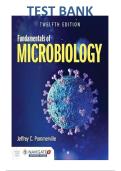
Test Bank for Fundamentals of Microbiology, 12th Edition by Jeffrey C. Pommerville – Complete Chapters 1–27 with 1,000+ Verified Questions, Answers & Detailed Rationales for Microbiology, Nursing & Allied Health Exams (2025–2027)

Document preview thumbnail
Vista previa 4 fuera de 713 páginas

Prepare with confidence for your microbiology, nursing, allied health, and pre-medical exams using this comprehensive test bank for "Fundamentals of Microbiology, 12th Edition" by Jeffrey C. Pommerville [0†L5-L7][0†L39-L43]. Published by Jones & Bartlett Learning (ISBN: 9781284211757) [0†L43][0†L49], this essential academic resource is specifically designed for undergraduate microbiology students, nursing students, allied health professionals, and pre-med students who need to master the core concepts of microbiology across the full spectrum of microbial life, disease mechanisms, and clinical applications. This test bank features over 1,000 exam-style questions covering all 27 chapters of the 12th edition [5†L7-L8][6†L8][8†L28-L29], with verified correct answers and detailed rationales that explain both correct and incorrect options [6†L8-L9][8†L30]. The content is updated for the 2025–2027 academic cycle [0†L42][8†L29] and includes multiple question formats such as multiple-choice, select-all-that-apply, and case-based questions that reflect the rigor of microbiology exams. The test bank is available across 714–809 pages on various platforms, with Grade A+ verified content [0†L31][8†L6-L7]. What's Included: 1,000+ practice questions covering all major microbiology topics Verified correct answers with detailed rationales and distractor analysis Chapter-by-chapter organization covering all 27 chapters of the 12th edition Multiple question formats including multiple-choice, select-all-that-apply (SATA), and case-based questions Comprehensive coverage of the complete microbiology curriculum Latest 2025–2026 updates with verified content Comprehensive coverage across all major microbiology topics [8†L12-L27][1†L18-L19]: Microbiology: Then and Now – Historical foundations of microbiology, spontaneous generation, germ theory, and contributions of early scientists The Chemical Building Blocks of Life – Chemistry of life as it applies to microorganisms Concepts and Tools for Studying Microorganisms – Microscopy, staining techniques, and laboratory methods [6†L40-L42] Structure and Organization of Prokaryotic Cells – Bacterial cell structure, cell walls (peptidoglycan, LPS), flagella, pili, capsules, plasmids, endospores [6†L40-L42] Microbial Growth and Nutrition – Bacterial growth requirements, environmental factors affecting growth, growth curves [6†L24-L26] Microbial Metabolism – Energy transfer, enzymes, metabolic pathways, fermentation, respiration Microbial Genetics – DNA structure and replication, transcription, translation, gene expression, mutations [6†L21-L24] Gene Transfer, Genetic Engineering, and Genomics – Recombinant DNA technology, PCR, genetic engineering tools [6†L51-L53] Control of Microorganisms – Physical methods (heat, radiation, filtration) and chemical agents Control of Microorganisms – Antimicrobial drugs, mechanisms of action, antibiotic resistance, and superbugs Bacterial Diseases by Transmission Route – Airborne, foodborne, waterborne, soilborne, arthropod-borne, sexually transmitted, and contact transmitted bacterial diseases Virology – Viruses and virus-like agents; viral structure, replication cycles, and viral infections of respiratory tract, skin, blood, lymphatic, gastrointestinal, and nervous systems Eukaryotic Microorganisms – The fungi and the parasites (protozoa and helminths) Host-Microbe Relationship and Epidemiology – Disease transmission, pathogenesis, and epidemiological principles Immunology – Innate immunity and adaptive immunity [6†L12-L14] Immunization and Serology – Vaccines and serological testing Immune Disorders and AIDS – Immunodeficiency, autoimmune disorders, hypersensitivity, and HIV/AIDS Applied and Industrial Microbiology – Biotechnology and industrial applications Environmental Microbiology – Microbial ecology and environmental roles Sample Questions Include (from verified test bank content) [5†L10-L36][7†L12-L40]: Who was one of the early natural philosophers who coined the name “cella” for the empty cork spaces that became the word we use today, “cells”? – Answer: A. Robert Hooke – Hooke first observed and named cells in cork tissue [5†L10-L12][7†L13-L15]. Leeuwenhoek was the first person to: – Answer: C. describe bacteria – Leeuwenhoek first observed and described bacteria using his handmade microscopes. Francesco Redi's famous experiment involving meat and gauze demonstrated: – Answer: B. He covered some jars of meat with gauze and left others open. The covered jars did not develop maggots, the uncovered ones did. – Redi's experiment provided early evidence against spontaneous generation [. Which pair of scientists were antagonists during the same period of history? – Answer: C. Spallanzani and Needham – Spallanzani and Needham were contemporaries who debated spontaneous generation [5†L36-L38][7†L38-L40]. Which group of bacteria has LPS? – Answer: Gram-negative bacteria – Lipopolysaccharide (LPS) is a component of the outer membrane of Gram-negative bacteria Key Features: Verified Answers with Detailed Rationales – Every question includes the correct answer and a comprehensive explanation, reinforcing key concepts and clarifying why incorrect options are wrong Updated for 2025–2027 – Reflects the latest microbiology exam content and curriculum standards Aligned with Jones & Bartlett Learning – Mapped directly to the 12th edition textbook (ISBN: 9781284211757) Chapter-by-Chapter Organization – Covering all 27 chapters for targeted review Multiple Question Formats – Includes multiple-choice, SATA, and case-based questions 1,000+ Practice Questions – Comprehensive coverage with verified answers A+ Graded Content – 100% verified solutions for exam success

Vista previa del contenido

TEST BANK

,Test Bank: Fundamentals of Microbiology 12th Edition, Jeffrey C. Pommerville

Chapter 1

Multiple Choice
1. Who was one of the early natural philosophers who coined the name “cella” for the
empty cork spaces that became the word we use today, “cells”?

A. Robert Hooke

B. Zacharias Janssen

C. Francesco Stalluti

D. Giovanni Faber
Ans: A
2. Leeuwenhoek made lenses that allowed him to magnify objects more than 200X.
However, he failed to promote scientific inquiry because:

A. he didn't share his drawings with other scientists.

B. he didn't reveal how he ground the lenses and no one else was doing it that well.

C. he limited his research to pond water

D. it was only a hobby and he didn't live very long


Ans: B

,3. Leeuwenhoek was the first person to:

A. see viruses.

B. use a microscope.

C. describe bacteria.

D. suggest animalcules caused disease.


Ans: C

4. Francesco Redi is famous for performing one of the first experiments over the debate
regarding spontaneous generation. What was his experiment?

A. He boiled some mutton gravy and sealed the tops with corks.

B. He covered some jars of meat with gauze and left others open. The covered jars did not
develop maggots, the uncovered ones did.

C. He showed that mice will appear with damp rags and rice.

D. He boiled broth for longer periods of time and sealed the tops with melted glass.


Ans: B


5. did not attempt to prove or refute the idea of spontaneous generation.

A. Francesco Redi

B. Robert Koch

C. Lazzaro Spallanzani

D. Louis Pasteur

Ans: B


6. Which one of the following would be consistent with the idea of spontaneous
generation?

, A. Microorganisms may be cultivated on solid laboratory media.

B. Insects are important in the transmission of disease.

C. Sick people give rise to microorganisms in their body.

D. Disinfection is essential to prevent the spread of
microorganisms. Ans: C

7. Spallanzani’s experiments showed that:

A. viruses were transmitted by water.

B. spontaneous generation occurs.

C. miasma was the cause of disease.

D. experiments can be modified to test a
hypothesis. Ans: D
Page: 8
8. Which pair of scientists were antagonists during the same period of history?

A. Pasteur and Ehrlich

B. Koch and Leeuwenhoek

C. Spallanzani and Needham
D. Pasteur and Snow


Ans: C


9. Semmelweis showed that the transmission of disease could be interrupted by:
A. killing disease-carrying mosquitoes.
B. disinfecting water supplies.

C. pasteurizing milk.
D. washing hands in chlorine water.

Libro relacionado
 image
Jeffrey C. Pommerville Fundamentals of Microbiology
Editorial: 2021 ISBN: 9781284211757 Edición: Desconocido

Información del documento

Subido en
14 de agosto de 2026
Número de páginas
713
Escrito en
2026/2027
Tipo
Examen
Contiene
Preguntas y respuestas
$19.39

¿Documento equivocado? Cámbialo gratis Dentro de los 14 días posteriores a la compra y antes de descargarlo, puedes elegir otro documento. Puedes gastar el importe de nuevo.
Escrito por estudiantes que aprobaron
Inmediatamente disponible después del pago
Leer en línea o como PDF

Vendido
2
Seguidores
0
Artículos
336
Última venta
6 días hace


Por qué los estudiantes eligen Stuvia

Creado por compañeros estudiantes, verificado por reseñas

Calidad en la que puedes confiar: escrito por estudiantes que aprobaron y evaluado por otros que han usado estos resúmenes.

¿No estás satisfecho? Elige otro documento

¡No te preocupes! Puedes elegir directamente otro documento que se ajuste mejor a lo que buscas.

Paga como quieras, empieza a estudiar al instante

Sin suscripción, sin compromisos. Paga como estés acostumbrado con tarjeta de crédito y descarga tu documento PDF inmediatamente.

Student with book image

“Comprado, descargado y aprobado. Así de fácil puede ser.”

Alisha Student

Preguntas frecuentes
