

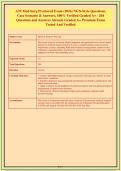
ATI Med-Surg Proctored Exam (2026) NGN-Style Questions,
Case Scenario & Answers, 100% Verified Graded A+ - 204
Questions and Answers Already Graded A+ Premium Exam
Tested And Verified
Subject Area Medical-Surgical Nursing
Description This exam assesses advanced clinical judgment and application of evidence-based
practice in medical-surgical nursing. It covers complex patient scenarios across
major body systems, including fluid and electrolyte management, cardiovascular,
respiratory, gastrointestinal, neurological, endocrine, and perioperative care, with
emphasis on NGN-style unfolding cases.
Expected Grade A+
Total Questions 204
Duration 3 hours
Learning Outcomes 1. Analyze pathophysiological changes to prioritize nursing interventions in acute
and chronic conditions.
2. Interpret diagnostic data and patient presentations to identify complications and
adjust treatment plans.
3. Apply evidence-based guidelines for pharmacological and non-pharmacological
management of multisystem disorders.
4. Demonstrate clinical reasoning in high-acuity situations requiring rapid
decision-making.
Accreditation This exam is designed to meet the rigor of top-tier US university medical-surgical
nursing courses accredited by the Commission on Collegiate Nursing Education
(CCNE) and aligned with the NCLEX-RN 2026 Test Plan.
Page 1
,ati. ATI Med-Surg Proctored Exam (2026) NGN-Style Questions, Case Scenario &
Answers, 100% Verified Graded A+ - 204 Questions and Answers Already Graded
Question: 1 of 204
A patient receiving loop diuretics develops an ECG with peaked T waves, widened
QRS, and loss of P wave. Which electrolyte intervention should the nurse prepare for?
Administer intravenous calcium gluconate
Administer oral potassium chloride if urine output >30 mL/hr
Administer intravenous sodium polystyrene sulfonate
Administer intravenous magnesium sulfate
PREVIOUS
Question: 2 of 204
A patient with chronic heart failure (LVEF 25%) on optimized therapy develops
worsening dyspnea, weight gain of 2 kg in 2 days, and JVD. Which modification should
the nurse anticipate?
Increase oral furosemide to 80 mg twice daily
Discontinue metoprolol succinate until euvolemic
Initiate nitroprusside infusion at 0.5 mcg/kg/min
Administer intravenous dobutamine at 5 mcg/kg/min
PREVIOUS
Page 2
,ati. ATI Med-Surg Proctored Exam (2026) NGN-Style Questions, Case Scenario &
Answers, 100% Verified Graded A+ - 204 Questions and Answers Already Graded
Question: 3 of 204
A patient with COPD (FEV1 35% predicted) presents with altered mental status, ABG:
pH 7.15, PaCO2 85 mm Hg, PaO2 55 mm Hg, HCO3- 28 mEq/L. Which initial
intervention is critical?
Administer noninvasive positive-pressure ventilation (NIPPV)
Provide high-flow oxygen via non-rebreather mask
Intubate immediately and start mechanical ventilation
Administer intravenous sodium bicarbonate
PREVIOUS
Question: 4 of 204
A patient with liver cirrhosis and ascites develops temperature 38.9°C, abdominal
tenderness, and confusion. Paracentesis reveals polymorphonuclear leukocyte count
of 350 cells/µL. Which complication does the nurse suspect?
Spontaneous bacterial peritonitis
Hepatic encephalopathy
Hepatorenal syndrome
Variceal hemorrhage
PREVIOUS
Page 3
, ati. ATI Med-Surg Proctored Exam (2026) NGN-Style Questions, Case Scenario &
Answers, 100% Verified Graded A+ - 204 Questions and Answers Already Graded
Question: 5 of 204
A post-surgical patient with a history of heart failure develops an increase in serum
creatinine from 0.9 to 2.1 mg/dL over 24 hours, urine output 20 mL/hr, and urine
sodium 15 mEq/L. The nurse administers a 500 mL fluid bolus; output remains
unchanged. Which type of acute kidney injury is most likely?
Prerenal (volume-responsive)
Intrinsic (acute tubular necrosis)
Postrenal (obstructive)
Chronic kidney disease exacerbation
PREVIOUS
Question: 6 of 204
A patient with acute ischemic stroke onset 3 hours ago receives alteplase. One hour
later, the patient develops severe headache, hypertension (180/110), and nausea.
Which action should the nurse take immediately?
Administer intravenous labetalol as ordered
Stop the alteplase infusion
Draw blood for coagulation studies
Remove all antiembolism stockings
PREVIOUS
Page 4
Case Scenario & Answers, 100% Verified Graded A+ - 204
Questions and Answers Already Graded A+ Premium Exam
Tested And Verified
Subject Area Medical-Surgical Nursing
Description This exam assesses advanced clinical judgment and application of evidence-based
practice in medical-surgical nursing. It covers complex patient scenarios across
major body systems, including fluid and electrolyte management, cardiovascular,
respiratory, gastrointestinal, neurological, endocrine, and perioperative care, with
emphasis on NGN-style unfolding cases.
Expected Grade A+
Total Questions 204
Duration 3 hours
Learning Outcomes 1. Analyze pathophysiological changes to prioritize nursing interventions in acute
and chronic conditions.
2. Interpret diagnostic data and patient presentations to identify complications and
adjust treatment plans.
3. Apply evidence-based guidelines for pharmacological and non-pharmacological
management of multisystem disorders.
4. Demonstrate clinical reasoning in high-acuity situations requiring rapid
decision-making.
Accreditation This exam is designed to meet the rigor of top-tier US university medical-surgical
nursing courses accredited by the Commission on Collegiate Nursing Education
(CCNE) and aligned with the NCLEX-RN 2026 Test Plan.
Page 1
,ati. ATI Med-Surg Proctored Exam (2026) NGN-Style Questions, Case Scenario &
Answers, 100% Verified Graded A+ - 204 Questions and Answers Already Graded
Question: 1 of 204
A patient receiving loop diuretics develops an ECG with peaked T waves, widened
QRS, and loss of P wave. Which electrolyte intervention should the nurse prepare for?
Administer intravenous calcium gluconate
Administer oral potassium chloride if urine output >30 mL/hr
Administer intravenous sodium polystyrene sulfonate
Administer intravenous magnesium sulfate
PREVIOUS
Question: 2 of 204
A patient with chronic heart failure (LVEF 25%) on optimized therapy develops
worsening dyspnea, weight gain of 2 kg in 2 days, and JVD. Which modification should
the nurse anticipate?
Increase oral furosemide to 80 mg twice daily
Discontinue metoprolol succinate until euvolemic
Initiate nitroprusside infusion at 0.5 mcg/kg/min
Administer intravenous dobutamine at 5 mcg/kg/min
PREVIOUS
Page 2
,ati. ATI Med-Surg Proctored Exam (2026) NGN-Style Questions, Case Scenario &
Answers, 100% Verified Graded A+ - 204 Questions and Answers Already Graded
Question: 3 of 204
A patient with COPD (FEV1 35% predicted) presents with altered mental status, ABG:
pH 7.15, PaCO2 85 mm Hg, PaO2 55 mm Hg, HCO3- 28 mEq/L. Which initial
intervention is critical?
Administer noninvasive positive-pressure ventilation (NIPPV)
Provide high-flow oxygen via non-rebreather mask
Intubate immediately and start mechanical ventilation
Administer intravenous sodium bicarbonate
PREVIOUS
Question: 4 of 204
A patient with liver cirrhosis and ascites develops temperature 38.9°C, abdominal
tenderness, and confusion. Paracentesis reveals polymorphonuclear leukocyte count
of 350 cells/µL. Which complication does the nurse suspect?
Spontaneous bacterial peritonitis
Hepatic encephalopathy
Hepatorenal syndrome
Variceal hemorrhage
PREVIOUS
Page 3
, ati. ATI Med-Surg Proctored Exam (2026) NGN-Style Questions, Case Scenario &
Answers, 100% Verified Graded A+ - 204 Questions and Answers Already Graded
Question: 5 of 204
A post-surgical patient with a history of heart failure develops an increase in serum
creatinine from 0.9 to 2.1 mg/dL over 24 hours, urine output 20 mL/hr, and urine
sodium 15 mEq/L. The nurse administers a 500 mL fluid bolus; output remains
unchanged. Which type of acute kidney injury is most likely?
Prerenal (volume-responsive)
Intrinsic (acute tubular necrosis)
Postrenal (obstructive)
Chronic kidney disease exacerbation
PREVIOUS
Question: 6 of 204
A patient with acute ischemic stroke onset 3 hours ago receives alteplase. One hour
later, the patient develops severe headache, hypertension (180/110), and nausea.
Which action should the nurse take immediately?
Administer intravenous labetalol as ordered
Stop the alteplase infusion
Draw blood for coagulation studies
Remove all antiembolism stockings
PREVIOUS
Page 4

