

Page |1
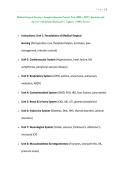
Medical-Surgical Nursing – Complete Question Practice Test (2026 | 2027) Questions and
Answers with detailed Rationales | Updates | 100% Correct
• Instructions: Unit 1: Foundations of Medical-Surgical
Nursing (Perioperative care, fluid/electrolytes, acid-base, pain
management, infection control)
• Unit 2: Cardiovascular System (Hypertension, heart failure, MI,
arrhythmias, peripheral vascular disease)
• Unit 3: Respiratory System (COPD, asthma, pneumonia, pulmonary
embolism, ARDS)
• Unit 4: Gastrointestinal System (GERD, PUD, IBD, liver disease, pancreatitis)
• Unit 5: Renal & Urinary System (CKD, AKI, UTI, glomerulonephritis)
• Unit 6: Endocrine System (Diabetes, DKA, HHS, thyroid disorders, adrenal
disorders)
• Unit 7: Neurological System (Stroke, seizures, Parkinson’s, Alzheimer’s,
increased ICP)
• Unit 8: Musculoskeletal & Integumentary (Fractures, osteoarthritis, RA,
pressure ulcers)
, Page |2
• Unit 9: Hematologic & Immunologic (Anemia, bleeding disorders, leukemia,
HIV)
• Unit 10: Emergency & Critical Care (Shock, sepsis, trauma, burns)
UNIT 1: Foundations of Medical-Surgical Nursing (Perioperative, Fluids,
Electrolytes, Acid-Base, Pain)
1. A patient is admitted with severe vomiting and diarrhea for 3 days. The nurse
suspects which type of fluid volume deficit?
A) Hypervolemia
B) Hypovolemia (isotonic dehydration)
C) Hypernatremia
D) Hyperkalemia
Answer: B
Rationale: Vomiting and diarrhea cause the loss of water and electrolytes in equal
proportions, leading to isotonic dehydration (hypovolemia). The body loses both
sodium and water, so the serum sodium remains normal, but total blood volume
drops.
, Page |3
2. The nurse is caring for a patient who has a nasogastric (NG) tube to low
intermittent suction. The patient is at highest risk for which electrolyte
imbalance?
A) Hyperkalemia
B) Hypokalemia (due to loss of gastric acids and potassium)
C) Hypercalcemia
D) Hyponatremia
Answer: B
Rationale: NG tube suction removes gastric juices, which are rich in hydrochloric
acid (HCl) and potassium. Prolonged suction leads to metabolic alkalosis (loss of
acid) and hypokalemia (loss of potassium).
3. A patient's arterial blood gas (ABG) results show: pH 7.30, PaCO₂ 50 mmHg,
HCO₃⁻ 24 mEq/L. What is the acid-base disturbance?
A) Metabolic acidosis
B) Respiratory acidosis (pH low, PaCO₂ high, HCO₃⁻ normal)
C) Metabolic alkalosis
D) Respiratory alkalosis
, Page |4
Answer: B
Rationale: The pH is low (acidemia). The PaCO₂ is high (> 45 mmHg), indicating a
respiratory cause. The HCO₃⁻ is normal (22-26 mEq/L). This is respiratory acidosis,
likely due to hypoventilation.
4. The nurse is preparing a patient for surgery. Which of the following is the
primary purpose of the preoperative "time-out" protocol?
A) To verify the patient's identity, the correct surgical site, and the correct
procedure before the incision.
B) To administer preoperative medications.
C) To check the patient's vital signs.
D) To review the patient's insurance.
Answer: A
Rationale: The "time-out" is a mandatory safety protocol conducted immediately
before the incision. It involves the entire surgical team verifying the patient's
identity, the correct procedure, and the correct surgical site.
5. A patient is in the post-anesthesia care unit (PACU) after surgery. The patient
has a heart rate of 110 bpm, blood pressure of 90/50 mmHg, and is restless. The
nurse should suspect:
Medical-Surgical Nursing – Complete Question Practice Test (2026 | 2027) Questions and
Answers with detailed Rationales | Updates | 100% Correct
• Instructions: Unit 1: Foundations of Medical-Surgical
Nursing (Perioperative care, fluid/electrolytes, acid-base, pain
management, infection control)
• Unit 2: Cardiovascular System (Hypertension, heart failure, MI,
arrhythmias, peripheral vascular disease)
• Unit 3: Respiratory System (COPD, asthma, pneumonia, pulmonary
embolism, ARDS)
• Unit 4: Gastrointestinal System (GERD, PUD, IBD, liver disease, pancreatitis)
• Unit 5: Renal & Urinary System (CKD, AKI, UTI, glomerulonephritis)
• Unit 6: Endocrine System (Diabetes, DKA, HHS, thyroid disorders, adrenal
disorders)
• Unit 7: Neurological System (Stroke, seizures, Parkinson’s, Alzheimer’s,
increased ICP)
• Unit 8: Musculoskeletal & Integumentary (Fractures, osteoarthritis, RA,
pressure ulcers)
, Page |2
• Unit 9: Hematologic & Immunologic (Anemia, bleeding disorders, leukemia,
HIV)
• Unit 10: Emergency & Critical Care (Shock, sepsis, trauma, burns)
UNIT 1: Foundations of Medical-Surgical Nursing (Perioperative, Fluids,
Electrolytes, Acid-Base, Pain)
1. A patient is admitted with severe vomiting and diarrhea for 3 days. The nurse
suspects which type of fluid volume deficit?
A) Hypervolemia
B) Hypovolemia (isotonic dehydration)
C) Hypernatremia
D) Hyperkalemia
Answer: B
Rationale: Vomiting and diarrhea cause the loss of water and electrolytes in equal
proportions, leading to isotonic dehydration (hypovolemia). The body loses both
sodium and water, so the serum sodium remains normal, but total blood volume
drops.
, Page |3
2. The nurse is caring for a patient who has a nasogastric (NG) tube to low
intermittent suction. The patient is at highest risk for which electrolyte
imbalance?
A) Hyperkalemia
B) Hypokalemia (due to loss of gastric acids and potassium)
C) Hypercalcemia
D) Hyponatremia
Answer: B
Rationale: NG tube suction removes gastric juices, which are rich in hydrochloric
acid (HCl) and potassium. Prolonged suction leads to metabolic alkalosis (loss of
acid) and hypokalemia (loss of potassium).
3. A patient's arterial blood gas (ABG) results show: pH 7.30, PaCO₂ 50 mmHg,
HCO₃⁻ 24 mEq/L. What is the acid-base disturbance?
A) Metabolic acidosis
B) Respiratory acidosis (pH low, PaCO₂ high, HCO₃⁻ normal)
C) Metabolic alkalosis
D) Respiratory alkalosis
, Page |4
Answer: B
Rationale: The pH is low (acidemia). The PaCO₂ is high (> 45 mmHg), indicating a
respiratory cause. The HCO₃⁻ is normal (22-26 mEq/L). This is respiratory acidosis,
likely due to hypoventilation.
4. The nurse is preparing a patient for surgery. Which of the following is the
primary purpose of the preoperative "time-out" protocol?
A) To verify the patient's identity, the correct surgical site, and the correct
procedure before the incision.
B) To administer preoperative medications.
C) To check the patient's vital signs.
D) To review the patient's insurance.
Answer: A
Rationale: The "time-out" is a mandatory safety protocol conducted immediately
before the incision. It involves the entire surgical team verifying the patient's
identity, the correct procedure, and the correct surgical site.
5. A patient is in the post-anesthesia care unit (PACU) after surgery. The patient
has a heart rate of 110 bpm, blood pressure of 90/50 mmHg, and is restless. The
nurse should suspect:

