

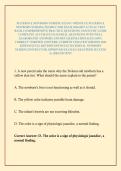
MATERNAL NEWBORN NURSING EXAM / OPENSTAX MATERNAL
NEWBORN NURSING INSTRUCTOR EXAM 2026/2027 ACTUAL TEST
BANK COMPREHENSIVE PRACTICE QUESTIONS AND STUDY GUIDE
COMPLETE ACCURATE EXAM REAL QUESTIONS WITH WELL
ELABORATED ANSWERS AND DETAILED RATIONALES (100%
CORRECT VERIFIED ANSWERS) CURRENT UPDATED VERSION 2026
EDITION |FULL REVISED OPENSTAX MATERNAL NEWBORN
NURSING INSTRUCTOR APPROVED EXAM |GUARANTEED SUCCESS
A+ |BRAND NEW!
1. A new parent asks the nurse why the 36-hour-old newborn has a
yellow skin tint. What should the nurse explain to the parent?
A. The newborn's liver is not functioning as well as it should.
B. The yellow color indicates possible brain damage.
C. The infant's bowels are not excreting bilirubin.
D. The color is a sign of physiologic jaundice, a normal finding.
Correct Answer: D. The color is a sign of physiologic jaundice, a
normal finding.
,Rationale: Physiologic jaundice is a common and normal finding in
newborns, typically appearing after 24 hours of life due to the
immature liver's inability to conjugate and excrete bilirubin
efficiently. It usually resolves without intervention as the liver
matures.
2. At birth, a newborn weighed 6 pounds, 12 ounces. Three days
later, the newborn weighs 5 pounds, 10 ounces. What conclusion
should the nurse draw regarding this newborn's weight?
A. This weight loss is within normal limits.
B. This weight gain is within normal limits.
C. This weight loss is excessive.
D. This weight gain is excessive.
Correct Answer: A. This weight loss is within normal limits.
Rationale: Newborns typically lose 5% to 10% of their birth weight
in the first 3 to 4 days of life. A loss of 10% or less is considered
within normal limits. This infant lost approximately 8.3% of birth
weight (from 108 oz to 90 oz), which is acceptable.
,3. The nurse is completing an initial assessment of the newborn. The
newborn's ears appear to be parallel to the outer and inner canthus of
the eye. How does the nurse document the ear placement?
A. low set
B. high set
C. a normal position
D. facial paralysis
Correct Answer: C. a normal position
Rationale: In a normal newborn, the top of the ear (pinna) should be
parallel to the outer and inner canthus of the eye. Low-set ears may
indicate chromosomal abnormalities or other congenital anomalies.
4. A new parent is concerned about a mass on the newborn's head.
The nurse assesses this to be a cephalohematoma based on what
characteristics?
A. The mass just appeared.
, B. The mass is on one side of the head and does not cross suture
lines.
C. The head is boggy and crosses suture lines.
D. The mass increases when the infant cries.
Correct Answer: B. The mass is on one side of the head and does
not cross suture lines.
Rationale: A cephalohematoma is a subperiosteal collection of blood
that does not cross suture lines and is typically unilateral. It is caused
by rupture of blood vessels during birth and usually resolves over
several weeks.
5. What condition can result from a long, difficult labor and is
characterized by a localized, soft area on the newborn's head?
A. caput succedaneum
B. molding
C. depressed fontanelles
D. cephalohematoma
NEWBORN NURSING INSTRUCTOR EXAM 2026/2027 ACTUAL TEST
BANK COMPREHENSIVE PRACTICE QUESTIONS AND STUDY GUIDE
COMPLETE ACCURATE EXAM REAL QUESTIONS WITH WELL
ELABORATED ANSWERS AND DETAILED RATIONALES (100%
CORRECT VERIFIED ANSWERS) CURRENT UPDATED VERSION 2026
EDITION |FULL REVISED OPENSTAX MATERNAL NEWBORN
NURSING INSTRUCTOR APPROVED EXAM |GUARANTEED SUCCESS
A+ |BRAND NEW!
1. A new parent asks the nurse why the 36-hour-old newborn has a
yellow skin tint. What should the nurse explain to the parent?
A. The newborn's liver is not functioning as well as it should.
B. The yellow color indicates possible brain damage.
C. The infant's bowels are not excreting bilirubin.
D. The color is a sign of physiologic jaundice, a normal finding.
Correct Answer: D. The color is a sign of physiologic jaundice, a
normal finding.
,Rationale: Physiologic jaundice is a common and normal finding in
newborns, typically appearing after 24 hours of life due to the
immature liver's inability to conjugate and excrete bilirubin
efficiently. It usually resolves without intervention as the liver
matures.
2. At birth, a newborn weighed 6 pounds, 12 ounces. Three days
later, the newborn weighs 5 pounds, 10 ounces. What conclusion
should the nurse draw regarding this newborn's weight?
A. This weight loss is within normal limits.
B. This weight gain is within normal limits.
C. This weight loss is excessive.
D. This weight gain is excessive.
Correct Answer: A. This weight loss is within normal limits.
Rationale: Newborns typically lose 5% to 10% of their birth weight
in the first 3 to 4 days of life. A loss of 10% or less is considered
within normal limits. This infant lost approximately 8.3% of birth
weight (from 108 oz to 90 oz), which is acceptable.
,3. The nurse is completing an initial assessment of the newborn. The
newborn's ears appear to be parallel to the outer and inner canthus of
the eye. How does the nurse document the ear placement?
A. low set
B. high set
C. a normal position
D. facial paralysis
Correct Answer: C. a normal position
Rationale: In a normal newborn, the top of the ear (pinna) should be
parallel to the outer and inner canthus of the eye. Low-set ears may
indicate chromosomal abnormalities or other congenital anomalies.
4. A new parent is concerned about a mass on the newborn's head.
The nurse assesses this to be a cephalohematoma based on what
characteristics?
A. The mass just appeared.
, B. The mass is on one side of the head and does not cross suture
lines.
C. The head is boggy and crosses suture lines.
D. The mass increases when the infant cries.
Correct Answer: B. The mass is on one side of the head and does
not cross suture lines.
Rationale: A cephalohematoma is a subperiosteal collection of blood
that does not cross suture lines and is typically unilateral. It is caused
by rupture of blood vessels during birth and usually resolves over
several weeks.
5. What condition can result from a long, difficult labor and is
characterized by a localized, soft area on the newborn's head?
A. caput succedaneum
B. molding
C. depressed fontanelles
D. cephalohematoma

