

Escrito por estudiantes que aprobaron Inmediatamente disponible después del pago Leer en línea o como PDF ¿Documento equivocado? Cámbialo gratis 4,6 TrustPilot
logo-home
Document preview thumbnail
Vista previa 4 fuera de 42 páginas
Examen

CPA Tax Module 2026/2027 | 100+ Questions & Answers | CCPC, Corporate Tax, GST/HST, LCGE, CCA & TOSI

Document preview thumbnail
Vista previa 4 fuera de 42 páginas

This CPA Tax Module 2026/2027 exam study guide contains 100+ questions, correct answers, calculations, formulas and applied tax rules across 42 pages, providing focused preparation in Canadian personal and corporate taxation. The material places particular emphasis on corporate tax calculations, beginning with the General Rate Reduction (GRR), Part I Additional Refundable Tax (ART), Part IV tax, passive investment income and the Small Business Deduction (SBD) before progressing into tax compliance, employment taxation, residency, capital transactions, GST/HST and advanced private-corporation concepts. The corporate taxation material provides detailed coverage of Canadian-Controlled Private Corporations (CCPCs), Active Business Income, Aggregate Investment Income (AII), the SBD, GRR, ART, refundable Part I tax, Part IV tax, GRIP, ERDTOH and NERDTOH. Students practice determining corporate tax consequences for active and passive income and review dividend refunds involving eligible and non-eligible dividends. The guide also addresses the tax advantages of incorporation, including potential tax reduction, tax deferral and income splitting, while emphasizing the restrictions imposed by Tax on Split Income (TOSI) rules. Tax compliance is covered through corporate and individual filing deadlines, balance-due dates, instalment requirements, arrears interest, late or deficient instalments and failure-to-file penalties. The questions distinguish monthly corporate instalments from quarterly instalments available to qualifying small CCPCs and examine alternative methods for calculating instalment payments. Schedule 1 adjustments are also reviewed, including financing expenses, reserves, warranties, unpaid remuneration, unreasonable salaries paid to family members and life-insurance expenses. The personal and employment taxation section examines the seven principal factors used to distinguish an employee from an independent contractor, net employment income, taxable and non-taxable benefits, gifts and awards, health-care plans, life insurance, allowances, automobile benefits and employee loans. Candidates also review deductible home-office expenses for regular employees, commissioned employees and sole proprietors. Dividend taxation is addressed through the gross-up and federal dividend tax-credit mechanisms for eligible and non-eligible dividends. A significant portion of the document addresses Canadian residency and capital-property taxation. Topics include full-year, part-year, non-resident and deemed-resident taxpayers; primary and secondary residential ties; corporate residency; deemed dispositions on departure from Canada; and property excluded from departure-tax treatment. The guide also covers the principal residence exemption, property-flipping rules, personal-use property and listed personal-use property, providing students with formulas and decision criteria for distinguishing capital gains from business income. The business-sale and owner-manager material compares asset sales with share sales, including after-tax cash calculations, deemed dividends, CDA balances, NERDTOH refunds, GRIP, eligible versus non-eligible dividends and the Lifetime Capital Gains Exemption (LCGE). The document explains why purchasers commonly prefer asset transactions while vendors may prefer share transactions and examines issues such as redundant assets, undisclosed liabilities, asset cost-base increases, goodwill, loss carryovers and transaction complexity. Candidates also receive focused preparation on Qualified Small Business Corporation (QSBC) shares and LCGE eligibility, including the 90% small-business-corporation test, the 24-month holding-period requirement and the active-asset test. The guide discusses purification strategies for removing non-eligible assets, including using excess cash to repay liabilities or acquire active business assets, as well as strategies such as dividends and owner-manager compensation that can create additional tax consequences. The guide further addresses income attribution and non-arm's-length transactions, including ITA section 69 treatment, transfers between spouses, the ITA section 73 spousal rollover, transfers involving related minors and circumstances that can create double taxation. TOSI exceptions involving excluded businesses, excluded shares and reasonable returns are included, making the document particularly useful for private-company and family-business tax planning questions. Advanced corporate material includes Acquisition of Control (AOC) rules and their implications for deemed taxation year-ends, short taxation years, accrued losses, expiring losses and restrictions on non-capital loss utilization. The CCA section covers luxury passenger vehicles, Class 10.1, manufacturing equipment under Class 53 and patents under Class 44, while replacement-property rules distinguish voluntary dispositions from involuntary losses, theft, expropriation or destruction. Finally, the GST/HST material covers registration requirements, small-supplier considerations, taxable supplies, place-of-supply rules, input tax credits, filing frequencies, reporting deadlines, late-filing consequences, bad debts and volume rebates. Together, these areas make the document a concentrated CPA taxation revision resource for students who need both computational practice and conceptual understanding of Canadian tax rules. Relevant students: This document is most relevant for CPA PEP Taxation candidates, Canadian CPA students, accounting graduates, public accounting trainees, junior tax accountants, corporate tax students, owner-manager taxation students and learners preparing for Canadian taxation examinations. It is especially valuable for students reviewing CCPC taxation, corporate tax calculations, GST/HST, LCGE and QSBC rules, CCA, employment taxation, residency, TOSI, attribution rules, business sales, dividend taxation and acquisition-of-control concepts. Keywords: CPA Tax Module 2026, CPA Tax Module 2027, CPA Tax Module questions and answers, CPA Tax exam, CPA taxation exam, CPA PEP Taxation, CPA Canada Tax, Canadian tax study guide, corporate tax Canada, personal income tax Canada, CCPC taxation, Canadian Controlled Private Corporation, small business deduction, SBD, General Rate Reduction, GRR, Additional Refundable Tax, ART, aggregate investment income, AII, Part I tax, Part IV tax, refundable Part I tax, NERDTOH, ERDTOH, RDTOH, GRIP, eligible dividends, non eligible dividends, dividend tax credit, corporate instalments, Schedule 1 adjustments, employment income, taxable benefits, automobile benefit, employee loans, Canadian tax residency, principal residence exemption, property flipping rules, asset sale vs share sale, Lifetime Capital Gains Exemption, LCGE, QSBC shares, QSBC test, capital gains, income attribution rules, ITA Section 69, ITA Section 73, spousal rollover, TOSI, Tax on Split Income, acquisition of control, AOC, CCA, Class 10.1, replacement property rules, GST HST, GST registration, input tax credits, CPA tax exam preparation

Vista previa del contenido

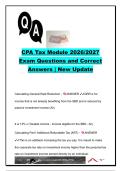
CPA Tax Module 2026/2027
Exam Questions and Correct
Answers | New Update


Calculating General Rate Reduction - ANSWER ✔✔GRR is for

income that is not already benefiting from the SBD and is reduced by

passive investment income (Aii)


It is 13% x (Taxable income - Income eligible for the SBD - Aii)


Calculating Part I Additional Refundable Tax (ART) - ANSWER

✔✔This is an addback increasing the tax you pay. It is meant to make

the corporate tax rate on investment income higher than the personal tax

rate on investment income earned directly by an individual.

,It is calculated by:

10 2/3% x lesser of:

a) Aii included in taxable income

b) Taxable income less the amount eligible for the SBD


Calculating Part IV Tax - ANSWER ✔✔Tax on dividends calculated as

follows:


Sum of:

a) 38 1/3% of dividends received from non-connected taxable Canadian

corporations

b) Investors share of the dividend refund received by connected

corporation paying the dividend (


Specific Schedule 1 adjustment - Financing Expenses - ANSWER

✔✔Costs incurred for the purposes of issuing shares or borrowing

money are deductible on a straight-line basis over five years.

,If included in accounting net income, addback and deduct 1/5 of the

cost.


Specific Schedule 1 adjustment - Reserves - ANSWER ✔✔Reserves

are not permitted to be deducted (special circumstances with Bad debt)


Warranties are an example of reserves. Only the cash paid in the year is

deductible.


Bad debts that are anticipated may be deductible but they must be

added back in the following year.


Leases are another reserve treated the same way as warranties


FILING Deadlines (corp/individual/terminal) - ANSWER

✔✔Corporation:


6 months after YE


Individual::

June 15th if taxpayer OR Spouse carried on a business


COPYRIGHT©NINJANERD 2025/2026. YEAR PUBLISHED 2026. COMPANY REGISTRATION NUMBER: 619652435. TERMS OF USE. PRIVACY
STATEMENT. ALL RIGHTS RESERVED
3

, April 30th of following year if did not


Deceased:

Later of:

a) regular deadline

b) 6 months from the date of death

EX. If carried on a business but died March 8, 2024, their terminal return

would be April 30, 2025 for 2024 and then would need to do a regular

return for 2023 I think...


Tax Balance due dates for indiv/corp - ANSWER ✔✔Corp:


a) 2 mths after YE

b) 3 mths for CCPCs that claimed the SBD in CY or preceding year and

taxable income of PY did not exceed 500k


Indiv:

April 30 - regardless of if taxpayer carried on a business

Información del documento

Subido en
12 de agosto de 2026
Número de páginas
42
Escrito en
2026/2027
Tipo
Examen
Contiene
Preguntas y respuestas
$18.99

¿Documento equivocado? Cámbialo gratis Dentro de los 14 días posteriores a la compra y antes de descargarlo, puedes elegir otro documento. Puedes gastar el importe de nuevo.
Escrito por estudiantes que aprobaron
Inmediatamente disponible después del pago
Leer en línea o como PDF

Seller avatar
Los indicadores de reputación están sujetos a la cantidad de artículos vendidos por una tarifa y las reseñas que ha recibido por esos documentos. Hay tres niveles: Bronce, Plata y Oro. Cuanto mayor reputación, más podrás confiar en la calidad del trabajo del vendedor.
NinjaNerd
3.4
(76)
Vendido
396
Seguidores
6
Artículos
15334
Última venta
9 horas hace


Por qué los estudiantes eligen Stuvia

Creado por compañeros estudiantes, verificado por reseñas

Calidad en la que puedes confiar: escrito por estudiantes que aprobaron y evaluado por otros que han usado estos resúmenes.

¿No estás satisfecho? Elige otro documento

¡No te preocupes! Puedes elegir directamente otro documento que se ajuste mejor a lo que buscas.

Paga como quieras, empieza a estudiar al instante

Sin suscripción, sin compromisos. Paga como estés acostumbrado con tarjeta de crédito y descarga tu documento PDF inmediatamente.

Student with book image

“Comprado, descargado y aprobado. Así de fácil puede ser.”

Alisha Student

Preguntas frecuentes
