

Escrito por estudiantes que aprobaron Inmediatamente disponible después del pago Leer en línea o como PDF ¿Documento equivocado? Cámbialo gratis 4,6 TrustPilot
logo-home
Document preview thumbnail
Vista previa 3 fuera de 22 páginas
Examen

BIOL 225 Lab Final 2026/2027 | 76 Questions & Answers | Spectrophotometry, Micropipetting, Cryopreservation, SDS-PAGE & Cell Biology

Document preview thumbnail
Vista previa 3 fuera de 22 páginas

This BIOL 225 Lab Final 2026/2027 study guide contains approximately 76 laboratory questions, definitions, calculations, and correct-answer sets designed for comprehensive final-exam preparation in cell biology and biological laboratory methods. The material covers spectrophotometry, standard curves, Beer-Lambert law, micropipetting, serial dilutions, microscopy, laboratory safety, fluorescence staining, hemocytometer cell counting, cryopreservation, centrifugation, mitochondrial enzyme assays, Bradford protein assays, electrophoresis, and SDS-PAGE. It combines theoretical laboratory concepts with calculations, experimental procedures, equipment use, data interpretation, and troubleshooting skills. The quantitative laboratory section reviews spectrophotometers, absorbance, chromogens, standard curves, linear trendlines, and the Beer-Lambert relationship (A = kLC). Students practice calculating unknown concentrations with linear equations and applying C1V1 = C2V2 to solution preparation. The guide also explains 1/100 and serial dilutions, total dilution factors, plating efficiency, and concentration calculations. Detailed micropipette coverage includes P10, P20, P200, and P1000 operating ranges, appropriate tips, correct handling procedures, and precautions designed to prevent contamination and equipment damage. Laboratory microscopy and imaging topics include the compound light microscope, Köhler illumination, DAPI staining, rhodamine-phalloidin staining, fluorescence excitation and emission, F-actin visualization, and DNA/nuclear staining. The material explains how fluorescently labelled human cheek cells can be interpreted, with DAPI identifying A-T-rich DNA regions and rhodamine-phalloidin identifying F-actin within the cytoskeleton. It also reviews methylene-blue absorbance and the use of standard curves to estimate unknown dye concentrations. A substantial section covers cell counting, cell viability, yeast culture, cryopreservation, and cryoprotective agents. Topics include hemocytometers, ten-fold serial dilution, plating efficiency, methylene-blue viability testing, glycerol and DMSO treatments, controlled freezing, centrifugation after thawing, and removal of cryoprotective agents before cells are returned to fresh growth medium. These questions connect experimental design with practical interpretation of viable and nonviable cells. The cellular respiration section concentrates on mitochondrial isolation, differential centrifugation, succinate dehydrogenase (SDH), the electron transport chain, DCIP, sodium azide, succinate, and spectrophotometric enzyme assays. Students review how mechanical disruption and sequential centrifugation separate cellular components, including nuclei, mitochondria, membranes, and ribosomes. The material also examines how SDH activity can be measured indirectly using DCIP as an artificial electron acceptor and how experimental inhibitors affect electron transport. Protein-analysis material covers the Bradford assay, bovine serum albumin (BSA) standards, Coomassie Brilliant Blue, electrophoresis, and SDS-PAGE. Students review protein-concentration calculations and the functions of beta-mercaptoethanol, sodium dodecyl sulfate (SDS), bromophenol blue, and glycerol in sample preparation. The guide further addresses vertical electrophoresis and the principle of separating SDS-treated proteins primarily according to molecular size. Laboratory safety is also extensively represented, including general laboratory conduct, biological and chemical waste, personal protective measures, fire-extinguisher classes, compressed gases, flammable and combustible substances, oxidizing materials, toxic substances, biohazardous infectious materials, corrosives, and dangerously reactive materials. This makes the document particularly useful for a laboratory final that assesses both experimental biology and safe laboratory practice. Relevant students: This document is relevant for BIOL 225 students, cell biology laboratory students, molecular biology students, biochemistry students, biomedical science students, biotechnology students, pre-medical and pre-health students, microbiology students, and undergraduate laboratory science students. It is especially useful for students preparing for a practical or written laboratory final covering quantitative calculations, experimental design, microscopy, fluorescence imaging, cell viability, cryopreservation, mitochondrial assays, protein quantification, and electrophoresis. The uploaded document identifies BIOL 225 as the course code but does not state a university or college, so University Not Specified is used rather than assigning an unsupported institution. Keywords: BIOL 225 lab final, BIOL 225 2026, BIOL 225 2027, BIOL 225 lab questions and answers, BIOL 225 laboratory exam, cell biology lab final, biology laboratory exam, spectrophotometry, Beer Lambert law, standard curve, absorbance calculations, micropipette, micropipetting, C1V1 C2V2, serial dilution, dilution calculations, compound microscope, Köhler illumination, DAPI stain, rhodamine phalloidin, fluorescence microscopy, hemocytometer, cell counting, cell viability, methylene blue, cryopreservation, DMSO, glycerol, centrifugation, differential centrifugation, mitochondria isolation, succinate dehydrogenase, SDH assay, electron transport chain, DCIP, sodium azide, Bradford assay, BSA standard curve, Coomassie Brilliant Blue, protein concentration, electrophoresis, SDS PAGE, beta mercaptoethanol, sodium dodecyl sulfate, laboratory safety, biological laboratory techniques, cell biology practical, biology lab exam preparation

Vista previa del contenido

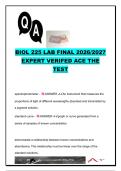
BIOL 225 LAB FINAL 2026/2027
EXPERT VERIFED ACE THE
TEST


spectrophotometer - ANSWER ✔✔An instrument that measures the

proportions of light of different wavelengths absorbed and transmitted by

a pigment solution.


standard curve - ANSWER ✔✔graph or curve generated from a

series of samples of known concentration


demonstrate a relationship between known concentrations and

absorbance. This relationship must be linear over the range of the

standard solutions.

,chromogen - ANSWER ✔✔a substance that becomes colored when it

undergoes a chemical change


micropipettes - ANSWER ✔✔a very fine pipette for measuring,

transferring, or injecting very small quantities of liquid.


slope of the linear trendline of a standard curve - ANSWER ✔✔can

be used to interpolate an unknown concentration of the same substance.

The equation y = mx+b is used to calculate unknown concentrations.

Note that the equation is y=mx is used when the linear trendline passes

through (0, 0). This will be the case for the standard curves prepared in

this course.


Micropipette Use - ANSWER ✔✔P10:


0.5 - 10 microL

white tips

P20:

2 - 20 microL

yellow tips

P200:

20 - 200 microL

, yellow tips

P1000:

200 - 1000 microL

blue tips


Precautions to Follow When Using Micropipettors - ANSWER

✔✔Never rotate the volume adjustor beyond the upper or lower range of

the pipette.

Never use the micropipettor without a disposable tip in place; this could

ruin the piston.

Never reuse a tip that has been used to measure a different reagent.

Never immerse the barrel of the micropipettor in fluid.

Never let the plunger snap back after withdrawing or expelling fluid.

Never invert or lay the micropipettor down with a filled tip.

Never flame the tip or the micropipettor.


Making dilutions - ANSWER ✔✔C1V1 = C2V2


Example: You have a stock solution of protein that has a concentration

of 1.25 μM, and you need 5.0 mL of a 0.25 μM concentration. How

would you make this? - ANSWER ✔✔C1 is the initial stock


COPYRIGHT©NINJANERD 2025/2026. YEAR PUBLISHED 2026. COMPANY REGISTRATION NUMBER: 619652435. TERMS OF USE. PRIVACY
STATEMENT. ALL RIGHTS RESERVED
3


Información del documento

Subido en
12 de agosto de 2026
Número de páginas
22
Escrito en
2026/2027
Tipo
Examen
Contiene
Preguntas y respuestas
$18.99

¿Documento equivocado? Cámbialo gratis Dentro de los 14 días posteriores a la compra y antes de descargarlo, puedes elegir otro documento. Puedes gastar el importe de nuevo.
Escrito por estudiantes que aprobaron
Inmediatamente disponible después del pago
Leer en línea o como PDF

Seller avatar
Los indicadores de reputación están sujetos a la cantidad de artículos vendidos por una tarifa y las reseñas que ha recibido por esos documentos. Hay tres niveles: Bronce, Plata y Oro. Cuanto mayor reputación, más podrás confiar en la calidad del trabajo del vendedor.
NinjaNerd
3.4
(76)
Vendido
396
Seguidores
6
Artículos
15334
Última venta
9 horas hace


Por qué los estudiantes eligen Stuvia

Creado por compañeros estudiantes, verificado por reseñas

Calidad en la que puedes confiar: escrito por estudiantes que aprobaron y evaluado por otros que han usado estos resúmenes.

¿No estás satisfecho? Elige otro documento

¡No te preocupes! Puedes elegir directamente otro documento que se ajuste mejor a lo que buscas.

Paga como quieras, empieza a estudiar al instante

Sin suscripción, sin compromisos. Paga como estés acostumbrado con tarjeta de crédito y descarga tu documento PDF inmediatamente.

Student with book image

“Comprado, descargado y aprobado. Así de fácil puede ser.”

Alisha Student

Preguntas frecuentes