

Escrito por estudiantes que aprobaron Inmediatamente disponible después del pago Leer en línea o como PDF ¿Documento equivocado? Cámbialo gratis 4,6 TrustPilot
logo-home
Document preview thumbnail
Vista previa 1 fuera de 3 páginas
Examen

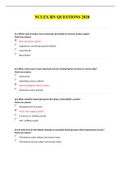
NCLEX RN QUESTIONS 2020

Document preview thumbnail
Vista previa 1 fuera de 3 páginas

NCLEX RN QUESTIONS 2020NCLEX RN QUESTIONS 2020 ________________________________________ Q:1-Which class of drug is most commonly prescribed to increase cardiac output? Mark one answer: Beta-adrenergic agonist Angiotensin-converting enzyme inhibitor Loop diuretic Beta blocker ________________________________________ ________________________________________ Q:2-What is the nurse’s most important tool for monitoring the severity of a shock state? Mark one answer: Arterial line Indwelling urinary catheter Electrocardiogram (ECG) monitor Pulmonary artery catheter ________________________________________ Q:3-What would be heard during the first phase of Korotkoff’s sounds? Mark one answer: Disappearance of sounds Faint, clear tapping sounds A murmur or swishing sounds Soft, muffling sounds ________________________________________ Q:4-In what way do the kidneys attempt to normalize blood pressure when hypertension occurs? Mark one answer: The kidneys retain sodium and excrete water. The kidneys excrete sodium and excrete water. The kidneys retain sodium and retain water. The kidneys excrete sodium and retain water. ________________________________________ Q:5-A nurse is teaching a client about the effects of angiotensin II on blood pressure. The nurse knows that teaching has been effective when the client states: Mark one answer: "It is a powerful vasodilator." "It increases aldosterone secretion." "It brings about a diuretic effect." "It stimulates the parasympathetic nervous system." ________________________________________ ________________________________________ Q:6-How would the nurse best describe the characteristics of primary hypertension to a client? Mark one answer: It is uncontrollable, and has a rapid onset of complications. It is a rapidly progressive increase in blood pressure. It is a gradual and asymptomatic increase in blood pressure. It can be corrected by treating the underlying conditions. ________________________________________ Q:7-Which statement best describes the action of furosemide for the treatment of hypertension? Mark one answer: It dilates peripheral blood vessels. It decreases sympathetic cardioacceleration. It inhibits the angiotensin-converting enzyme. It inhibits reabsorption of sodium and water in the loop of Henle. ________________________________________ Q:8-Which statement, by a client with a history of hypertension, indicates that teaching regarding an annual eye exam has been effective? Mark one answer: "By examining your corneas, an ophthalmologist can visualize microvascular hemorrhages in your eyes." "By examining the fovea in your eyes, an ophthalmologist can visualize microvascular venous occlusions in your eyes." "By examining the retina in your eyes, an ophthalmologist can detect changes in the arteries in your eyes." "By examining the sclera of your eyes, an ophthalmologist can detect changes in the arteries in your eyes." ________________________________________ Q:9-A nurse determines that a client understands the cause of primary varicose veins when the client states: Mark one answer: "Hypertension." "Pregnancy." "Thrombosis." "Trauma." ________________________________________ Q:10-Which condition is caused by increased hydrostatic pressure and chronic venous stasis? Mark one answer: Venous occlusion Cool extremities Nocturnal calf muscle cramps Diminished blood supply to the feet

Vista previa del contenido

NCLEX RN QUESTIONS 2020


Q:1-Which class of drug is most commonly prescribed to increase cardiac output?
Mark one answer:

Beta-adrenergic agonist

Angiotensin-converting enzyme inhibitor

Loop diuretic

Beta blocker


Q:2-What is the nurse’s most important tool for monitoring the severity of a shock state?
Mark one answer:

Arterial line

Indwelling urinary catheter

Electrocardiogram (ECG) monitor

Pulmonary artery catheter


Q:3-What would be heard during the first phase of Korotkoff’s sounds?
Mark one answer:

Disappearance of sounds

Faint, clear tapping sounds

A murmur or swishing sounds

Soft, muffling sounds


Q:4-In what way do the kidneys attempt to normalize blood pressure when hypertension occurs?
Mark one answer:

The kidneys retain sodium and excrete water.

The kidneys excrete sodium and excrete water.

Información del documento

Subido en
3 de julio de 2021
Número de páginas
3
Escrito en
2021/2022
Tipo
Examen
Contiene
Preguntas y respuestas
$10.99

¿Documento equivocado? Cámbialo gratis Dentro de los 14 días posteriores a la compra y antes de descargarlo, puedes elegir otro documento. Puedes gastar el importe de nuevo.
Escrito por estudiantes que aprobaron
Inmediatamente disponible después del pago
Leer en línea o como PDF

Seller avatar
Los indicadores de reputación están sujetos a la cantidad de artículos vendidos por una tarifa y las reseñas que ha recibido por esos documentos. Hay tres niveles: Bronce, Plata y Oro. Cuanto mayor reputación, más podrás confiar en la calidad del trabajo del vendedor.
Vendido
247
Seguidores
221
Artículos
1737
Última venta
3 meses hace


Por qué los estudiantes eligen Stuvia

Creado por compañeros estudiantes, verificado por reseñas

Calidad en la que puedes confiar: escrito por estudiantes que aprobaron y evaluado por otros que han usado estos resúmenes.

¿No estás satisfecho? Elige otro documento

¡No te preocupes! Puedes elegir directamente otro documento que se ajuste mejor a lo que buscas.

Paga como quieras, empieza a estudiar al instante

Sin suscripción, sin compromisos. Paga como estés acostumbrado con tarjeta de crédito y descarga tu documento PDF inmediatamente.

Student with book image

“Comprado, descargado y aprobado. Así de fácil puede ser.”

Alisha Student

Preguntas frecuentes