

Page 1 of 77
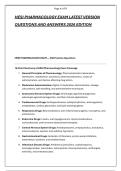
HESI PHARMACOLOGY EXAM LATEST VERSION
QUESTIONS AND ANSWERS 2026 EDITION
HESI PHARMACOLOGY EXAM — 250 Practice Questions
10-Point Summary of HESI Pharmacology Exam Coverage
1. General Principles of Pharmacology: Pharmacokinetics (absorption,
distribution, metabolism, excretion), pharmacodynamics, routes of
administration, and factors affecting drug action.
2. Medication Administration: Rights of medication administration, dosage
calculations, safe handling, and administration techniques.
3. Autonomic Nervous System Drugs: Cholinergic agonists/antagonists,
adrenergic agonists/antagonists, and their clinical applications.
4. Cardiovascular Drugs: Antihypertensives, antidysrhythmics, anticoagulants,
antiplatelets, cardiac glycosides, and lipid-lowering agents.
5. Respiratory Drugs: Bronchodilators, anti-inflammatory agents, mucolytics, and
antitussives.
6. Endocrine Drugs: Insulin, oral hypoglycemics, thyroid medications,
corticosteroids, and hormone replacement therapies.
7. Central Nervous System Drugs: Antidepressants, antipsychotics, anxiolytics,
anticonvulsants, opioids, and sedative-hypnotics.
8. Gastrointestinal Drugs: Antacids, H2 blockers, proton pump inhibitors,
antiemetics, laxatives, and antidiarrheals.
9. Infectious Disease Drugs: Antibiotics (penicillins, cephalosporins,
aminoglycosides, macrolides, tetracyclines, fluoroquinolones), antifungals,
antivirals, and antituberculars.
, Page 2 of 77
10. Safety & Nursing Considerations: Drug interactions, adverse effects,
contraindications, patient education, medication reconciliation, and error
prevention.
SECTION 1: GENERAL PRINCIPLES OF PHARMACOLOGY (Questions 1-25)
1. A nurse is preparing to administer a medication that has a high first-pass effect.
Which route of administration would the nurse expect to use to avoid this effect?
• A. Oral.
• B. Sublingual.
• C. Rectal.
• D. Intravenous.
• Answer: D. Rationale: The first-pass effect occurs when a drug is metabolized in
the liver before reaching systemic circulation. Drugs administered orally (A) are
subject to first-pass metabolism. Sublingual (B) and rectal (C) routes bypass
some first-pass metabolism but not completely. IV administration (D) completely
bypasses the first-pass effect.
2. A nurse is teaching a client about a medication that has a half-life of 12 hours.
Which statement by the client indicates understanding of this concept?
• A. "I will need to take this medication twice a day."
• B. "Half of the medication will be eliminated from my body in 12 hours."
• C. "The medication will be completely gone from my body in 12 hours."
• D. "I will need to double the dose after 12 hours."
• Answer: B. Rationale: Half-life is the time required for the serum concentration
of a drug to decrease by 50%. A half-life of 12 hours means that after 12 hours,
half of the medication will be eliminated from the body (B). This does not mean
the medication should be taken twice daily (A) without considering therapeutic
range. The medication is not completely gone in 12 hours (C), and the dose
should not be doubled (D) without a provider order.
3. A client is prescribed a medication that is highly protein-bound. The nurse
understands that which of the following may occur if another highly protein-bound
medication is added?
• A. Increased drug effect due to displacement.
, Page 3 of 77
• B. Decreased drug effect due to competition.
• C. No change in drug effect.
• D. Increased drug excretion.
• Answer: A. Rationale: When two highly protein-bound drugs are administered
together, they compete for binding sites on plasma proteins. This can displace
the first drug, leading to increased free drug concentration and increased drug
effect (A) or toxicity. Competition (B) does not decrease effect; it increases free
drug. No change (C) is incorrect, and excretion (D) is not directly affected.
4. The nurse is administering a medication that is an agonist. Which statement best
describes the action of an agonist?
• A. It blocks the receptor and prevents activation.
• B. It binds to the receptor and activates it.
• C. It binds to a different site and alters receptor function.
• D. It has no effect on the receptor.
• Answer: B. Rationale: An agonist binds to a receptor and activates it, producing
a response (B). An antagonist blocks the receptor and prevents activation (A). A
drug that binds to a different site and alters receptor function is a modulator (C).
The statement that it has no effect (D) is incorrect.
5. A client is prescribed a medication that has a narrow therapeutic index. What is
the nurse's priority action?
• A. Monitor serum drug levels frequently.
• B. Administer the medication with food.
• C. Instruct the client to take the medication at bedtime.
• D. Increase the dose if side effects occur.
• Answer: A. Rationale: A narrow therapeutic index means there is a small margin
between therapeutic and toxic doses. Frequent monitoring of serum drug levels
(A) is essential to ensure therapeutic levels are maintained without causing
toxicity. Administering with food (B), taking at bedtime (C), or increasing the dose
(D) do not address the risk of toxicity.
6. Which route of medication administration has the fastest onset of action?
• A. Oral.
• B. Subcutaneous.
, Page 4 of 77
• C. Intramuscular.
• D. Intravenous.
• Answer: D. Rationale: IV administration delivers the medication directly into the
bloodstream, providing the fastest onset of action (D). Oral (A) has a slower
onset due to absorption through the GI tract. Subcutaneous (B) and IM (C) are
faster than oral but slower than IV.
7. The nurse is teaching a client about a medication that is metabolized by the liver.
Which factor would the nurse identify as increasing the risk of toxicity?
• A. Renal impairment.
• B. Hepatic impairment.
• C. Advanced age.
• D. Female gender.
• Answer: B. Rationale: If a medication is metabolized by the liver, hepatic
impairment (B) would decrease metabolism and increase the risk of toxicity.
Renal impairment (A) would affect drugs that are excreted by the kidneys.
Advanced age (C) and female gender (D) may affect drug metabolism, but
hepatic impairment is the most direct risk factor for a hepatically metabolized
drug.
8. A nurse is evaluating a client's understanding of a medication that is an
antagonist. Which statement by the client indicates understanding?
• A. "The medication will activate the receptor."
• B. "The medication will block the receptor."
• C. "The medication will increase the effect of the receptor."
• D. "The medication will have no effect on the receptor."
• Answer: B. Rationale: An antagonist binds to a receptor and blocks it, preventing
activation (B). An agonist activates the receptor (A). An antagonist does not
increase the effect of the receptor (C) or have no effect (D).
9. Which of the following routes of administration avoids the gastrointestinal tract
and first-pass effect?
• A. Oral.
• B. Sublingual.
• C. Rectal.
HESI PHARMACOLOGY EXAM LATEST VERSION
QUESTIONS AND ANSWERS 2026 EDITION
HESI PHARMACOLOGY EXAM — 250 Practice Questions
10-Point Summary of HESI Pharmacology Exam Coverage
1. General Principles of Pharmacology: Pharmacokinetics (absorption,
distribution, metabolism, excretion), pharmacodynamics, routes of
administration, and factors affecting drug action.
2. Medication Administration: Rights of medication administration, dosage
calculations, safe handling, and administration techniques.
3. Autonomic Nervous System Drugs: Cholinergic agonists/antagonists,
adrenergic agonists/antagonists, and their clinical applications.
4. Cardiovascular Drugs: Antihypertensives, antidysrhythmics, anticoagulants,
antiplatelets, cardiac glycosides, and lipid-lowering agents.
5. Respiratory Drugs: Bronchodilators, anti-inflammatory agents, mucolytics, and
antitussives.
6. Endocrine Drugs: Insulin, oral hypoglycemics, thyroid medications,
corticosteroids, and hormone replacement therapies.
7. Central Nervous System Drugs: Antidepressants, antipsychotics, anxiolytics,
anticonvulsants, opioids, and sedative-hypnotics.
8. Gastrointestinal Drugs: Antacids, H2 blockers, proton pump inhibitors,
antiemetics, laxatives, and antidiarrheals.
9. Infectious Disease Drugs: Antibiotics (penicillins, cephalosporins,
aminoglycosides, macrolides, tetracyclines, fluoroquinolones), antifungals,
antivirals, and antituberculars.
, Page 2 of 77
10. Safety & Nursing Considerations: Drug interactions, adverse effects,
contraindications, patient education, medication reconciliation, and error
prevention.
SECTION 1: GENERAL PRINCIPLES OF PHARMACOLOGY (Questions 1-25)
1. A nurse is preparing to administer a medication that has a high first-pass effect.
Which route of administration would the nurse expect to use to avoid this effect?
• A. Oral.
• B. Sublingual.
• C. Rectal.
• D. Intravenous.
• Answer: D. Rationale: The first-pass effect occurs when a drug is metabolized in
the liver before reaching systemic circulation. Drugs administered orally (A) are
subject to first-pass metabolism. Sublingual (B) and rectal (C) routes bypass
some first-pass metabolism but not completely. IV administration (D) completely
bypasses the first-pass effect.
2. A nurse is teaching a client about a medication that has a half-life of 12 hours.
Which statement by the client indicates understanding of this concept?
• A. "I will need to take this medication twice a day."
• B. "Half of the medication will be eliminated from my body in 12 hours."
• C. "The medication will be completely gone from my body in 12 hours."
• D. "I will need to double the dose after 12 hours."
• Answer: B. Rationale: Half-life is the time required for the serum concentration
of a drug to decrease by 50%. A half-life of 12 hours means that after 12 hours,
half of the medication will be eliminated from the body (B). This does not mean
the medication should be taken twice daily (A) without considering therapeutic
range. The medication is not completely gone in 12 hours (C), and the dose
should not be doubled (D) without a provider order.
3. A client is prescribed a medication that is highly protein-bound. The nurse
understands that which of the following may occur if another highly protein-bound
medication is added?
• A. Increased drug effect due to displacement.
, Page 3 of 77
• B. Decreased drug effect due to competition.
• C. No change in drug effect.
• D. Increased drug excretion.
• Answer: A. Rationale: When two highly protein-bound drugs are administered
together, they compete for binding sites on plasma proteins. This can displace
the first drug, leading to increased free drug concentration and increased drug
effect (A) or toxicity. Competition (B) does not decrease effect; it increases free
drug. No change (C) is incorrect, and excretion (D) is not directly affected.
4. The nurse is administering a medication that is an agonist. Which statement best
describes the action of an agonist?
• A. It blocks the receptor and prevents activation.
• B. It binds to the receptor and activates it.
• C. It binds to a different site and alters receptor function.
• D. It has no effect on the receptor.
• Answer: B. Rationale: An agonist binds to a receptor and activates it, producing
a response (B). An antagonist blocks the receptor and prevents activation (A). A
drug that binds to a different site and alters receptor function is a modulator (C).
The statement that it has no effect (D) is incorrect.
5. A client is prescribed a medication that has a narrow therapeutic index. What is
the nurse's priority action?
• A. Monitor serum drug levels frequently.
• B. Administer the medication with food.
• C. Instruct the client to take the medication at bedtime.
• D. Increase the dose if side effects occur.
• Answer: A. Rationale: A narrow therapeutic index means there is a small margin
between therapeutic and toxic doses. Frequent monitoring of serum drug levels
(A) is essential to ensure therapeutic levels are maintained without causing
toxicity. Administering with food (B), taking at bedtime (C), or increasing the dose
(D) do not address the risk of toxicity.
6. Which route of medication administration has the fastest onset of action?
• A. Oral.
• B. Subcutaneous.
, Page 4 of 77
• C. Intramuscular.
• D. Intravenous.
• Answer: D. Rationale: IV administration delivers the medication directly into the
bloodstream, providing the fastest onset of action (D). Oral (A) has a slower
onset due to absorption through the GI tract. Subcutaneous (B) and IM (C) are
faster than oral but slower than IV.
7. The nurse is teaching a client about a medication that is metabolized by the liver.
Which factor would the nurse identify as increasing the risk of toxicity?
• A. Renal impairment.
• B. Hepatic impairment.
• C. Advanced age.
• D. Female gender.
• Answer: B. Rationale: If a medication is metabolized by the liver, hepatic
impairment (B) would decrease metabolism and increase the risk of toxicity.
Renal impairment (A) would affect drugs that are excreted by the kidneys.
Advanced age (C) and female gender (D) may affect drug metabolism, but
hepatic impairment is the most direct risk factor for a hepatically metabolized
drug.
8. A nurse is evaluating a client's understanding of a medication that is an
antagonist. Which statement by the client indicates understanding?
• A. "The medication will activate the receptor."
• B. "The medication will block the receptor."
• C. "The medication will increase the effect of the receptor."
• D. "The medication will have no effect on the receptor."
• Answer: B. Rationale: An antagonist binds to a receptor and blocks it, preventing
activation (B). An agonist activates the receptor (A). An antagonist does not
increase the effect of the receptor (C) or have no effect (D).
9. Which of the following routes of administration avoids the gastrointestinal tract
and first-pass effect?
• A. Oral.
• B. Sublingual.
• C. Rectal.

