

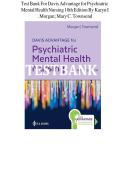
Test Bank For Davis Advantage for Psychiatric
F! F! F! F! F! F! F!
Mental Health Nursing 10th Edition By Karyn I
F! F! F! F! F! F! F!
. Morgan; Mary C. Townsend
F! F! F! F!
TESTBANK F!
,Table of Contents
F! F!
I. BASIC CONCEPTS IN PSYCHIATRIC-MENTAL HEALTH NURSING
F! F! F! F! F!
1. The Concept of Stress Adaptation
F! F! F! F!
2. Mental Health and Mental Illness: Historical and Theoretical Concepts
F! F! F! F! F! F! F! F!
II. FOUNDATIONS FOR PSYCHIATRIC-MENTAL HEALTH NURSING F! F! F! F!
3. Concepts of PsychobiologyF! F!
4. Psychopharmacology
5. Ethical and Legal Issues
F! F! F!
III. THERAPEUTIC APPROACHES IN PSYCHIATRIC NURSING CARE F! F! F! F! F!
6. Relationship Development F!
7. Therapeutic Communication F!
8. The Nursing Process in Psychiatric-Mental Health Nursing
F! F! F! F! F! F!
9. Therapeutic Groups F!
10. Intervention with Families F! F!
11. Milieu Therapy—The Therapeutic Community
F! F! F!
12. Crisis Intervention
F!
13. Assertiveness Training F!
14. Promoting Self Esteem F! F!
15. Anger and Aggression Management
F! F! F!
16. Suicide Prevention F!
17. Behavior Therapy F!
18. Cognitive Behavioral Therapy F! F!
19. Electroconvulsive Therapy F!
20. The Recovery Model
F! F!
IV. NURSING CARE OF PATIENTS WITH ALTERATIONS IN PSYCHOSOCIAL ADAPTATION
F! F! F! F! F! F! F! F!
21. Caring for Patients with Mental Illness and Substance Use Disorders in General Practice Settings
F! F! F! F! F! F! F! F! F! F! F! F! F!
22. Neurocognitive Disorders F!
23. Substance-Related and Addictive Disorders F! F! F!
24. Schizophrenia Spectrum and Other Psychotic Disorders F! F! F! F! F!
25. Depressive Disorders F!
26. Bipolar and Related Disorders
F! F! F!
27. Anxiety, Obsessive-Compulsive, and Related Disorders
F! F! F! F!
28. Trauma and Stressor-Related Disorders
F! F! F!
29. Somatic Symptom and Dissociative Disorders
F! F! F! F!
30. Eating Disorders F!
31. Personality Disorders F!
V. PSYCHIATRIC/MENTAL HEALTH NURSING OF SPECIAL POPULATIONS F! F! F! F! F!
32. Children and Adolescents F! F!
33. The Aging Individual
F! F!
34. Survivors of Abuse or Neglect F! F! F! F!
35. Community Mental Health Nursing F! F! F!
36. The Bereaved Individual
F! F!
37. Military Families F!
eBook Bonus Chapters
F! F!
38. Theoretical Models of Personality Development
F! F! F! F!
39. Cultural and Spiritual Concepts Relevant to Psychiatric Mental Health Nursing
F! F! F! F! F! F! F! F! F!
40. Complementary and Psychosocial Therapies F! F! F!
41. Relaxation Therapy F!
42. Issues Related to Human Sexuality and Gender Dysphoria
F! F! F! F! F! F! F!
43. Forensic Nursing F!
,Chapter 1. The Concept of Stress Adaptation
F! F! F! F! F! F!
MULTIPLE CHOICE F!
1. A client has experienced the death of a close family member and at the same timebecomes
F! F! F! F! F! F! F! F! F! F! F! F! F! F! F!
unemployed. The client’s 6-month score on the Recent Life Changes Questionnaire is 110. The nurse:
F! F! F! F! F! F! F! F! F! F! F! F! F! F!
Understands the client is at risk for significant stress-
F! F! F! F! F! F! F! F!
related illness. Determines the client is not at risk for significant stress-
F! F! F! F! F! F! F! F! F! F! F!
related illness. F!
Needs further assessment of the client’s coping skills to determine susceptibility tostress-
F! F! F! F! F! F! F! F! F! F! F!
related illness. F!
Recognizes the client may view the losses as challenges and perceive them asopportunities.
F! F! F! F! F! F! F! F! F! F! F! F!
ANS: 3 F!
Chapter: Chapter 1, The Concept of Stress Adaptation
F! F! F! F! F! F! F!
Objective: Explain the relationship between stress and diseases of adaptation.Page: 5
F! F! F! F! F! F! F! F! F! F!
Heading: Stress as an Environmental Event Integrated Processes: Nursing Process: EvaluationClient N
F! F! F! F! F! F! F! F! F! F! F!
eed: Psychosocial Integrity
F! F!
Cognitive Level: Application [Applying]Concept: Stress Difficult
F! F! F! F! F!
y: Moderate
F!
Feedback
1. This is incorrect. Assessment is the first step of the nursing process. The nurse shoul
F! F! F! F! F! F! F! F! F! F! F! F! F! F!
d assess the client’s coping skills and available support before determining susceptibil
F! F! F! F! F! F! F! F! F! F! F!
ity to stress-F! F!
related physical and psychological illnesses. The Recent LifeChanges Questionnaire
F! F! F! F! F! F! F! F! F!
is an expanded version of the Schedule of Recent Experiences and the Rahe-
F! F! F! F! F! F! F! F! F! F! F! F!
Holmes Social Readjustment Rating Scale. A 6-
F! F! F! F! F! F!
month score of 300 or more or a year-
F! F! F! F! F! F! F! F!
score total of 500 or more indicates high stress in a
F! F! F! F! F! F! F! F! F! F!
client’s life and susceptibility to stress-related illnesses.
F! F! F! F! F! F!
2. This is incorrect. Assessment is the first step in the nursing process. The nurse should
F! F! F! F! F! F! F! F! F! F! F! F! F! F!
assess the client’s coping skills and available support before determining the client’s
F! F! F! F! F! F! F! F! F! F! F! F! F!
perception of the current stresses. A 6-month score of 300 or more or a year-
F! F! F! F! F! F! F! F! F! F! F! F! F! F!
score total of 500 or more on the Recent Life Changes Questionnaire indicates high s
F! F! F! F! F! F! F! F! F! F! F! F! F! F!
tress in a F! F!
client’s life and susceptibility to stress-related physical and psychological illnesses.
F! F! F! F! F! F! F! F! F!
3. This is correct. Assessment is the first step in the nursing process. The nurse should a
F! F! F! F! F! F! F! F! F! F! F! F! F! F! F!
ssess the client’s coping skills and available support before determining susceptibility t
F! F! F! F! F! F! F! F! F! F! F!
o stress-related physical and psychological illnesses. A 6-month score
F! F! F! F! F! F! F! F!
, of 300 or more or a year-
F! F! F! F! F! F!
score of 500 or more indicates high stress in a client’s lifeand risk for significant stres
F! F! F! F! F! F! F! F! F! F! F! F! F! F! F!
s-related physical and psychological illness. F! F! F! F!
4. This is incorrect. Assessment is the first step in the nursing process. The nurse shoul
F! F! F! F! F! F! F! F! F! F! F! F! F! F!
d assess the client’s coping skills and available support before determining susceptibil
F! F! F! F! F! F! F! F! F! F! F!
ity to stress-related illness. A 6-month score of 300 or more or a year-
F! F! F! F! F! F! F! F! F! F! F! F! F!
score of 500 or more on the Recent Life Changes Questionnaire indicates high stress
F! F! F! F! F! F! F! F! F! F! F! F! F! F!
in a client’s life is susceptible to significant stress-
F! F! F! F! F! F! F! F!
related physical and psychologicalillness.
F! F! F!
CON: Stress F!
2. A physically and emotionally healthy client has just been fired. During a routine office visit, he te
F! F! F! F! F! F! F! F! F! F! F! F! F! F! F! F!
lls the nurse, “Perhaps this was the best thing to happen. Maybe I’ll
F! F! F! F! F! F! F! F! F! F! F! F!
consider pursuing an art degree.” The nurse determines the client perceives the stressorof his job loss as:
F! F! F! F! F! F! F! F! F! F! F! F! F! F! F! F!
Irrelevant Ha F!
rm or loss Th
F! F! F!
reatening A F! F!
challenge
ANS: 4 F!
Chapter: Chapter 1, The Concept of Stress Adaptation
F! F! F! F! F! F! F!
Objective: Discuss adaptive coping strategies in the management of stress.Page: 7 H
F! F! F! F! F! F! F! F! F! F! F!
eading: Stress as a transaction between the individual and the environment
F! F! F! F! F! F! F! F! F! F!
>Individual’s Perception of the Event > Primary AppraisalIntegrated Processes: Nursing Process: Asse
F! F! F! F! F! F! F! F! F! F! F!
ssment
Client Need: Psychosocial Integrity Cognitive Level: Application [Applying]Concept: Stress
F! F! F! F! F! F! F! F! F!
Difficulty: Easy F!
Feedback
1. This is incorrect. An irrelevant perception is one where the event holds nosignificance
F! F! F! F! F! F! F! F! F! F! F! F! F!
for the individual.
F! F!
2. This is incorrect. A harm or loss appraisal refers to damage or loss alreadyexperienced
F! F! F! F! F! F! F! F! F! F! F! F! F! F
by the individual.
! F! F!
3. This is incorrect. A threatening appraisal is perceived as anticipated harms or losses.
F! F! F! F! F! F! F! F! F! F! F! F!
4. This is correct. The client’s statement indicates he perceives the loss of his job as a c
F! F! F! F! F! F! F! F! F! F! F! F! F! F! F! F!
hallenge and an opportunity for growth, demonstrated by his statement to consideran a
F! F! F! F! F! F! F! F! F! F! F! F!
rt degree.
F!
CON: Stress F!
F! F! F! F! F! F! F!
Mental Health Nursing 10th Edition By Karyn I
F! F! F! F! F! F! F!
. Morgan; Mary C. Townsend
F! F! F! F!
TESTBANK F!
,Table of Contents
F! F!
I. BASIC CONCEPTS IN PSYCHIATRIC-MENTAL HEALTH NURSING
F! F! F! F! F!
1. The Concept of Stress Adaptation
F! F! F! F!
2. Mental Health and Mental Illness: Historical and Theoretical Concepts
F! F! F! F! F! F! F! F!
II. FOUNDATIONS FOR PSYCHIATRIC-MENTAL HEALTH NURSING F! F! F! F!
3. Concepts of PsychobiologyF! F!
4. Psychopharmacology
5. Ethical and Legal Issues
F! F! F!
III. THERAPEUTIC APPROACHES IN PSYCHIATRIC NURSING CARE F! F! F! F! F!
6. Relationship Development F!
7. Therapeutic Communication F!
8. The Nursing Process in Psychiatric-Mental Health Nursing
F! F! F! F! F! F!
9. Therapeutic Groups F!
10. Intervention with Families F! F!
11. Milieu Therapy—The Therapeutic Community
F! F! F!
12. Crisis Intervention
F!
13. Assertiveness Training F!
14. Promoting Self Esteem F! F!
15. Anger and Aggression Management
F! F! F!
16. Suicide Prevention F!
17. Behavior Therapy F!
18. Cognitive Behavioral Therapy F! F!
19. Electroconvulsive Therapy F!
20. The Recovery Model
F! F!
IV. NURSING CARE OF PATIENTS WITH ALTERATIONS IN PSYCHOSOCIAL ADAPTATION
F! F! F! F! F! F! F! F!
21. Caring for Patients with Mental Illness and Substance Use Disorders in General Practice Settings
F! F! F! F! F! F! F! F! F! F! F! F! F!
22. Neurocognitive Disorders F!
23. Substance-Related and Addictive Disorders F! F! F!
24. Schizophrenia Spectrum and Other Psychotic Disorders F! F! F! F! F!
25. Depressive Disorders F!
26. Bipolar and Related Disorders
F! F! F!
27. Anxiety, Obsessive-Compulsive, and Related Disorders
F! F! F! F!
28. Trauma and Stressor-Related Disorders
F! F! F!
29. Somatic Symptom and Dissociative Disorders
F! F! F! F!
30. Eating Disorders F!
31. Personality Disorders F!
V. PSYCHIATRIC/MENTAL HEALTH NURSING OF SPECIAL POPULATIONS F! F! F! F! F!
32. Children and Adolescents F! F!
33. The Aging Individual
F! F!
34. Survivors of Abuse or Neglect F! F! F! F!
35. Community Mental Health Nursing F! F! F!
36. The Bereaved Individual
F! F!
37. Military Families F!
eBook Bonus Chapters
F! F!
38. Theoretical Models of Personality Development
F! F! F! F!
39. Cultural and Spiritual Concepts Relevant to Psychiatric Mental Health Nursing
F! F! F! F! F! F! F! F! F!
40. Complementary and Psychosocial Therapies F! F! F!
41. Relaxation Therapy F!
42. Issues Related to Human Sexuality and Gender Dysphoria
F! F! F! F! F! F! F!
43. Forensic Nursing F!
,Chapter 1. The Concept of Stress Adaptation
F! F! F! F! F! F!
MULTIPLE CHOICE F!
1. A client has experienced the death of a close family member and at the same timebecomes
F! F! F! F! F! F! F! F! F! F! F! F! F! F! F!
unemployed. The client’s 6-month score on the Recent Life Changes Questionnaire is 110. The nurse:
F! F! F! F! F! F! F! F! F! F! F! F! F! F!
Understands the client is at risk for significant stress-
F! F! F! F! F! F! F! F!
related illness. Determines the client is not at risk for significant stress-
F! F! F! F! F! F! F! F! F! F! F!
related illness. F!
Needs further assessment of the client’s coping skills to determine susceptibility tostress-
F! F! F! F! F! F! F! F! F! F! F!
related illness. F!
Recognizes the client may view the losses as challenges and perceive them asopportunities.
F! F! F! F! F! F! F! F! F! F! F! F!
ANS: 3 F!
Chapter: Chapter 1, The Concept of Stress Adaptation
F! F! F! F! F! F! F!
Objective: Explain the relationship between stress and diseases of adaptation.Page: 5
F! F! F! F! F! F! F! F! F! F!
Heading: Stress as an Environmental Event Integrated Processes: Nursing Process: EvaluationClient N
F! F! F! F! F! F! F! F! F! F! F!
eed: Psychosocial Integrity
F! F!
Cognitive Level: Application [Applying]Concept: Stress Difficult
F! F! F! F! F!
y: Moderate
F!
Feedback
1. This is incorrect. Assessment is the first step of the nursing process. The nurse shoul
F! F! F! F! F! F! F! F! F! F! F! F! F! F!
d assess the client’s coping skills and available support before determining susceptibil
F! F! F! F! F! F! F! F! F! F! F!
ity to stress-F! F!
related physical and psychological illnesses. The Recent LifeChanges Questionnaire
F! F! F! F! F! F! F! F! F!
is an expanded version of the Schedule of Recent Experiences and the Rahe-
F! F! F! F! F! F! F! F! F! F! F! F!
Holmes Social Readjustment Rating Scale. A 6-
F! F! F! F! F! F!
month score of 300 or more or a year-
F! F! F! F! F! F! F! F!
score total of 500 or more indicates high stress in a
F! F! F! F! F! F! F! F! F! F!
client’s life and susceptibility to stress-related illnesses.
F! F! F! F! F! F!
2. This is incorrect. Assessment is the first step in the nursing process. The nurse should
F! F! F! F! F! F! F! F! F! F! F! F! F! F!
assess the client’s coping skills and available support before determining the client’s
F! F! F! F! F! F! F! F! F! F! F! F! F!
perception of the current stresses. A 6-month score of 300 or more or a year-
F! F! F! F! F! F! F! F! F! F! F! F! F! F!
score total of 500 or more on the Recent Life Changes Questionnaire indicates high s
F! F! F! F! F! F! F! F! F! F! F! F! F! F!
tress in a F! F!
client’s life and susceptibility to stress-related physical and psychological illnesses.
F! F! F! F! F! F! F! F! F!
3. This is correct. Assessment is the first step in the nursing process. The nurse should a
F! F! F! F! F! F! F! F! F! F! F! F! F! F! F!
ssess the client’s coping skills and available support before determining susceptibility t
F! F! F! F! F! F! F! F! F! F! F!
o stress-related physical and psychological illnesses. A 6-month score
F! F! F! F! F! F! F! F!
, of 300 or more or a year-
F! F! F! F! F! F!
score of 500 or more indicates high stress in a client’s lifeand risk for significant stres
F! F! F! F! F! F! F! F! F! F! F! F! F! F! F!
s-related physical and psychological illness. F! F! F! F!
4. This is incorrect. Assessment is the first step in the nursing process. The nurse shoul
F! F! F! F! F! F! F! F! F! F! F! F! F! F!
d assess the client’s coping skills and available support before determining susceptibil
F! F! F! F! F! F! F! F! F! F! F!
ity to stress-related illness. A 6-month score of 300 or more or a year-
F! F! F! F! F! F! F! F! F! F! F! F! F!
score of 500 or more on the Recent Life Changes Questionnaire indicates high stress
F! F! F! F! F! F! F! F! F! F! F! F! F! F!
in a client’s life is susceptible to significant stress-
F! F! F! F! F! F! F! F!
related physical and psychologicalillness.
F! F! F!
CON: Stress F!
2. A physically and emotionally healthy client has just been fired. During a routine office visit, he te
F! F! F! F! F! F! F! F! F! F! F! F! F! F! F! F!
lls the nurse, “Perhaps this was the best thing to happen. Maybe I’ll
F! F! F! F! F! F! F! F! F! F! F! F!
consider pursuing an art degree.” The nurse determines the client perceives the stressorof his job loss as:
F! F! F! F! F! F! F! F! F! F! F! F! F! F! F! F!
Irrelevant Ha F!
rm or loss Th
F! F! F!
reatening A F! F!
challenge
ANS: 4 F!
Chapter: Chapter 1, The Concept of Stress Adaptation
F! F! F! F! F! F! F!
Objective: Discuss adaptive coping strategies in the management of stress.Page: 7 H
F! F! F! F! F! F! F! F! F! F! F!
eading: Stress as a transaction between the individual and the environment
F! F! F! F! F! F! F! F! F! F!
>Individual’s Perception of the Event > Primary AppraisalIntegrated Processes: Nursing Process: Asse
F! F! F! F! F! F! F! F! F! F! F!
ssment
Client Need: Psychosocial Integrity Cognitive Level: Application [Applying]Concept: Stress
F! F! F! F! F! F! F! F! F!
Difficulty: Easy F!
Feedback
1. This is incorrect. An irrelevant perception is one where the event holds nosignificance
F! F! F! F! F! F! F! F! F! F! F! F! F!
for the individual.
F! F!
2. This is incorrect. A harm or loss appraisal refers to damage or loss alreadyexperienced
F! F! F! F! F! F! F! F! F! F! F! F! F! F
by the individual.
! F! F!
3. This is incorrect. A threatening appraisal is perceived as anticipated harms or losses.
F! F! F! F! F! F! F! F! F! F! F! F!
4. This is correct. The client’s statement indicates he perceives the loss of his job as a c
F! F! F! F! F! F! F! F! F! F! F! F! F! F! F! F!
hallenge and an opportunity for growth, demonstrated by his statement to consideran a
F! F! F! F! F! F! F! F! F! F! F! F!
rt degree.
F!
CON: Stress F!

