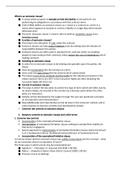
What is an exclusion clause?
■ A clause which purports to exclude or limit the liability of one party for not
performing his obligations in accordance with the contract terms
■ Yates (1982) defines an exclusion clause as a ‘clause in a contract or a term in a
notice which appears to exclude or restrict a liability or a legal duty which would
otherwise arise’
■ The term ‘exclusion clause' is used to refer to both an exception clause and a
limitation clause
■ Function of exclusion clauses?
■ They help in the allocation of risks under the contract
■ Exclusion clauses can help reduce litigation costs by making clear the division of
responsibility between the parties.
■ Exclusion clauses are often used in standard form contracts which, by enabling
people to mass-produce their contracts, helps reduce the cost of negotiations and of
making contracts
■ Including an exclusion clause
■ In order for an exclusion clause to be binding and operable upon the parties, the
clause:
■ must be incorporated into the contract as a term.
■ must cover the type of loss that has arisen (rule of construction)
■ The clause must not be rendered unenforceable by the statutory provisions in the
Unfair Contract Terms Act 1977 or the Consumer Rights Act 2015 (enacting the
Consumer Rights Bill 2013-14)
■ Control of exclusion clauses
■ The ways in which the law seeks to control this type of term (which will often, but by
no means always, be inserted in the contract by a business party where the other
party is a consumer)
■ Initially control developed by the judges through the case-law (particular principles
on incorporation and interpretation)
■ Now (additionally and importantly) control (at least in the consumer context, and in
some business-to-business contexts too) developed by statute.
1. Common law controls on exclusion clauses
2. Statutory controls on exclusion clauses and unfair terms
1. Common law controls
3. Incorporation of the exemption/limitation clause
4. Interpretation of exemption/limitation clauses seeking to exclude/limit liability for
that party’s negligence
5. Special approach to interpretation of exemption/limitation clauses where the breach
is of a fundamental nature: fundamental breach/breach of fundamental term
6. Incorporation of the exemption/limitation clause
It must be shown that the exclusion clause was validly incorporated into the contract – what
do we remember about incorporation of terms?
The three ways in which a term may be incorporated are:
■ Signature – L’Estrange v E. Graucob Ltd [1934] 2 KB 394.
■ Notice – Chapelton v Barry Urban District Council [1940] 1 KB 532
■ Previous course of dealings
■ A clause which purports to exclude or limit the liability of one party for not
performing his obligations in accordance with the contract terms
■ Yates (1982) defines an exclusion clause as a ‘clause in a contract or a term in a
notice which appears to exclude or restrict a liability or a legal duty which would
otherwise arise’
■ The term ‘exclusion clause' is used to refer to both an exception clause and a
limitation clause
■ Function of exclusion clauses?
■ They help in the allocation of risks under the contract
■ Exclusion clauses can help reduce litigation costs by making clear the division of
responsibility between the parties.
■ Exclusion clauses are often used in standard form contracts which, by enabling
people to mass-produce their contracts, helps reduce the cost of negotiations and of
making contracts
■ Including an exclusion clause
■ In order for an exclusion clause to be binding and operable upon the parties, the
clause:
■ must be incorporated into the contract as a term.
■ must cover the type of loss that has arisen (rule of construction)
■ The clause must not be rendered unenforceable by the statutory provisions in the
Unfair Contract Terms Act 1977 or the Consumer Rights Act 2015 (enacting the
Consumer Rights Bill 2013-14)
■ Control of exclusion clauses
■ The ways in which the law seeks to control this type of term (which will often, but by
no means always, be inserted in the contract by a business party where the other
party is a consumer)
■ Initially control developed by the judges through the case-law (particular principles
on incorporation and interpretation)
■ Now (additionally and importantly) control (at least in the consumer context, and in
some business-to-business contexts too) developed by statute.
1. Common law controls on exclusion clauses
2. Statutory controls on exclusion clauses and unfair terms
1. Common law controls
3. Incorporation of the exemption/limitation clause
4. Interpretation of exemption/limitation clauses seeking to exclude/limit liability for
that party’s negligence
5. Special approach to interpretation of exemption/limitation clauses where the breach
is of a fundamental nature: fundamental breach/breach of fundamental term
6. Incorporation of the exemption/limitation clause
It must be shown that the exclusion clause was validly incorporated into the contract – what
do we remember about incorporation of terms?
The three ways in which a term may be incorporated are:
■ Signature – L’Estrange v E. Graucob Ltd [1934] 2 KB 394.
■ Notice – Chapelton v Barry Urban District Council [1940] 1 KB 532
■ Previous course of dealings