

Escrito por estudiantes que aprobaron Inmediatamente disponible después del pago Leer en línea o como PDF ¿Documento equivocado? Cámbialo gratis 4,6 TrustPilot
logo-home
Document preview thumbnail
Vista previa 2 fuera de 10 páginas
Examen

ANP 1106 Midterm 2 2026/2027 – 80+ Questions & Answers | Muscular System, Brain & Cerebral Cortex

Document preview thumbnail
Vista previa 2 fuera de 10 páginas

This ANP 1106 Midterm 2 2026/2027 study guide contains 80+ expert-verified question-and-answer study points across 10 pages, providing concentrated revision of two major Human Anatomy and Physiology areas: the muscular system and nervous system. The document progresses from skeletal-muscle organization, connective tissue coverings, muscle attachments and individual muscle functions to cerebral anatomy, functional cortical areas, white-matter pathways, basal nuclei and selected neurological disorders. This concise Q&A structure makes the material suitable for memorization, active recall, last-minute revision and preparation for an ANP 1106 Midterm 2 examination. The muscular-system material begins with the structural organization of skeletal muscle, including the endomysium, perimysium, epimysium and deep fascia, as well as muscle origin and insertion. It then reviews muscles of the tongue and mastication—including the genioglossus, hyoglossus, styloglossus, masseter, temporalis and pterygoids—before covering important muscles of the neck, vertebral column, abdomen and pelvic floor. Students encounter the sternocleidomastoid, scalenes, splenius, erector spinae, semispinalis, quadratus lumborum, rectus abdominis, external and internal obliques, transversus abdominis, levator ani and coccygeus, with emphasis on their principal anatomical actions. Upper-body and upper-limb anatomy receive particularly useful coverage. The guide reviews the pectoralis major, latissimus dorsi, deltoid, trapezius and rhomboids and connects each muscle to actions involving the arm, shoulder and scapula. It then examines the triceps brachii, biceps brachii, brachialis, brachioradialis, pronator teres, flexor carpi radialis, flexor carpi ulnaris, flexor digitorum superficialis, extensor carpi radialis, extensor digitorum and supinator. These entries reinforce key concepts involving elbow flexion and extension, forearm pronation and supination, wrist movement, finger extension and shoulder movement. The second half transitions into brain anatomy and functional neuroanatomy. Students review the longitudinal and transverse cerebral fissures, central, lateral and parieto-occipital sulci, primary motor cortex, pyramidal cells, somatotopic organization and premotor cortex. The material also covers Broca's area, frontal eye field, primary somatosensory cortex, somatosensory association area, primary visual cortex, visual association area, vestibular cortex, olfactory cortex and gustatory cortex, providing a focused overview of how different cortical regions contribute to movement, sensation, language, vision, balance, smell and taste. The guide further distinguishes commissural, association and projection fibers and introduces the role of the corpus callosum and basal nuclei in communication and movement control. Clinical and functional concepts include stroke, Huntington's disease and Parkinson's disease, alongside the substantia nigra, red nucleus, superior and inferior colliculi and pyramidal decussation. The concluding material covers functional brain systems and limbic structures, including the amygdala, hippocampus and anterior cingulate gyrus, linking neuroanatomical structures with emotion, memory, danger assessment and behavioral regulation. For academic reference, the content aligns with standard undergraduate anatomy and physiology coverage in Betts et al., Anatomy and Physiology 2e, OpenStax, particularly its chapters on the muscular system, nervous tissue, central nervous system and neurological control. This textbook provides a useful academic reference for expanding and verifying the anatomical and physiological concepts summarized in the document. OpenStax Anatomy and Physiology 2e Relevant students: This document is most relevant to ANP 1106 students preparing for Midterm 2, particularly those who need rapid review of skeletal muscles and functional neuroanatomy. It can also benefit nursing and pre-nursing students, biology majors, kinesiology and exercise science students, physiotherapy and occupational therapy students, medical-assisting students, radiography students and other allied-health learners whose coursework includes muscular anatomy, cerebral anatomy and nervous-system function. The document identifies ANP 1106, Midterm 2 and 2026/2027, but no university is stated, so an institution should not be invented for SEO purposes. Keywords: ANP 1106 Midterm 2, ANP , ANP 1106 questions and answers, ANP 1106 study guide, Midterm 2 anatomy and physiology, anatomy and physiology exam, muscular system questions, muscular system study guide, skeletal muscle anatomy, endomysium perimysium epimysium, muscle origin and insertion, muscle actions, muscles of mastication, pectoralis major, latissimus dorsi, deltoid muscle, triceps brachii, biceps brachii, forearm muscles, cerebral cortex, brain anatomy, nervous system study guide, neuroanatomy questions and answers, primary motor cortex, somatosensory cortex, Broca area, visual cortex, cerebral white matter, association fibers, commissural fibers, projection fibers, basal nuclei, substantia nigra, Parkinson disease, Huntington disease, amygdala, hippocampus, anatomy Midterm 2 study guide, nursing anatomy exam, anatomy exam preparation

Vista previa del contenido

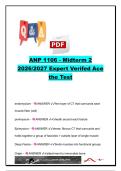
ANP 1106 - Midterm 2
2026/2027 Expert Verifed Ace
the Test


endomysium - ANSWER ✔✔fine layer of CT that surrounds each

muscle fiber (cell)


perimysium - ANSWER ✔✔sheath around each fasicle


Epimysium - ANSWER ✔✔dense, fibrous CT that surrounds and

holds together a group of fascicles = outside layer of single muscle


Deep Fascia - ANSWER ✔✔binds muscles into functional groups


Origin - ANSWER ✔✔attachment to immovable bone

, insertion - ANSWER ✔✔attachment to a movable bone


genioglossus - ANSWER ✔✔prime mover of tongue; anchors tongue

to prevent obstruction of respiration


hyoglossus - ANSWER ✔✔depresses tongue, especially lateral

margins


styloglossus - ANSWER ✔✔retracts and elevates tongue


masseter - ANSWER ✔✔prime mover of jaw closure


temporalis - ANSWER ✔✔elevates and retracts mandible


medial and lateral pterygoid - ANSWER ✔✔two-headerd; additional

jaw movements (side-to-side grinding movements)


buccinator - ANSWER ✔✔compresses the cheek; helps keep food

between grinding surfaces of teeth during chewing


sternocleidomastoid - ANSWER ✔✔2-headed; deep to platysma;

prime mover of head flexions


scalene - ANSWER ✔✔more laterally and deep to platysma and

sternocleidomastoid - elevates first two ribs, role in coughing, felt and

rotate neck

Información del documento

Subido en
8 de agosto de 2026
Número de páginas
10
Escrito en
2026/2027
Tipo
Examen
Contiene
Preguntas y respuestas
$18.99

¿Documento equivocado? Cámbialo gratis Dentro de los 14 días posteriores a la compra y antes de descargarlo, puedes elegir otro documento. Puedes gastar el importe de nuevo.
Escrito por estudiantes que aprobaron
Inmediatamente disponible después del pago
Leer en línea o como PDF

Seller avatar
Los indicadores de reputación están sujetos a la cantidad de artículos vendidos por una tarifa y las reseñas que ha recibido por esos documentos. Hay tres niveles: Bronce, Plata y Oro. Cuanto mayor reputación, más podrás confiar en la calidad del trabajo del vendedor.
NinjaNerd
3.4
(76)
Vendido
395
Seguidores
6
Artículos
15309
Última venta
15 horas hace


Por qué los estudiantes eligen Stuvia

Creado por compañeros estudiantes, verificado por reseñas

Calidad en la que puedes confiar: escrito por estudiantes que aprobaron y evaluado por otros que han usado estos resúmenes.

¿No estás satisfecho? Elige otro documento

¡No te preocupes! Puedes elegir directamente otro documento que se ajuste mejor a lo que buscas.

Paga como quieras, empieza a estudiar al instante

Sin suscripción, sin compromisos. Paga como estés acostumbrado con tarjeta de crédito y descarga tu documento PDF inmediatamente.

Student with book image

“Comprado, descargado y aprobado. Así de fácil puede ser.”

Alisha Student

Preguntas frecuentes
