

lOMoAR cPSD| 67691079
Introduction to Acute Kidney Injury
The kidneys play a crucial role in the body, responsible for filtering waste
products from the blood, regulating fluid balance, and maintaining electrolyte
equilibrium, among other essential tasks. In the context of acute kidney injury
(AKI), these processes are disrupted, leading to an accumulation of waste
products in the body, imbalances in fluids and electrolytes, and potentially
severe health complications.
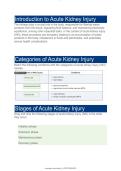
Categories of Acute Kidney Injury
Match the following conditions with the categories of acute kidney injury (AKI)
causes.
Stages of Acute Kidney Injury
Drag and drop the following stages of acute kidney injury (AKI) in the order
they occur.
Initiation phase
Extension phase
Maintenance phase
Recovery phase
messages.downloaded_by PERFORMANCE
, lOMoAR cPSD| 67691079
Tests for Acute Kidney Injury
Which of the following lab findings is most indicative of acute kidney injury (AKI)?
Elevated blood urea nitrogen (BUN)
Decreased serum creatinine
Increased serum albumin
Increased blood pressure
Normal Physiology of the
ReninAngiotensin-Aldosterone System
The renin-angiotensin-aldosterone system (RAAS) is a hormonal system in
the body that plays a vital role in regulating blood pressure, fluid and
electrolyte balance, and systemic vascular resistance. The kidneys (as well as
the lungs, blood vessels, adrenal cortex, and brain) play a critical role in the
RAAS process.
Normal Physiology of the Nephron
The kidneys are complex organs, vital for maintaining health. Each kidney
contains approximately 1.2 million nephrons, which are the functional units of
the kidney. The nephrons perform crucial tasks, such as filtration,
reabsorption, and secretion.
These tasks contribute to the body’s ability to remove waste products from the
blood, regulate body fluids, electrolytes, pH, and blood pressure, and produce
certain hormones like erythropoietin (necessary for red blood cell production)
and renin (to initiate the renin-angiotensin-aldosterone [RAAS] process), and
activate vitamin D (required for bone health).
Introduction to Acute Kidney Injury
The kidneys play a crucial role in the body, responsible for filtering waste
products from the blood, regulating fluid balance, and maintaining electrolyte
equilibrium, among other essential tasks. In the context of acute kidney injury
(AKI), these processes are disrupted, leading to an accumulation of waste
products in the body, imbalances in fluids and electrolytes, and potentially
severe health complications.
Categories of Acute Kidney Injury
Match the following conditions with the categories of acute kidney injury (AKI)
causes.
Stages of Acute Kidney Injury
Drag and drop the following stages of acute kidney injury (AKI) in the order
they occur.
Initiation phase
Extension phase
Maintenance phase
Recovery phase
messages.downloaded_by PERFORMANCE
, lOMoAR cPSD| 67691079
Tests for Acute Kidney Injury
Which of the following lab findings is most indicative of acute kidney injury (AKI)?
Elevated blood urea nitrogen (BUN)
Decreased serum creatinine
Increased serum albumin
Increased blood pressure
Normal Physiology of the
ReninAngiotensin-Aldosterone System
The renin-angiotensin-aldosterone system (RAAS) is a hormonal system in
the body that plays a vital role in regulating blood pressure, fluid and
electrolyte balance, and systemic vascular resistance. The kidneys (as well as
the lungs, blood vessels, adrenal cortex, and brain) play a critical role in the
RAAS process.
Normal Physiology of the Nephron
The kidneys are complex organs, vital for maintaining health. Each kidney
contains approximately 1.2 million nephrons, which are the functional units of
the kidney. The nephrons perform crucial tasks, such as filtration,
reabsorption, and secretion.
These tasks contribute to the body’s ability to remove waste products from the
blood, regulate body fluids, electrolytes, pH, and blood pressure, and produce
certain hormones like erythropoietin (necessary for red blood cell production)
and renin (to initiate the renin-angiotensin-aldosterone [RAAS] process), and
activate vitamin D (required for bone health).

