

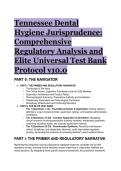
Tennessee Dental
Hygiene Jurisprudence:
Comprehensive
Regulatory Analysis and
Elite Universal Test Bank
Protocol v10.0
PART 0: THE NAVIGATOR
● PART I: THE PRIMER AND REGULATORY NARRATIVE
○ The Mission & The Hook
○ The Critical Axioms: Legislative Foundations and the 2026 Mandate
○ Supervision Architecture and Practice Ratios
○ Pharmacological Autonomy: Prescriptive Authority and Anesthesia
○ Teledentistry Parameters and Technological Constraints
○ Disciplinary Infrastructure and Continuing Education
● PART II: THE ELITE TEST BANK
○ Tier 1 (Questions 1–12) - Foundational Syntax & Application: Testing statutory
definitions, scope of practice limits, supervision ceilings, and baseline administrative
compliance.
○ Tier 2 (Questions 13–24) - Complex Application & Simulation: Navigating
clinical scenarios involving prescriptive authority variables, teledentistry guardrails,
continuing education audits, and nuanced supervision matrices.
○ Tier 3 (Questions 25–35) - Grandmaster Synthesis: Resolving multi-layered
ethical, disciplinary, and teledentistry dilemmas under high-stakes regulatory
scrutiny, demanding the synthesis of competing statutes to avert systemic failure.
PART I: THE PRIMER AND REGULATORY NARRATIVE
Mastering this exhaustive clinical jurisprudence database forges the candidate into an elite
regulatory scholar, ensuring clinical decisions remain impervious to malpractice liabilities and
board sanctions. By integrating these specific statutory frameworks, the practitioner transforms
,rote memorization into real-time, defensible professional intuition.
The Critical Axioms: Legislative Foundations and the 2026 Mandate
The Tennessee Board of Dentistry operates under a mandate to safeguard the health, safety,
and welfare of the public through the strict regulation of dentists, dental hygienists, and dental
assistants. The regulatory landscape is continuously evolving to balance expanding access to
care with the absolute necessity of clinical safety. A defining shift in this balance is the recent
legislative update regarding the composition of the Board itself.
Historically, dental hygienists appointed to the regulatory board were required to possess a
minimum of five years of clinical experience. However, recognizing the increasing complexity of
auxiliary scopes of practice—including prescriptive authority and advanced sedation
monitoring—the legislature amended Tennessee Code Annotated § 63-5-103(a)(2). For all
appointments made on or after July 1, 2026, a dental hygienist member must possess at least
six years of residency and practice in the state prior to their appointment. This statutory
amendment ensures that the regulatory authority governing the profession possesses a
sufficiently deep and unassailable foundation in the realities of Tennessee clinical practice.
Supervision Architecture and Practice Ratios
The delegation of clinical duties in Tennessee is strictly governed by the proximity and
availability of the authorizing dentist. The state utilizes a tiered supervision architecture to
dictate exactly what an auxiliary can perform, and how many auxiliaries a single dentist can
safely manage at any given moment. General supervision allows a dental hygienist to perform
delegable procedures without the dentist being physically present in the facility, provided the
patient is a patient of record and the dentist has authorized the services. Conversely, direct
supervision demands the uninterrupted, physical presence of the dentist within the treatment
facility for the duration of the procedure.
To prevent the hyper-commercialization of clinical practice and the degradation of patient safety,
the state enforces rigid supervision ratios. In a standard private practice setting, a licensed
dentist is strictly prohibited from allowing more than three (3) dental hygienists to practice under
general supervision at any one time. However, the state actively incentivizes altruism and public
health outreach. If a dentist is supervising hygienists who are providing dental services on a
volunteer basis through a non-profit provider of free mobile clinics, the supervision ratio
dramatically expands, allowing the dentist to directly supervise up to ten (10) dental hygienists
simultaneously.
Supervision Physical Presence Maximum Hygienist Authorized Delegable
Classification Required Ratio Duties
General Supervision Dentist not required 1 Dentist to 3 Prophylaxis, Sealants,
on-site Hygienists Radiographs, Topical
Fluorides (including
SDF), Prescriptive
Authority execution.
Direct Supervision Dentist physically in N/A (Standard) Subgingival curettage,
facility Root planing, Local
Anesthesia
administration, Nitrous
, Supervision Physical Presence Maximum Hygienist Authorized Delegable
Classification Required Ratio Duties
Oxide
monitoring/administrati
on.
Volunteer Clinic Dentist physically in 1 Dentist to 10 Permitted volunteer
Supervision facility Hygienists scope.
Pharmacological Autonomy: Prescriptive Authority and Anesthesia
The expansion of dental hygiene into pharmacological management represents a critical
evolution in the profession's scope of practice, governed heavily by Rule 0460-03-.13.
Tennessee dental hygienists are not granted automatic prescriptive rights upon licensure. To
obtain a Prescriptive Authority Certification, a hygienist must demonstrate a profound clinical
baseline by proving no less than 1,600 hours of active practice as a licensed dental hygienist,
alongside the successful completion of a rigorous, Board-approved two-hour pharmacology
continuing education course.
The authority granted is meticulously circumscribed. Hygienists are strictly limited to prescribing
fluoride agents, topical oral anesthetic agents, and nonsystemic oral antimicrobials. They are
absolutely prohibited from prescribing controlled substances or any medication requiring a
federal Drug Enforcement Agency (DEA) license. Furthermore, prescriptive autonomy is not
clinical independence; any prescription written by a hygienist must be formally reviewed by the
supervising dentist within 30 days, tethering the pharmacological intervention back to the
primary diagnostician.
Pharmacological Agent Authorized Drug Maximum Allowable Statutory
Category Concentration
Topical Anti-Caries Sodium Fluoride 1.1%
(Toothpaste/Gel)
Topical Anti-Caries Stannous Fluoride (Oral Rinse 0.63%
Concentrate)
Topical Anti-Caries Fluoride Varnish / Paste 5.0%
Topical Oral Anesthetic Benzocaine Up to 20%
Nonsystemic Antimicrobial Chlorhexidine Gluconate Rinse 0.12%
Nonsystemic Antimicrobial Arestin (Minocycline 1 mg per periodontal sulcus
Hydrochloride)
Beyond prescriptions, the administration of injectable local anesthesia and nitrous oxide
analgesia demands separate, standalone certifications. A hygienist cannot inject a patient
unless they have completed an ADA Commission on Dental Accreditation (CODA) approved
program that teaches local anesthesia to clinical competency, or a specific Board-approved
certification course. Unlike prescriptive authority, which operates under general supervision, the
administration of local anesthesia and the induction or monitoring of nitrous oxide
unconditionally demand the direct, physical presence of the dentist. The legal documentation
standards for these interventions are unforgiving; the clinical chart must record the exact date,
time, identity of the administering individual, type of anesthesia, dosage, precise anatomical site
of administration, and any adverse reaction.
Teledentistry Parameters and Technological Constraints
Hygiene Jurisprudence:
Comprehensive
Regulatory Analysis and
Elite Universal Test Bank
Protocol v10.0
PART 0: THE NAVIGATOR
● PART I: THE PRIMER AND REGULATORY NARRATIVE
○ The Mission & The Hook
○ The Critical Axioms: Legislative Foundations and the 2026 Mandate
○ Supervision Architecture and Practice Ratios
○ Pharmacological Autonomy: Prescriptive Authority and Anesthesia
○ Teledentistry Parameters and Technological Constraints
○ Disciplinary Infrastructure and Continuing Education
● PART II: THE ELITE TEST BANK
○ Tier 1 (Questions 1–12) - Foundational Syntax & Application: Testing statutory
definitions, scope of practice limits, supervision ceilings, and baseline administrative
compliance.
○ Tier 2 (Questions 13–24) - Complex Application & Simulation: Navigating
clinical scenarios involving prescriptive authority variables, teledentistry guardrails,
continuing education audits, and nuanced supervision matrices.
○ Tier 3 (Questions 25–35) - Grandmaster Synthesis: Resolving multi-layered
ethical, disciplinary, and teledentistry dilemmas under high-stakes regulatory
scrutiny, demanding the synthesis of competing statutes to avert systemic failure.
PART I: THE PRIMER AND REGULATORY NARRATIVE
Mastering this exhaustive clinical jurisprudence database forges the candidate into an elite
regulatory scholar, ensuring clinical decisions remain impervious to malpractice liabilities and
board sanctions. By integrating these specific statutory frameworks, the practitioner transforms
,rote memorization into real-time, defensible professional intuition.
The Critical Axioms: Legislative Foundations and the 2026 Mandate
The Tennessee Board of Dentistry operates under a mandate to safeguard the health, safety,
and welfare of the public through the strict regulation of dentists, dental hygienists, and dental
assistants. The regulatory landscape is continuously evolving to balance expanding access to
care with the absolute necessity of clinical safety. A defining shift in this balance is the recent
legislative update regarding the composition of the Board itself.
Historically, dental hygienists appointed to the regulatory board were required to possess a
minimum of five years of clinical experience. However, recognizing the increasing complexity of
auxiliary scopes of practice—including prescriptive authority and advanced sedation
monitoring—the legislature amended Tennessee Code Annotated § 63-5-103(a)(2). For all
appointments made on or after July 1, 2026, a dental hygienist member must possess at least
six years of residency and practice in the state prior to their appointment. This statutory
amendment ensures that the regulatory authority governing the profession possesses a
sufficiently deep and unassailable foundation in the realities of Tennessee clinical practice.
Supervision Architecture and Practice Ratios
The delegation of clinical duties in Tennessee is strictly governed by the proximity and
availability of the authorizing dentist. The state utilizes a tiered supervision architecture to
dictate exactly what an auxiliary can perform, and how many auxiliaries a single dentist can
safely manage at any given moment. General supervision allows a dental hygienist to perform
delegable procedures without the dentist being physically present in the facility, provided the
patient is a patient of record and the dentist has authorized the services. Conversely, direct
supervision demands the uninterrupted, physical presence of the dentist within the treatment
facility for the duration of the procedure.
To prevent the hyper-commercialization of clinical practice and the degradation of patient safety,
the state enforces rigid supervision ratios. In a standard private practice setting, a licensed
dentist is strictly prohibited from allowing more than three (3) dental hygienists to practice under
general supervision at any one time. However, the state actively incentivizes altruism and public
health outreach. If a dentist is supervising hygienists who are providing dental services on a
volunteer basis through a non-profit provider of free mobile clinics, the supervision ratio
dramatically expands, allowing the dentist to directly supervise up to ten (10) dental hygienists
simultaneously.
Supervision Physical Presence Maximum Hygienist Authorized Delegable
Classification Required Ratio Duties
General Supervision Dentist not required 1 Dentist to 3 Prophylaxis, Sealants,
on-site Hygienists Radiographs, Topical
Fluorides (including
SDF), Prescriptive
Authority execution.
Direct Supervision Dentist physically in N/A (Standard) Subgingival curettage,
facility Root planing, Local
Anesthesia
administration, Nitrous
, Supervision Physical Presence Maximum Hygienist Authorized Delegable
Classification Required Ratio Duties
Oxide
monitoring/administrati
on.
Volunteer Clinic Dentist physically in 1 Dentist to 10 Permitted volunteer
Supervision facility Hygienists scope.
Pharmacological Autonomy: Prescriptive Authority and Anesthesia
The expansion of dental hygiene into pharmacological management represents a critical
evolution in the profession's scope of practice, governed heavily by Rule 0460-03-.13.
Tennessee dental hygienists are not granted automatic prescriptive rights upon licensure. To
obtain a Prescriptive Authority Certification, a hygienist must demonstrate a profound clinical
baseline by proving no less than 1,600 hours of active practice as a licensed dental hygienist,
alongside the successful completion of a rigorous, Board-approved two-hour pharmacology
continuing education course.
The authority granted is meticulously circumscribed. Hygienists are strictly limited to prescribing
fluoride agents, topical oral anesthetic agents, and nonsystemic oral antimicrobials. They are
absolutely prohibited from prescribing controlled substances or any medication requiring a
federal Drug Enforcement Agency (DEA) license. Furthermore, prescriptive autonomy is not
clinical independence; any prescription written by a hygienist must be formally reviewed by the
supervising dentist within 30 days, tethering the pharmacological intervention back to the
primary diagnostician.
Pharmacological Agent Authorized Drug Maximum Allowable Statutory
Category Concentration
Topical Anti-Caries Sodium Fluoride 1.1%
(Toothpaste/Gel)
Topical Anti-Caries Stannous Fluoride (Oral Rinse 0.63%
Concentrate)
Topical Anti-Caries Fluoride Varnish / Paste 5.0%
Topical Oral Anesthetic Benzocaine Up to 20%
Nonsystemic Antimicrobial Chlorhexidine Gluconate Rinse 0.12%
Nonsystemic Antimicrobial Arestin (Minocycline 1 mg per periodontal sulcus
Hydrochloride)
Beyond prescriptions, the administration of injectable local anesthesia and nitrous oxide
analgesia demands separate, standalone certifications. A hygienist cannot inject a patient
unless they have completed an ADA Commission on Dental Accreditation (CODA) approved
program that teaches local anesthesia to clinical competency, or a specific Board-approved
certification course. Unlike prescriptive authority, which operates under general supervision, the
administration of local anesthesia and the induction or monitoring of nitrous oxide
unconditionally demand the direct, physical presence of the dentist. The legal documentation
standards for these interventions are unforgiving; the clinical chart must record the exact date,
time, identity of the administering individual, type of anesthesia, dosage, precise anatomical site
of administration, and any adverse reaction.
Teledentistry Parameters and Technological Constraints

