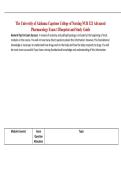
The University of Alabama Capstone College of Nursing NUR 521 Advanced
Pharmacology Exam 1 Blueprint and Study Guide
General Tips for Exam Success: A review of anatomy and pathophysiology is included at the beginning of most
modules in the course. You will not see many direct questions about this information; however, this foundational
knowledge is necessary to understand how drugs work in the body and how the body responds to drugs. You will
be much more successful if you have a strong foundational knowledge and understanding of this information.
Module Covered Exam Topic
Question
Allocation
,Module I: Foundational 10 Legal Issues
You are responsible for knowing the name, MOA, Use, Common AE, Serious AE, Dosing, Administration, CI,
Interactions, and Patient Education for all prototype drugs included in each module. Most of the exam
questions will focus on the prototype drugs presented in each module. You also need to know about the drug
class across the life span. There is content in each module that discusses use of each drug class in pediatric,
pregnancy, breastfeeding, and older adult populations. You will not necessarily need to know an exact dose for
prescribing on all of the prototype drugs, but if faculty stresses a certain dose in a lecture, you will be responsible
for this information. When attempting to narrow down the content, consider what you need to know to be a safe
prescriber. Also, listen for tips and what is emphasized in the lecture. This study guide is intended to help you
focus your studies, but it does not include a list of all necessary details about each individual drug. If any
evidenced base guidelines were presented in the module, I would be sure to review what information was
discussed by faculty in the lecture.
,Principles of o Why should APRNs have full prescriptive authority? Who would
Pharmacotherapeutics benefit from this?
o Whether APRNs possess full prescriptive authority depends on
their legal right to prescribe without a supervisory or
collaborative requirement. APRNs are educated to practice and
prescribe independently without supervision; however, some
state laws require that they practice in collaboration with or
under a physician's supervision.
o Advance practice providers complete rigorous programs of
study, largely in accredited programs that meet stringent
national standards. Although there are differences in each
program, all include common components. They require
extensive education focused on assessment, diagnosis, and
management of health problems. Diagnostic reasoning, critical
thinking, and procedural skills are evaluated in both didactic
and clinical courses. National examinations validate the ability
to provide safe and competent care. Licensure ensures that
providers comply with standards of the practice that promote
public health and safety.
o Limited prescriptive authority creates numerous barriers to
quality, affordable, and accessible patient care.
, Controlled Substances Classification o What is the definition of
each schedule? Can you provide an example drug that fits in
each schedule? o Schedule I: substances in this schedule are
those that have no
accepted medical use in the United States and have a high
potential for abuse. e.g. heronin, marijuana, LSD, MDMA
o Schedule II: substances in this schedule have a high abuse
potential with sever psychic or physical dependence liability.
Consists of certain narcotics and stimulants and depressant
drugs. e.g. opium, morphine codeine, dilaudid, methadone
demerol, and hydrocodone. Can also consist of narcotic and
stimulant drugs. o Schedule III: Substances listed in this class
have a potential for abuse, B less than those in schedule I and II.
Includes compounds containing limited quantities of certain
narcotic drugs. e.g. products containing no more than 90 mg of
codeine per dosage unit such as Tylenol with codeine,
Buprenophrine
o Buprenorphine- is a long-acting opioid drug used to replace
shorter- acting opioids that someone may be addicted to, such as
heroin, oxycodone, fentanyl, or hydromorphone. o
Pharmacology Exam 1 Blueprint and Study Guide
General Tips for Exam Success: A review of anatomy and pathophysiology is included at the beginning of most
modules in the course. You will not see many direct questions about this information; however, this foundational
knowledge is necessary to understand how drugs work in the body and how the body responds to drugs. You will
be much more successful if you have a strong foundational knowledge and understanding of this information.
Module Covered Exam Topic
Question
Allocation
,Module I: Foundational 10 Legal Issues
You are responsible for knowing the name, MOA, Use, Common AE, Serious AE, Dosing, Administration, CI,
Interactions, and Patient Education for all prototype drugs included in each module. Most of the exam
questions will focus on the prototype drugs presented in each module. You also need to know about the drug
class across the life span. There is content in each module that discusses use of each drug class in pediatric,
pregnancy, breastfeeding, and older adult populations. You will not necessarily need to know an exact dose for
prescribing on all of the prototype drugs, but if faculty stresses a certain dose in a lecture, you will be responsible
for this information. When attempting to narrow down the content, consider what you need to know to be a safe
prescriber. Also, listen for tips and what is emphasized in the lecture. This study guide is intended to help you
focus your studies, but it does not include a list of all necessary details about each individual drug. If any
evidenced base guidelines were presented in the module, I would be sure to review what information was
discussed by faculty in the lecture.
,Principles of o Why should APRNs have full prescriptive authority? Who would
Pharmacotherapeutics benefit from this?
o Whether APRNs possess full prescriptive authority depends on
their legal right to prescribe without a supervisory or
collaborative requirement. APRNs are educated to practice and
prescribe independently without supervision; however, some
state laws require that they practice in collaboration with or
under a physician's supervision.
o Advance practice providers complete rigorous programs of
study, largely in accredited programs that meet stringent
national standards. Although there are differences in each
program, all include common components. They require
extensive education focused on assessment, diagnosis, and
management of health problems. Diagnostic reasoning, critical
thinking, and procedural skills are evaluated in both didactic
and clinical courses. National examinations validate the ability
to provide safe and competent care. Licensure ensures that
providers comply with standards of the practice that promote
public health and safety.
o Limited prescriptive authority creates numerous barriers to
quality, affordable, and accessible patient care.
, Controlled Substances Classification o What is the definition of
each schedule? Can you provide an example drug that fits in
each schedule? o Schedule I: substances in this schedule are
those that have no
accepted medical use in the United States and have a high
potential for abuse. e.g. heronin, marijuana, LSD, MDMA
o Schedule II: substances in this schedule have a high abuse
potential with sever psychic or physical dependence liability.
Consists of certain narcotics and stimulants and depressant
drugs. e.g. opium, morphine codeine, dilaudid, methadone
demerol, and hydrocodone. Can also consist of narcotic and
stimulant drugs. o Schedule III: Substances listed in this class
have a potential for abuse, B less than those in schedule I and II.
Includes compounds containing limited quantities of certain
narcotic drugs. e.g. products containing no more than 90 mg of
codeine per dosage unit such as Tylenol with codeine,
Buprenophrine
o Buprenorphine- is a long-acting opioid drug used to replace
shorter- acting opioids that someone may be addicted to, such as
heroin, oxycodone, fentanyl, or hydromorphone. o