Biological Molecules
Oxidation and reduction reactions
- Loss of electrons oxidation formation of positive ion
- Receiving of election reduction formation of negative ion
Bonding and formation of molecules
- Covalent bonding: atoms share a pair of electrons in their outer shell the outer
shell of both atoms is filled, and a stable molecule is formed
- Ionic bonding: ions with opposite charges attract one another. Weaker than covalent
bonding
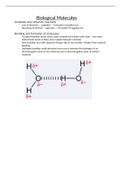
- Hydrogen bonding: weak attractive force occurs between the hydrogen of an
electronegative atom of one molecule and an electronegative atom of another
molecule
, Protons Neutrons Electrons
(no charge) (-ve)
(+ve)
Isotopes Atom Ion
Inorganic mineral
Molecules
ions
Nucleotides Monosaccharides Fatty acids Glycerol Amino acids Water
Lipids
Polynucleotides Polysaccharides Polypeptides
(nucleic acid) (carbohydrates) (proteins)
® Condensation
® Hydrolysis
, Carbohydrates
Monosaccharides
Sweet tasting
Soluble
Same number Carbon and Oxygen atoms but twice as many Hydrogen atoms
(CH2O)n ® n = 3 to 7
Types of monosaccharides
Formula Name Examples
C3O6H3 Triose Glyceraldehyde
C5H10O5 Pentose Ribose
Deoxyribose
C6H12O6 Hexose Glucose
Fructose
Galactose
*All are reducing sugars = all will test positive when tested with Benedict’s solution
a-glucose hydroxyl
group is at the bottom
b-glucose hydroxyl group is at
the top
Oxidation and reduction reactions
- Loss of electrons oxidation formation of positive ion
- Receiving of election reduction formation of negative ion
Bonding and formation of molecules
- Covalent bonding: atoms share a pair of electrons in their outer shell the outer
shell of both atoms is filled, and a stable molecule is formed
- Ionic bonding: ions with opposite charges attract one another. Weaker than covalent
bonding
- Hydrogen bonding: weak attractive force occurs between the hydrogen of an
electronegative atom of one molecule and an electronegative atom of another
molecule
, Protons Neutrons Electrons
(no charge) (-ve)
(+ve)
Isotopes Atom Ion
Inorganic mineral
Molecules
ions
Nucleotides Monosaccharides Fatty acids Glycerol Amino acids Water
Lipids
Polynucleotides Polysaccharides Polypeptides
(nucleic acid) (carbohydrates) (proteins)
® Condensation
® Hydrolysis
, Carbohydrates
Monosaccharides
Sweet tasting
Soluble
Same number Carbon and Oxygen atoms but twice as many Hydrogen atoms
(CH2O)n ® n = 3 to 7
Types of monosaccharides
Formula Name Examples
C3O6H3 Triose Glyceraldehyde
C5H10O5 Pentose Ribose
Deoxyribose
C6H12O6 Hexose Glucose
Fructose
Galactose
*All are reducing sugars = all will test positive when tested with Benedict’s solution
a-glucose hydroxyl
group is at the bottom
b-glucose hydroxyl group is at
the top