

Escrito por estudiantes que aprobaron Inmediatamente disponible después del pago Leer en línea o como PDF ¿Documento equivocado? Cámbialo gratis 4,6 TrustPilot
logo-home
Document preview thumbnail
Vista previa 3 fuera de 30 páginas
Examen

CHEM 2202 Lab 2026/2027 | 100+ Exam Questions & Answers | TLC, Distillation, Chromatography, Recrystallization & Stereochemistry

Document preview thumbnail
Vista previa 3 fuera de 30 páginas

CHEM 2202 Lab 2026/2027 is a comprehensive 30-page organic chemistry laboratory exam study guide containing 100+ questions and answers, presented as already graded A+. The material provides detailed preparation across essential laboratory concepts, calculations and experimental techniques, with major coverage of thin-layer chromatography (TLC), simple and fractional distillation, fermentation, hydrometry, column chromatography, extraction, recrystallization, stereochemistry and green chemistry. The question-and-answer structure is particularly useful for active recall, laboratory quizzes, practical examinations and final exam revision. The opening section provides extensive coverage of thin-layer chromatography (TLC). Students review the composition of silica/alumina TLC plates, preparation and use of glass spotters, developing chambers, solvent saturation, correct sample application and UV visualization. The document explains how to calculate Rf values, why Rf is dimensionless, how stationary-phase and solvent polarity affect compound migration and why polar compounds generally travel less on a polar stationary phase. It also discusses the recommended Rf range and correct procedures for comparing chromatographic results. These principles are consistent with the standard treatment of chromatography in Pavia et al., Introduction to Organic Laboratory Techniques. A second major area covers fermentation and distillation. Questions explain the conversion of sucrose to ethanol and carbon dioxide, limitations caused by ethanol concentration and the interpretation of percentage solutions. The material then distinguishes simple from fractional distillation, including boiling-point behavior of pure liquids versus mixtures, vaporization and condensation, fractionating columns, theoretical plates, boiling-point differences, thermometer readings, collection rates and practical procedures for obtaining relatively pure fractions. Hydrometer operation and density measurements are also included. The chromatography material extends beyond TLC to column chromatography and separation theory. Students review mobile and stationary phases, analytes, eluents, silica as a polar stationary phase and how differences in polarity, solubility, vapor pressure and affinity influence chromatographic separation. The document also uses practical examples to help students predict elution order and determine which fractions are relatively more or less polar. Another important laboratory application is caffeine extraction from tea. The resource discusses cellulose, caffeine, tannins, gallic acid, methylene chloride extraction, aqueous and organic phases, drying agents and the origin of colored impurities in crude caffeine. It also considers an alternative calcium-carbonate treatment for removing tannins and gallic acid and the filtration step needed to separate insoluble salts. The recrystallization and purification section explains how solvent choice depends on temperature-dependent solubility. Students learn that a suitable recrystallization solvent should dissolve the desired compound when hot but poorly when cold, while impurities should either remain soluble in cold solvent or remain insoluble in hot solvent. Practical questions cover hot and cold filtration, washing crystals, acetanilide purification and quantitative calculations involving solubility and expected mass recovery. These procedures align with standard experimental organic chemistry methodology described in established laboratory texts such as Mohrig et al., Laboratory Techniques in Organic Chemistry. The document additionally provides substantial revision of stereochemistry, including chirality, chiral carbons, enantiomers, diastereomers, structural isomers, stereoisomers, meso compounds, planes of symmetry, E/Z configurations, axial bonds and conformational analysis. Staggered and eclipsed conformations are compared in terms of energy and steric strain, helping connect three-dimensional molecular structure with stability. Finally, the resource introduces green chemistry, atom economy and reaction mass efficiency, connecting laboratory chemistry with waste reduction and more sustainable chemical processes. It also includes an ecotoxicity experiment involving lettuce-seed germination and root growth at different alcohol concentrations, while explicitly noting the limitations of extrapolating plant-assay observations to human toxicity. Overall, the document combines laboratory theory, experimental procedures, calculations and conceptual questions into a practical CHEM 2202 exam-preparation resource. Relevant Students: This document is most relevant to students enrolled in CHEM 2202 or an equivalent undergraduate organic chemistry laboratory course. It can also support students in chemistry, biochemistry, biomedical science, pharmaceutical science, pharmacy, chemical biology, environmental science and other programs requiring practical knowledge of separation, purification, chromatography and stereochemistry. The uploaded material does not identify a university, so a university name should not be added until the institution can be verified. Keywords: CHEM 2202, CHEM 2202 Lab, CHEM , CHEM 2202 exam questions, CHEM 2202 exam answers, organic chemistry lab, organic chemistry lab exam, laboratory exam questions, TLC, thin layer chromatography, Rf value, TLC polarity, chromatography, column chromatography, mobile phase, stationary phase, simple distillation, fractional distillation, theoretical plates, boiling point, ethanol fermentation, hydrometer, density measurement, caffeine extraction, tea caffeine extraction, drying agents, recrystallization, acetanilide recrystallization, hot filtration, cold filtration, solubility calculations, stereochemistry, chirality, chiral carbon, enantiomers, diastereomers, meso compounds, E Z isomers, conformational analysis, steric strain, green chemistry, atom economy, reaction mass efficiency, chemistry laboratory techniques, organic chemistry study guide, chemistry lab exam preparation

Vista previa del contenido

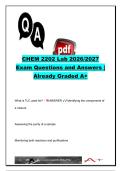
CHEM 2202 Lab 2026/2027
Exam Questions and Answers |
Already Graded A+


What is TLC used for? - ANSWER ✔✔Identifying the components of

a mixture


Assessing the purity of a sample


Monitoring both reactions and purifications

,What are TLC plates composed of? - ANSWER ✔✔Polar absorbant

(silica or aluminum)


bound to solid powder (plastic or glass)


Fluorescent powder mixed in to aid with visualization


What is a sample applied to a TLC plate using? - ANSWER ✔✔Glass

Spotter: prepared by pulling and heating a pipette

Where do you put a TLC plate that has been dabbed with a sample by a

glass spotter? - ANSWER ✔✔In a developing chamber. Basically a

glass jar, with a piece of round filter paper and 5-10 mL of an appropriate

developing solvent


How do you assemble the developing chamber? - ANSWER ✔✔1.

Put the round filter paper on the side


2. Pour 5-10 mL of developing solvent

, 3. Close the chamber immediately. The moist filter paper indicates that

the solvent hasn't left the chamber


4. Pencil in a line and a mark for each compound


5. 1-3 spots lightly tapped for each compound. The smaller the better.

Make sure the compound doesn't dissolve completely in solvent


6. Place plate in developing chamber. Make sure spots are below

solvent in the chamber. Otherwise, the sample will dissolve in the

solvent


7. Make sure the TLC plate doesn't touch the filter paper, otherwise the

capillary movement will be disturbed


8. When the solvent has travelled up the TLC plate, remove it and

immediately draw a line where the solvent stopped. The solvent will soon

disappear


COPYRIGHT©NINJANERD 2025/2026. YEAR PUBLISHED 2026. COMPANY REGISTRATION NUMBER: 619652435. TERMS OF USE. PRIVACY
STATEMENT. ALL RIGHTS RESERVED
3


Información del documento

Subido en
7 de agosto de 2026
Número de páginas
30
Escrito en
2026/2027
Tipo
Examen
Contiene
Preguntas y respuestas
$18.99

¿Documento equivocado? Cámbialo gratis Dentro de los 14 días posteriores a la compra y antes de descargarlo, puedes elegir otro documento. Puedes gastar el importe de nuevo.
Escrito por estudiantes que aprobaron
Inmediatamente disponible después del pago
Leer en línea o como PDF

Seller avatar
Los indicadores de reputación están sujetos a la cantidad de artículos vendidos por una tarifa y las reseñas que ha recibido por esos documentos. Hay tres niveles: Bronce, Plata y Oro. Cuanto mayor reputación, más podrás confiar en la calidad del trabajo del vendedor.
NinjaNerd
3.4
(76)
Vendido
395
Seguidores
6
Artículos
15309
Última venta
15 horas hace


Por qué los estudiantes eligen Stuvia

Creado por compañeros estudiantes, verificado por reseñas

Calidad en la que puedes confiar: escrito por estudiantes que aprobaron y evaluado por otros que han usado estos resúmenes.

¿No estás satisfecho? Elige otro documento

¡No te preocupes! Puedes elegir directamente otro documento que se ajuste mejor a lo que buscas.

Paga como quieras, empieza a estudiar al instante

Sin suscripción, sin compromisos. Paga como estés acostumbrado con tarjeta de crédito y descarga tu documento PDF inmediatamente.

Student with book image

“Comprado, descargado y aprobado. Así de fácil puede ser.”

Alisha Student

Preguntas frecuentes