

Escrito por estudiantes que aprobaron Inmediatamente disponible después del pago Leer en línea o como PDF ¿Documento equivocado? Cámbialo gratis 4,6 TrustPilot
logo-home
Document preview thumbnail
Vista previa 2 fuera de 13 páginas
Examen

CHEM 335 Organic Chemistry Reagents 2026/2027 | 70+ Reagents & Reactions | SN1/SN2, E2, Grignard, Oxidation & Reduction

Document preview thumbnail
Vista previa 2 fuera de 13 páginas

CHEM 335 Reagents 2026/2027 is a focused 13-page organic chemistry reagent and reaction study guide covering 70+ reagents, reaction conditions and synthetic transformations for exam preparation. The material organizes commonly tested reagents by what they accomplish, including alkene and alkyne reactions, substitution and elimination, oxidation and reduction, carbonyl chemistry, aromatic reactions, Grignard chemistry, ester reactions and carbon–carbon bond-forming reactions. For many transformations, the document identifies Markovnikov versus anti-Markovnikov regioselectivity, syn versus anti stereochemistry, nucleophile/base strength and the expected functional-group conversion, making it particularly useful for reaction prediction and synthesis questions. The guide begins with major alkene, alkyne, substitution and elimination reagents. It reviews acid-catalyzed hydration with H₃O⁺, alcohol dehydration with concentrated H₂SO₄ and heat, NaOEt and t-BuOK for SN2/E2 chemistry, catalytic hydrogenation with H₂/Pt, Lindlar reduction of alkynes, dissolving-metal reduction, hydroboration–oxidation, oxymercuration–demercuration, halogenation, HBr addition and radical HBr/ROOR chemistry. It also covers PBr₃, SOCl₂/pyridine and TsCl/pyridine for transforming alcohols into better leaving groups or alkyl halides. A substantial portion covers oxidation and reduction reactions. LiAlH₄ and NaBH₄ are compared as reducing agents for carbonyl-containing compounds, while PCC and dichromate conditions are used for alcohol oxidation. Other transformations include ozonolysis, Baeyer–Villiger oxidation, Clemmensen reduction and selective conversion of acid chlorides to aldehydes. These reaction families are fundamental to undergraduate organic synthesis and are treated extensively in standard references such as Clayden, Greeves and Warren's Organic Chemistry and McMurry's Organic Chemistry. The document also provides concentrated revision of carbonyl chemistry and carbon–carbon bond formation, including cyanohydrin formation, acetals, imines, enamines, reductive amination, Wittig reactions, Grignard reagents and organocuprate/Gilman reagents. Grignard chemistry includes reactions with carbonyl electrophiles and CO₂, while Wittig chemistry is presented as a method for converting carbonyl compounds into alkenes. These transformations are especially relevant for multistep synthesis problems in which students must choose an appropriate reagent sequence to produce a target molecule. The aromatic chemistry section reviews electrophilic aromatic substitution and diazonium chemistry, including Br₂/FeBr₃, Cl₂/AlCl₃, HNO₃/H₂SO₄ nitration and sulfonation. It also covers conversion of nitro groups to amines, formation of aryldiazonium salts and subsequent replacement reactions using CuBr, CuCl, CuI, CuCN, HBF₄, water/heat and H₃PO₂. Later sections address carboxylic acids and derivatives, ester chemistry and synthetic strategies. Students can review Fischer esterification, acid-catalyzed ester hydrolysis, saponification, amide formation, malonic ester synthesis, acetoacetic ester synthesis, Claisen condensation, Michael reactions and Stork enamine synthesis. The final material also introduces azide and Gabriel syntheses as strategies for preparing primary amines. Overall, the compact reagent-to-product format makes the document particularly valuable for memorizing reaction conditions, predicting products, comparing similar reagents and preparing for synthesis-heavy CHEM 335 examinations. Relevant Students: This resource is most relevant to students enrolled in CHEM 335 or equivalent Organic Chemistry II/advanced organic chemistry courses. It can also support students studying chemistry, biochemistry, medicinal chemistry, pharmaceutical sciences, pharmacy, chemical biology and related programs that require mastery of organic reagents and synthetic transformations. The uploaded document does not identify a university, so an institution should not be invented for the title. Keywords: CHEM 335, CHEM 335 reagents, CHEM , organic chemistry reagents, organic chemistry reaction guide, organic chemistry reagent chart, organic chemistry reactions, organic chemistry exam preparation, reaction mechanisms, reaction prediction, organic synthesis, SN2 reactions, E2 reactions, nucleophiles and bases, Markovnikov addition, anti Markovnikov addition, syn addition, anti addition, alkene reactions, alkyne reactions, hydroboration oxidation, oxymercuration demercuration, ozonolysis, catalytic hydrogenation, Lindlar catalyst, LiAlH4, NaBH4, PCC oxidation, Grignard reagents, Gilman reagent, Wittig reaction, carbonyl reactions, reductive amination, imine formation, enamine formation, electrophilic aromatic substitution, aromatic nitration, aromatic halogenation, diazonium reactions, Fischer esterification, ester hydrolysis, saponification, malonic ester synthesis, acetoacetic ester synthesis, Claisen condensation, Michael reaction, Stork enamine synthesis, Gabriel synthesis, organic chemistry study guide

Vista previa del contenido

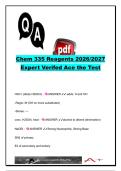
Chem 335 Reagents 2026/2027
Expert Verifed Ace the Test


H3O+ (dilute H2SO4) - ANSWER ✔✔-adds: H and OH


-Regio: M (OH on more substituted)

-Stereo: ---


conc. H2SO4, heat - ANSWER ✔✔alcohol to alkene (elimination)


NaOEt - ANSWER ✔✔Strong Nucleophile, Strong Base


SN2 of primary

E2 of secondary and tertiary

, t-BuOK - ANSWER ✔✔strong base, weak nucleophile (E2), double

bond on least substituted


H2, Pt - ANSWER ✔✔Alkyne/Alkene to Alkane via syn addition.


H2, Lindar's Catalyst - ANSWER ✔✔alkyne to cis (Z) alkene


adds: 2 H atoms

regio:--

stereo: cis, syn addition (both H on same side)


Na, NH3 - ANSWER ✔✔alkyne to trans (E) alkene


adds: 2 H atoms

regio: --

stereo: trans, syn addition (both H on same side)


LAH (LiAlH4), H2O - ANSWER ✔✔reduces ketones, aldehydes, AND

esters to alcohols (stronger reducing agent)


xs LAH, then H2O + amide - ANSWER ✔✔amide to amine (removes

=O completely)


xs LAH, then H2O + carboxylic acid - ANSWER ✔✔carboxylic acid to

alcohol (removes =O)

Información del documento

Subido en
7 de agosto de 2026
Número de páginas
13
Escrito en
2026/2027
Tipo
Examen
Contiene
Preguntas y respuestas
$18.99

¿Documento equivocado? Cámbialo gratis Dentro de los 14 días posteriores a la compra y antes de descargarlo, puedes elegir otro documento. Puedes gastar el importe de nuevo.
Escrito por estudiantes que aprobaron
Inmediatamente disponible después del pago
Leer en línea o como PDF

Seller avatar
Los indicadores de reputación están sujetos a la cantidad de artículos vendidos por una tarifa y las reseñas que ha recibido por esos documentos. Hay tres niveles: Bronce, Plata y Oro. Cuanto mayor reputación, más podrás confiar en la calidad del trabajo del vendedor.
NinjaNerd
3.4
(76)
Vendido
395
Seguidores
6
Artículos
15309
Última venta
15 horas hace


Por qué los estudiantes eligen Stuvia

Creado por compañeros estudiantes, verificado por reseñas

Calidad en la que puedes confiar: escrito por estudiantes que aprobaron y evaluado por otros que han usado estos resúmenes.

¿No estás satisfecho? Elige otro documento

¡No te preocupes! Puedes elegir directamente otro documento que se ajuste mejor a lo que buscas.

Paga como quieras, empieza a estudiar al instante

Sin suscripción, sin compromisos. Paga como estés acostumbrado con tarjeta de crédito y descarga tu documento PDF inmediatamente.

Student with book image

“Comprado, descargado y aprobado. Así de fácil puede ser.”

Alisha Student

Preguntas frecuentes
