

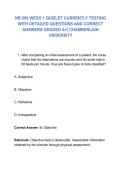
NR 509 WEEK 1 QUIZLET CURRENTLY TESTING
WITH DETAILED QUESTIONS AND CORRECT
ANSWERS GRADED A+| CHAMBERLAIN
UNIVERSITY
1. After completing an initial assessment of a patient, the nurse
charts that his respirations are eupneic and his pulse rate is
58 beats per minute. How are these types of data classified?
A. Subjective
B. Objective
C. Reflective
D. Introspective
Correct Answer: B. Objective
Rationale: Objective data is observable, measurable information
obtained by the clinician through physical assessment,
,measurement, or diagnostic testing. Pulse rate and respiratory
observations are direct measurements.
2. A patient reports feeling extremely nervous, nauseated, and
warm. Which category of data does this represent?
A. Objective
B. Reflective
C. Subjective
D. Introspective
Correct Answer: C. Subjective
Rationale: Subjective data consists of symptoms, sensations,
and feelings reported directly by the patient that cannot be directly
measured or verified independently by an examiner.
3. The combination of the patient's record, laboratory studies,
physical assessment findings, and subjective statements
forms the:
,A. Financial statement
B. Admitting data
C. Database
D. Discharge summary
Correct Answer: C. Database
Rationale: The patient database incorporates subjective history,
objective physical exam findings, medical records, and diagnostic
results to establish a comprehensive profile for clinical decision-
making.
4. While auscultating breath sounds, a nurse hears an
unfamiliar sound. What is the nurse's most appropriate
immediate action?
A. Notify the attending physician immediately
B. Document the sound exactly as heard without further action
, C. Validate the data by asking a colleague to listen to the breath
sounds
D. Re-assess the patient in 30 minutes to determine if the sound
persists
Correct Answer: C. Validate the data by asking a colleague to
listen to breath sounds
Rationale: When assessment findings are uncertain, the clinician
should first validate the data to ensure accuracy before forming
diagnostic conclusions or initiating interventions.
5. When teaching graduate nurses about clinical decision-
making, the nurse educator notes that novice nurses rely
primarily on which approach?
A. Intuition
B. A defined set of rules
C. Published journal articles
D. Collegial advice
WITH DETAILED QUESTIONS AND CORRECT
ANSWERS GRADED A+| CHAMBERLAIN
UNIVERSITY
1. After completing an initial assessment of a patient, the nurse
charts that his respirations are eupneic and his pulse rate is
58 beats per minute. How are these types of data classified?
A. Subjective
B. Objective
C. Reflective
D. Introspective
Correct Answer: B. Objective
Rationale: Objective data is observable, measurable information
obtained by the clinician through physical assessment,
,measurement, or diagnostic testing. Pulse rate and respiratory
observations are direct measurements.
2. A patient reports feeling extremely nervous, nauseated, and
warm. Which category of data does this represent?
A. Objective
B. Reflective
C. Subjective
D. Introspective
Correct Answer: C. Subjective
Rationale: Subjective data consists of symptoms, sensations,
and feelings reported directly by the patient that cannot be directly
measured or verified independently by an examiner.
3. The combination of the patient's record, laboratory studies,
physical assessment findings, and subjective statements
forms the:
,A. Financial statement
B. Admitting data
C. Database
D. Discharge summary
Correct Answer: C. Database
Rationale: The patient database incorporates subjective history,
objective physical exam findings, medical records, and diagnostic
results to establish a comprehensive profile for clinical decision-
making.
4. While auscultating breath sounds, a nurse hears an
unfamiliar sound. What is the nurse's most appropriate
immediate action?
A. Notify the attending physician immediately
B. Document the sound exactly as heard without further action
, C. Validate the data by asking a colleague to listen to the breath
sounds
D. Re-assess the patient in 30 minutes to determine if the sound
persists
Correct Answer: C. Validate the data by asking a colleague to
listen to breath sounds
Rationale: When assessment findings are uncertain, the clinician
should first validate the data to ensure accuracy before forming
diagnostic conclusions or initiating interventions.
5. When teaching graduate nurses about clinical decision-
making, the nurse educator notes that novice nurses rely
primarily on which approach?
A. Intuition
B. A defined set of rules
C. Published journal articles
D. Collegial advice

