

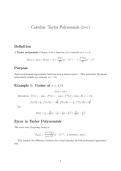
Calculus: Taylor Polynomials (x=c)
Definition
A Taylor polynomial of degree n for a function f (x) centered at x = c is:
f ′′ (c) f (n) (c)
Pn (x) = f (c) + f ′ (c)(x − c) + (x − c)2 + · · · + (x − c)n
2! n!
Purpose
Taylor polynomials approximate functions near a chosen center c. They generalize Maclaurin
polynomials (which are centered at c = 0).
Example 1: Cosine at c = π/3
f (x) = cos x
Derivatives: f ′ (x) = − sin x, f ′′ (x) = − cos x, f (3) (x) = sin x. At x = π/3:
√ √
f (π/3) = 12 , f ′ (π/3) = − 2
3
, f ′′ (π/3) = − 12 , f (3) (π/3) = 2
3
So:
√ √
P3 (x) = 1
2
− 2
3
(x − π3 ) − 14 (x − π3 )2 + 3
12
(x − π3 )3
Error in Taylor Polynomials
The error term (Lagrange form) is:
f (n+1) (ξ)
Rn (x) = (x − c)n+1 , ξ between c and x
(n + 1)!
This bounds the difference between the actual function and the polynomial approxima-
tion.
1
Definition
A Taylor polynomial of degree n for a function f (x) centered at x = c is:
f ′′ (c) f (n) (c)
Pn (x) = f (c) + f ′ (c)(x − c) + (x − c)2 + · · · + (x − c)n
2! n!
Purpose
Taylor polynomials approximate functions near a chosen center c. They generalize Maclaurin
polynomials (which are centered at c = 0).
Example 1: Cosine at c = π/3
f (x) = cos x
Derivatives: f ′ (x) = − sin x, f ′′ (x) = − cos x, f (3) (x) = sin x. At x = π/3:
√ √
f (π/3) = 12 , f ′ (π/3) = − 2
3
, f ′′ (π/3) = − 12 , f (3) (π/3) = 2
3
So:
√ √
P3 (x) = 1
2
− 2
3
(x − π3 ) − 14 (x − π3 )2 + 3
12
(x − π3 )3
Error in Taylor Polynomials
The error term (Lagrange form) is:
f (n+1) (ξ)
Rn (x) = (x − c)n+1 , ξ between c and x
(n + 1)!
This bounds the difference between the actual function and the polynomial approxima-
tion.
1

