

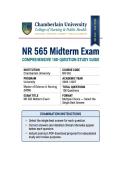
,NR 565 Midterm Exam – Advanced Pharmacology –
Q&A (2026) PDF | Chamberlain
1. A client taking warfarin has an INR of 4.8 and minor bleeding. Which antidote should the
nurse practitioner anticipate administering?
A) Vitamin K
B) Protamine sulfate
C) Fresh frozen plasma
D) Andexanet alfa
Correct Answer: A) Vitamin K
Rationale: Warfarin overdose is reversed by vitamin K, which promotes synthesis of
functional clotting factors. Protamine sulfate reverses heparin, andexanet alfa reverses factor
Xa inhibitors. Fresh frozen plasma provides immediate factors but vitamin K is the specific
antidote.
2. The APRN prescribes lisinopril for hypertension. Which side effect requires immediate
discontinuation of the drug?
A) Dry cough
B) Angioedema
C) Hyperkalemia
D) Dizziness
Correct Answer: B) Angioedema
Rationale: Angioedema, swelling of the lips, tongue, or airway, is a life-threatening adverse
effect of ACE inhibitors, requiring permanent discontinuation. Dry cough is common but not
emergent; hyperkalemia and dizziness require monitoring but not always immediate
cessation.
,3. An older adult with heart failure is on digoxin. Which finding would most likely indicate
digoxin toxicity?
A) Increased urine output
B) Tachycardia
C) Yellow-green halos around lights
D) Hypertension
Correct Answer: C) Yellow-green halos around lights
Rationale: Visual disturbances, including yellow-green halos and blurred vision, are classic
signs of digoxin toxicity, along with nausea, vomiting, and bradycardia. Increased urine
output and tachycardia are not typical; hypertension is unrelated.
4. A 52-year-old with type 2 diabetes is scheduled for a CT with iodinated contrast.
Metformin should be held for how long before and after the procedure?
A) 24 hours before and 24 hours after
B) 12 hours before and 12 hours after
C) No need to hold
D) 48 hours before and 48 hours after
Correct Answer: D) 48 hours before and 48 hours after
Rationale: Metformin must be withheld for 48 hours before and after contrast dye to reduce
the risk of lactic acidosis, particularly in patients with renal impairment. Renal function
should be reassessed before restarting. Shorter intervals are inadequate.
5. What schedule of controlled substances has the highest potential for abuse but has
currently accepted medical use?
, A) Schedule II
B) Schedule I
C) Schedule III
D) Schedule IV
Correct Answer: A) Schedule II
Rationale: Schedule II drugs (e.g., morphine, oxycodone) have high abuse potential but
accepted medical uses. Schedule I substances have no accepted medical use. Schedule III and
IV have progressively lower abuse potential and are less restrictive.
6. The clinician is reviewing a patient's opioid prescription for chronic pain. To calculate
overdose risk, the nurse practitioner uses:
A) Patient's weight in kilograms
B) Morphine milligram equivalent (MME)
C) Pain intensity score
D) Duration of opioid therapy alone
Correct Answer: B) Morphine milligram equivalent (MME)
Rationale: MME quantifies the total daily opioid dose, standardizing different opioids to
morphine potency. Higher MME/day correlates with increased overdose risk. Weight, pain
score, and duration are factors but MME is the primary metric.
7. What pharmacokinetic process is primarily responsible for the first-pass effect after oral
drug administration?
A) Renal excretion
B) Protein binding
C) Hepatic metabolism
Q&A (2026) PDF | Chamberlain
1. A client taking warfarin has an INR of 4.8 and minor bleeding. Which antidote should the
nurse practitioner anticipate administering?
A) Vitamin K
B) Protamine sulfate
C) Fresh frozen plasma
D) Andexanet alfa
Correct Answer: A) Vitamin K
Rationale: Warfarin overdose is reversed by vitamin K, which promotes synthesis of
functional clotting factors. Protamine sulfate reverses heparin, andexanet alfa reverses factor
Xa inhibitors. Fresh frozen plasma provides immediate factors but vitamin K is the specific
antidote.
2. The APRN prescribes lisinopril for hypertension. Which side effect requires immediate
discontinuation of the drug?
A) Dry cough
B) Angioedema
C) Hyperkalemia
D) Dizziness
Correct Answer: B) Angioedema
Rationale: Angioedema, swelling of the lips, tongue, or airway, is a life-threatening adverse
effect of ACE inhibitors, requiring permanent discontinuation. Dry cough is common but not
emergent; hyperkalemia and dizziness require monitoring but not always immediate
cessation.
,3. An older adult with heart failure is on digoxin. Which finding would most likely indicate
digoxin toxicity?
A) Increased urine output
B) Tachycardia
C) Yellow-green halos around lights
D) Hypertension
Correct Answer: C) Yellow-green halos around lights
Rationale: Visual disturbances, including yellow-green halos and blurred vision, are classic
signs of digoxin toxicity, along with nausea, vomiting, and bradycardia. Increased urine
output and tachycardia are not typical; hypertension is unrelated.
4. A 52-year-old with type 2 diabetes is scheduled for a CT with iodinated contrast.
Metformin should be held for how long before and after the procedure?
A) 24 hours before and 24 hours after
B) 12 hours before and 12 hours after
C) No need to hold
D) 48 hours before and 48 hours after
Correct Answer: D) 48 hours before and 48 hours after
Rationale: Metformin must be withheld for 48 hours before and after contrast dye to reduce
the risk of lactic acidosis, particularly in patients with renal impairment. Renal function
should be reassessed before restarting. Shorter intervals are inadequate.
5. What schedule of controlled substances has the highest potential for abuse but has
currently accepted medical use?
, A) Schedule II
B) Schedule I
C) Schedule III
D) Schedule IV
Correct Answer: A) Schedule II
Rationale: Schedule II drugs (e.g., morphine, oxycodone) have high abuse potential but
accepted medical uses. Schedule I substances have no accepted medical use. Schedule III and
IV have progressively lower abuse potential and are less restrictive.
6. The clinician is reviewing a patient's opioid prescription for chronic pain. To calculate
overdose risk, the nurse practitioner uses:
A) Patient's weight in kilograms
B) Morphine milligram equivalent (MME)
C) Pain intensity score
D) Duration of opioid therapy alone
Correct Answer: B) Morphine milligram equivalent (MME)
Rationale: MME quantifies the total daily opioid dose, standardizing different opioids to
morphine potency. Higher MME/day correlates with increased overdose risk. Weight, pain
score, and duration are factors but MME is the primary metric.
7. What pharmacokinetic process is primarily responsible for the first-pass effect after oral
drug administration?
A) Renal excretion
B) Protein binding
C) Hepatic metabolism

