

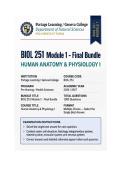
,BIOL 251 Modules 1-9 & Final Exam | Human Anatomy
& Physiology I w/Lab Exam Q&A | Portage Learning
Module 1
1. The structural hierarchy of the human body from simplest to most complex is:
A) Chemical → tissue → cellular → organ → organ system → organism
B) Chemical → cellular → tissue → organ → organ system → organism
C) Cellular → chemical → tissue → organ → organ system → organism
D) Organ → tissue → cellular → chemical → organ system → organism
Correct Answer: B) Chemical → cellular → tissue → organ → organ system →
organism
Rationale: The chemical level (atoms and molecules) is the foundation; cells are
made of molecules; tissues are groups of similar cells; organs consist of multiple
tissues; organ systems are cooperating organs; and the organism is the
complete living individual.
2. Which of the following best describes the principle of complementarity in
anatomy and physiology?
A) Structure determines function
B) Function determines structure
C) Anatomy and physiology are unrelated
D) All organisms have identical anatomy
Correct Answer: D) Structure determines function
,Rationale: The principle of complementarity states that the shape of a structure
is directly related to its job. For example, the thinness of alveolar walls
facilitates gas exchange.
3. A person is standing in the standard anatomical position. Which statement is
correct?
A) The palms face posteriorly
B) The body is lying face down
C) The arms are raised above the head
D) The body is upright, feet parallel, palms facing forward
Correct Answer: D) The body is upright, feet parallel, palms facing forward
Rationale: The anatomical position is the reference point for directional terms:
standing erect, feet slightly apart, arms at sides, palms and face directed
forward.
4. The term "superior" is synonymous with which directional term?
A) Ventral
B) Cranial
C) Medial
D) Proximal
Correct Answer: B) Cranial
, Rationale: Superior (cranial) means toward the head or upper part of the body.
Inferior (caudal) means toward the feet or lower part. Ventral is anterior;
proximal is closer to the point of attachment.
5. A plane that divides the body into anterior and posterior portions is the:
A) Frontal (coronal) plane
B) Sagittal plane
C) Transverse plane
D) Midsagittal plane
Correct Answer: A) Frontal (coronal) plane
Rationale: The frontal plane runs vertically and separates the body into front
(anterior) and back (posterior) sections. The sagittal plane divides right and left;
transverse divides superior and inferior.
6. The heart is located within which body cavity?
A) Dorsal
B) Thoracic
C) Abdominopelvic
D) Cranial
Correct Answer: B) Thoracic
& Physiology I w/Lab Exam Q&A | Portage Learning
Module 1
1. The structural hierarchy of the human body from simplest to most complex is:
A) Chemical → tissue → cellular → organ → organ system → organism
B) Chemical → cellular → tissue → organ → organ system → organism
C) Cellular → chemical → tissue → organ → organ system → organism
D) Organ → tissue → cellular → chemical → organ system → organism
Correct Answer: B) Chemical → cellular → tissue → organ → organ system →
organism
Rationale: The chemical level (atoms and molecules) is the foundation; cells are
made of molecules; tissues are groups of similar cells; organs consist of multiple
tissues; organ systems are cooperating organs; and the organism is the
complete living individual.
2. Which of the following best describes the principle of complementarity in
anatomy and physiology?
A) Structure determines function
B) Function determines structure
C) Anatomy and physiology are unrelated
D) All organisms have identical anatomy
Correct Answer: D) Structure determines function
,Rationale: The principle of complementarity states that the shape of a structure
is directly related to its job. For example, the thinness of alveolar walls
facilitates gas exchange.
3. A person is standing in the standard anatomical position. Which statement is
correct?
A) The palms face posteriorly
B) The body is lying face down
C) The arms are raised above the head
D) The body is upright, feet parallel, palms facing forward
Correct Answer: D) The body is upright, feet parallel, palms facing forward
Rationale: The anatomical position is the reference point for directional terms:
standing erect, feet slightly apart, arms at sides, palms and face directed
forward.
4. The term "superior" is synonymous with which directional term?
A) Ventral
B) Cranial
C) Medial
D) Proximal
Correct Answer: B) Cranial
, Rationale: Superior (cranial) means toward the head or upper part of the body.
Inferior (caudal) means toward the feet or lower part. Ventral is anterior;
proximal is closer to the point of attachment.
5. A plane that divides the body into anterior and posterior portions is the:
A) Frontal (coronal) plane
B) Sagittal plane
C) Transverse plane
D) Midsagittal plane
Correct Answer: A) Frontal (coronal) plane
Rationale: The frontal plane runs vertically and separates the body into front
(anterior) and back (posterior) sections. The sagittal plane divides right and left;
transverse divides superior and inferior.
6. The heart is located within which body cavity?
A) Dorsal
B) Thoracic
C) Abdominopelvic
D) Cranial
Correct Answer: B) Thoracic

