

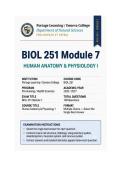
,BIOL 251 Module 7 Exam | Human Anatomy &
Physiology I w/Lab Exam Q&A | Portage Learning
1. The peripheral nervous system (PNS) is functionally divided into:
A) Central and peripheral divisions
B) Afferent (sensory) and efferent (motor) divisions
C) Sympathetic and parasympathetic divisions
D) Somatic and visceral divisions
Correct Answer: B) Afferent (sensory) and efferent (motor) divisions
Rationale: The PNS is divided into afferent pathways that carry signals toward
the CNS and efferent pathways that carry signals away from the CNS. The other
pairs describe subdivisions or the autonomic nervous system.
2. The somatic afferent division of the PNS transmits sensory information from:
A) The skin, skeletal muscles, and joints
B) Internal organs and blood vessels
C) Glands and cardiac muscle
D) The brainstem only
Correct Answer: A) The skin, skeletal muscles, and joints
Rationale: Somatic afferent fibers carry conscious sensations—touch, pain,
temperature, and proprioception—from body surfaces and musculoskeletal
structures to the CNS. Visceral afferents serve internal organs.
,3. The efferent division that controls skeletal muscle is the:
A) Autonomic nervous system
B) Sympathetic nervous system
C) Parasympathetic nervous system
D) Somatic nervous system
Correct Answer: D) Somatic nervous system
Rationale: The somatic motor division innervates skeletal muscle, producing
voluntary movement. The autonomic nervous system controls involuntary
effectors: smooth muscle, cardiac muscle, and glands.
4. The autonomic nervous system is subdivided into:
A) Somatic and visceral
B) Sympathetic and parasympathetic
C) Central and peripheral
D) Afferent and efferent
Correct Answer: B) Sympathetic and parasympathetic
Rationale: The ANS consists of two anatomically and functionally distinct
divisions: the sympathetic (fight‑or‑flight) and parasympathetic
(rest‑and‑digest). They usually have opposing effects on target organs.
5. The sympathetic division of the ANS prepares the body for:
A) Rest and digestion
, B) Conservation of energy
C) Intense physical activity or stress
D) Pupillary constriction and salivation
Correct Answer: C) Intense physical activity or stress
Rationale: Sympathetic activation increases heart rate, dilates bronchioles, and
shunts blood to skeletal muscles, readying the body for fight‑or‑flight
responses. Rest‑and‑digest functions are parasympathetic.
6. The parasympathetic division of the ANS:
A) Increases heart rate and dilates pupils
B) Slows the heart and stimulates gastrointestinal activity
C) Releases norepinephrine at target organs
D) Originates from the thoracolumbar spinal cord
Correct Answer: B) Slows the heart and stimulates gastrointestinal activity
Rationale: Parasympathetic activity conserves energy: it decreases heart rate,
constricts pupils, and enhances digestion and elimination. It originates from the
brainstem and sacral cord (craniosacral outflow).
7. The preganglionic neuron of the sympathetic division releases:
A) Norepinephrine
B) Acetylcholine
C) Dopamine
Physiology I w/Lab Exam Q&A | Portage Learning
1. The peripheral nervous system (PNS) is functionally divided into:
A) Central and peripheral divisions
B) Afferent (sensory) and efferent (motor) divisions
C) Sympathetic and parasympathetic divisions
D) Somatic and visceral divisions
Correct Answer: B) Afferent (sensory) and efferent (motor) divisions
Rationale: The PNS is divided into afferent pathways that carry signals toward
the CNS and efferent pathways that carry signals away from the CNS. The other
pairs describe subdivisions or the autonomic nervous system.
2. The somatic afferent division of the PNS transmits sensory information from:
A) The skin, skeletal muscles, and joints
B) Internal organs and blood vessels
C) Glands and cardiac muscle
D) The brainstem only
Correct Answer: A) The skin, skeletal muscles, and joints
Rationale: Somatic afferent fibers carry conscious sensations—touch, pain,
temperature, and proprioception—from body surfaces and musculoskeletal
structures to the CNS. Visceral afferents serve internal organs.
,3. The efferent division that controls skeletal muscle is the:
A) Autonomic nervous system
B) Sympathetic nervous system
C) Parasympathetic nervous system
D) Somatic nervous system
Correct Answer: D) Somatic nervous system
Rationale: The somatic motor division innervates skeletal muscle, producing
voluntary movement. The autonomic nervous system controls involuntary
effectors: smooth muscle, cardiac muscle, and glands.
4. The autonomic nervous system is subdivided into:
A) Somatic and visceral
B) Sympathetic and parasympathetic
C) Central and peripheral
D) Afferent and efferent
Correct Answer: B) Sympathetic and parasympathetic
Rationale: The ANS consists of two anatomically and functionally distinct
divisions: the sympathetic (fight‑or‑flight) and parasympathetic
(rest‑and‑digest). They usually have opposing effects on target organs.
5. The sympathetic division of the ANS prepares the body for:
A) Rest and digestion
, B) Conservation of energy
C) Intense physical activity or stress
D) Pupillary constriction and salivation
Correct Answer: C) Intense physical activity or stress
Rationale: Sympathetic activation increases heart rate, dilates bronchioles, and
shunts blood to skeletal muscles, readying the body for fight‑or‑flight
responses. Rest‑and‑digest functions are parasympathetic.
6. The parasympathetic division of the ANS:
A) Increases heart rate and dilates pupils
B) Slows the heart and stimulates gastrointestinal activity
C) Releases norepinephrine at target organs
D) Originates from the thoracolumbar spinal cord
Correct Answer: B) Slows the heart and stimulates gastrointestinal activity
Rationale: Parasympathetic activity conserves energy: it decreases heart rate,
constricts pupils, and enhances digestion and elimination. It originates from the
brainstem and sacral cord (craniosacral outflow).
7. The preganglionic neuron of the sympathetic division releases:
A) Norepinephrine
B) Acetylcholine
C) Dopamine

