

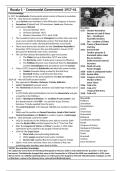
Russia 1 – Communist Government 1917-41
Core knowledge
In 1917 the Bolsheviks (Communists) seized control of Russia in revolution
1917-24 – How did Lenin establish control?
Local Soviets sent members to the All-Russian Congress of Soviets
Sovnarkom (Cabinet) had 13 Commissars. Lenin was Chairman.
Lenin passed decrees Key dates
o On Land (October 1917) 1917 – October Revolution
o On Peace (October 1917) Decrees on Land & Peace
o Workers (November 1917, April 1918) Nov – Constituent
The revolution had occurred in Petrograd, but other cities and rural Assembly elections
areas were outside the Bolsheviks control. The State Bank and Dec – creation of Cheka
Treasury went on strike, denying the Bolsheviks crucial funds 1918 – Treaty of Brest-Litovsk
There were democratic elections for the Constituent Assembly in Civil War
November 1918. However, this was disbanded in January 1918 1921 – End Civil War
(because the Bolsheviks were only a minority) Tambov peasants &
The Civil War allowed the Bolsheviks to gain more power Kronstadt sailors rebel
o The Cheka (set up in December 1917) was active Ban on Factions
o The Red Army under Trotsky grew in power & efficiency Stalin becomes General
o The Politburo became more important than the Sovnarkom Secretary
and the nomenklatura took precedence over the Soviets 1924 – Death of Lenin
Crises of 1921 meant the Bolsheviks extended their power further Power Struggle
o Tambov Peasants Rising crushed by the Red Army 1928 – Stalin is undisputed leader
o Kronstadt Mutiny crushed by the Red Army 1932 – Ryutin Affair
o Dissention in the party quelled by the Ban on Factions 1934 – Congress of Victors
1924-28 – How did Stalin become leader? Murder of Kirov
Key opponents: Zinoviev, Kamenev, Trotsky, Bukharin Great Terror
Lenin’s Testament was kept secret 1936 – Trial of 16
The Triumvirate of Zinoviev, Kamenev and Stalin kept Trotsky out of 1937 – Trial of 17
power Purge of Red Army
In 1925 Stalin allied with Bukharin to form the Duumvirate and gain 1938 – Trial of 21
a majority in the Politburo
Stalin’s ‘ideological orthodoxy’ on ‘socialism in one country’ and Key words
the abandonment of the NEP – he used this to get Zinoviev, Politburo
Kamenev, Trotsky expelled from the party Sovnarkom
The Lenin Enrolment, 1924 allowed 128,000 new members, loyal to Nomenklatura
Stalin Soviet
Stalin used his position as General Secretary, Head of the Central Triumvirate
Control Commission and Rabkrin to create a system of patronage Duumvirate
1928-41 – How did Stalin control the USSR? Bolshevik
1932-33 moderates in the Politburo were able to overrule Stalin Constituent Assembly
over the Ryutin Affair and the targets for the 2nd Five Year Plan Ryutin
After the Congress of Victors and Kirov’s murder in 1934 Stalin Congress of Victors
claimed the party needed to be purged of internal threats Ideological Orthodoxy
1934-38 The Great Terror Patronage
o Show trials removed leading Bolsheviks Cheka
o Wider purges targeted senior party members Kronstadt
o Secret trials targeted Red Army leaders loyal to Trotsky Tambov
Stalin’s rivals were removed, there was a climate of fear, the Lenin Enrolment
remaining party members were loyal to Stalin
‘WOW’ the examiner knowledge
The capital city moved from St Petersburg (Petrograd) to Moscow; Stalin’s rivals called him the ‘grey blur’ or the ‘grey
bureaucrat; The Bolsheviks changed their name to the Communists in 1918 and the USSR was established in 1922; Lenin
did use Terror; in a Chistka (cleansing) about 1/3 of the party were purged in 1918 and 1920 (drunkards, hooligans as well
as Bim-Bom, a clown in the Moscow circus, who told anti-Bolshevik jokes)
Core knowledge
In 1917 the Bolsheviks (Communists) seized control of Russia in revolution
1917-24 – How did Lenin establish control?
Local Soviets sent members to the All-Russian Congress of Soviets
Sovnarkom (Cabinet) had 13 Commissars. Lenin was Chairman.
Lenin passed decrees Key dates
o On Land (October 1917) 1917 – October Revolution
o On Peace (October 1917) Decrees on Land & Peace
o Workers (November 1917, April 1918) Nov – Constituent
The revolution had occurred in Petrograd, but other cities and rural Assembly elections
areas were outside the Bolsheviks control. The State Bank and Dec – creation of Cheka
Treasury went on strike, denying the Bolsheviks crucial funds 1918 – Treaty of Brest-Litovsk
There were democratic elections for the Constituent Assembly in Civil War
November 1918. However, this was disbanded in January 1918 1921 – End Civil War
(because the Bolsheviks were only a minority) Tambov peasants &
The Civil War allowed the Bolsheviks to gain more power Kronstadt sailors rebel
o The Cheka (set up in December 1917) was active Ban on Factions
o The Red Army under Trotsky grew in power & efficiency Stalin becomes General
o The Politburo became more important than the Sovnarkom Secretary
and the nomenklatura took precedence over the Soviets 1924 – Death of Lenin
Crises of 1921 meant the Bolsheviks extended their power further Power Struggle
o Tambov Peasants Rising crushed by the Red Army 1928 – Stalin is undisputed leader
o Kronstadt Mutiny crushed by the Red Army 1932 – Ryutin Affair
o Dissention in the party quelled by the Ban on Factions 1934 – Congress of Victors
1924-28 – How did Stalin become leader? Murder of Kirov
Key opponents: Zinoviev, Kamenev, Trotsky, Bukharin Great Terror
Lenin’s Testament was kept secret 1936 – Trial of 16
The Triumvirate of Zinoviev, Kamenev and Stalin kept Trotsky out of 1937 – Trial of 17
power Purge of Red Army
In 1925 Stalin allied with Bukharin to form the Duumvirate and gain 1938 – Trial of 21
a majority in the Politburo
Stalin’s ‘ideological orthodoxy’ on ‘socialism in one country’ and Key words
the abandonment of the NEP – he used this to get Zinoviev, Politburo
Kamenev, Trotsky expelled from the party Sovnarkom
The Lenin Enrolment, 1924 allowed 128,000 new members, loyal to Nomenklatura
Stalin Soviet
Stalin used his position as General Secretary, Head of the Central Triumvirate
Control Commission and Rabkrin to create a system of patronage Duumvirate
1928-41 – How did Stalin control the USSR? Bolshevik
1932-33 moderates in the Politburo were able to overrule Stalin Constituent Assembly
over the Ryutin Affair and the targets for the 2nd Five Year Plan Ryutin
After the Congress of Victors and Kirov’s murder in 1934 Stalin Congress of Victors
claimed the party needed to be purged of internal threats Ideological Orthodoxy
1934-38 The Great Terror Patronage
o Show trials removed leading Bolsheviks Cheka
o Wider purges targeted senior party members Kronstadt
o Secret trials targeted Red Army leaders loyal to Trotsky Tambov
Stalin’s rivals were removed, there was a climate of fear, the Lenin Enrolment
remaining party members were loyal to Stalin
‘WOW’ the examiner knowledge
The capital city moved from St Petersburg (Petrograd) to Moscow; Stalin’s rivals called him the ‘grey blur’ or the ‘grey
bureaucrat; The Bolsheviks changed their name to the Communists in 1918 and the USSR was established in 1922; Lenin
did use Terror; in a Chistka (cleansing) about 1/3 of the party were purged in 1918 and 1920 (drunkards, hooligans as well
as Bim-Bom, a clown in the Moscow circus, who told anti-Bolshevik jokes)

