

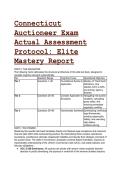
Connecticut
Auctioneer Exam
Actual Assessment
Protocol: Elite
Mastery Report
PART 0: THE NAVIGATOR
The following matrix delineates the structural architecture of this elite test bank, designed to
escalate cognitive demand systematically.
Tier Question Range Cognitive Focus Operational Objective
Tier 1 Questions 1–28 Foundational Syntax & Mastery of "Hard Deck"
Application definitions, core
statutes (UCC 2-328),
and primary agency
theories.
Tier 2 Questions 29–58 Complex Application & Navigating mid-auction
Simulation variables, calculating
gross yields, and
resolving immediate
regulatory conflicts.
Tier 3 Questions 59–88 Grandmaster Synthesis Synthesizing conflicting
legal frameworks,
averting catastrophic
liability, and executing
high-stakes
problem-solving.
PART I: THE PRIMER
Mastering this specific test bank translates directly into flawless legal compliance and maximum
financial yield within elite auctioneering practice. By internalizing these complex operational
boundaries, practitioners eliminate catastrophic liabilities and elevate their strategic command of
the auction block. The state of Connecticut, alongside universal federal mandates, requires an
impenetrable understanding of the Uniform Commercial Code (UCC), real estate statutes, and
fiduciary obligations.
● UCC 2-328 Dominance: All auctions are strictly with reserve unless explicitly deemed
absolute in public advertising; the physical or verbal fall of the hammer dictates statutory
, finality.
● Escrow Inviolability: Commingling operational and client funds is a terminal professional
failure that triggers immediate regulatory revocation. Trust accounts must remain
mathematically pure.
● Contractual Perfection: Without confirmed probate authority, clear title, or executed
listing agreements, no auction may lawfully proceed.
● The Parol Evidence Supremacy: Written terms and conditions unconditionally
supersede verbal declarations made from the auction block, neutralizing downstream
litigation.
Fiduciary Agency Matrix (COALD)
To operate as an elite agent, one must internalize the five pillars of fiduciary duty that govern all
principal-agent relationships in the auction industry:
Fiduciary Duty Core Mandate Catastrophic Failure
Consequence
Care Operating with elite Negligence lawsuits; E&O
professional competence and insurance claims.
standard industry skill.
Obedience Executing all strictly lawful Breach of agency contract.
demands of the principal.
Accountability Exacting financial ledger Commingling charges; license
transparency and prompt revocation.
settlement.
Loyalty Prioritizing the principal's equity Voided contracts; forfeiture of
above the auctioneer's commissions.
personal gain.
Disclosure Revealing all material facts Fraudulent concealment; civil
affecting the asset's value to all damages.
parties.
PART II: THE ELITE TEST BANK
Tier 1: Foundational Syntax & Application
Q1: Under UCC 2-328, an auction is presumed to be of what type unless explicitly stated
otherwise? Based on the Uniform Commercial Code, which classification is MOST
ACCURATE? A) Absolute B) Without Reserve C) With Reserve D) Dutch
● The Answer: C (With Reserve)
● Distractor Analysis:
○ A is incorrect: Absolute status must be explicitly declared and prevents the seller
from withdrawing the item.
○ B is incorrect: This is merely a synonym for absolute, not the statutory default
condition.
○ D is incorrect: A Dutch format is a descending price structure, totally unrelated to
the reserve baseline.
The Mentor's Analysis: Statutory defaults inherently protect the seller's equity position. When
facing unclassified listings, the immediate priority is acknowledging the with reserve default. By
, utilizing UCC baseline assumptions, you bypass premature asset forfeiture.
Professional/Academic Intuition: Always presume the seller retains the right of confirmation
unless explicitly waived in writing.
Q2: A bidder retracts their bid prior to the hammer falling. Under UCC 2-328, what is the
IMMEDIATE effect on the preceding bid? A) It is automatically reinstated. B) It remains invalid.
C) It becomes the active high bid. D) It converts to an absentee bid.
● The Answer: B (It remains invalid)
● Distractor Analysis:
○ A is incorrect: A retraction does not legally revive earlier extinguished bids.
○ C is incorrect: The previous bid was fundamentally extinguished the moment the
higher bid was recognized.
○ D is incorrect: Absentee status requires prior written proxy authorization.
The Mentor's Analysis: Bid progression is inherently linear and destructive to previous offers.
When facing bid retractions, the immediate priority is restarting the bid calling from the active
increment. By utilizing statutory extinguishment rules, you bypass invalid contract enforcement.
Professional/Academic Intuition: A retracted bid never revives the immediately preceding
bid.
Q3: An auctioneer receives two identical bids simultaneously from different sections of the floor.
What is the MOST APPROPRIATE action to resolve the tie? A) Award to the absentee bidder.
B) Award to the floor bidder. C) Reopen the bidding between the two parties. D) Cancel the lot.
● The Answer: C (Reopen the bidding between the two parties)
● Distractor Analysis:
○ A is incorrect: Geographic proximity or digital format does not automatically break
ties.
○ B is incorrect: Precedence is never given simply based on physical presence.
○ D is incorrect: Cancellation directly harms the seller's financial interest.
The Mentor's Analysis: Tie bids create simultaneous, conflicting legal claims of acceptance.
When facing simultaneous offers, the immediate priority is resuming price discovery. By utilizing
immediate reopening protocols, you bypass arbitrary favoritism. Professional/Academic Intuition:
Tie bids must be resolved via immediate competitive reopening.
Q4: A principal secretly places bids to artificially drive up the price of their own asset. Which
legal violation is MOST ACCURATE? A) Puffing B) Trotting C) Shill Bidding D) Chandelier
Bidding
● The Answer: C (Shill Bidding)
● Distractor Analysis:
○ A is incorrect: Puffing is exaggerated subjective opinion, not fraudulent bidding.
○ B is incorrect: Trotting involves the auctioneer taking phantom bids off the wall.
○ D is incorrect: Chandelier bidding targets the reserve and is legal if disclosed
upfront.
The Mentor's Analysis: Artificial inflation mathematically destroys market trust. When facing low
engagement, the immediate priority is transparent price discovery. By utilizing ethical bid calling,
you bypass criminal fraud. Professional/Academic Intuition: Shill bidding is a terminal
violation that voids contracts.
Q5: In estate law, an individual dying without a will is defined as what? Based on probate
frameworks, which term is MOST ACCURATE? A) Testate B) In Escrow C) Intestate D) In
Probate
● The Answer: C (Intestate)
● Distractor Analysis:
Auctioneer Exam
Actual Assessment
Protocol: Elite
Mastery Report
PART 0: THE NAVIGATOR
The following matrix delineates the structural architecture of this elite test bank, designed to
escalate cognitive demand systematically.
Tier Question Range Cognitive Focus Operational Objective
Tier 1 Questions 1–28 Foundational Syntax & Mastery of "Hard Deck"
Application definitions, core
statutes (UCC 2-328),
and primary agency
theories.
Tier 2 Questions 29–58 Complex Application & Navigating mid-auction
Simulation variables, calculating
gross yields, and
resolving immediate
regulatory conflicts.
Tier 3 Questions 59–88 Grandmaster Synthesis Synthesizing conflicting
legal frameworks,
averting catastrophic
liability, and executing
high-stakes
problem-solving.
PART I: THE PRIMER
Mastering this specific test bank translates directly into flawless legal compliance and maximum
financial yield within elite auctioneering practice. By internalizing these complex operational
boundaries, practitioners eliminate catastrophic liabilities and elevate their strategic command of
the auction block. The state of Connecticut, alongside universal federal mandates, requires an
impenetrable understanding of the Uniform Commercial Code (UCC), real estate statutes, and
fiduciary obligations.
● UCC 2-328 Dominance: All auctions are strictly with reserve unless explicitly deemed
absolute in public advertising; the physical or verbal fall of the hammer dictates statutory
, finality.
● Escrow Inviolability: Commingling operational and client funds is a terminal professional
failure that triggers immediate regulatory revocation. Trust accounts must remain
mathematically pure.
● Contractual Perfection: Without confirmed probate authority, clear title, or executed
listing agreements, no auction may lawfully proceed.
● The Parol Evidence Supremacy: Written terms and conditions unconditionally
supersede verbal declarations made from the auction block, neutralizing downstream
litigation.
Fiduciary Agency Matrix (COALD)
To operate as an elite agent, one must internalize the five pillars of fiduciary duty that govern all
principal-agent relationships in the auction industry:
Fiduciary Duty Core Mandate Catastrophic Failure
Consequence
Care Operating with elite Negligence lawsuits; E&O
professional competence and insurance claims.
standard industry skill.
Obedience Executing all strictly lawful Breach of agency contract.
demands of the principal.
Accountability Exacting financial ledger Commingling charges; license
transparency and prompt revocation.
settlement.
Loyalty Prioritizing the principal's equity Voided contracts; forfeiture of
above the auctioneer's commissions.
personal gain.
Disclosure Revealing all material facts Fraudulent concealment; civil
affecting the asset's value to all damages.
parties.
PART II: THE ELITE TEST BANK
Tier 1: Foundational Syntax & Application
Q1: Under UCC 2-328, an auction is presumed to be of what type unless explicitly stated
otherwise? Based on the Uniform Commercial Code, which classification is MOST
ACCURATE? A) Absolute B) Without Reserve C) With Reserve D) Dutch
● The Answer: C (With Reserve)
● Distractor Analysis:
○ A is incorrect: Absolute status must be explicitly declared and prevents the seller
from withdrawing the item.
○ B is incorrect: This is merely a synonym for absolute, not the statutory default
condition.
○ D is incorrect: A Dutch format is a descending price structure, totally unrelated to
the reserve baseline.
The Mentor's Analysis: Statutory defaults inherently protect the seller's equity position. When
facing unclassified listings, the immediate priority is acknowledging the with reserve default. By
, utilizing UCC baseline assumptions, you bypass premature asset forfeiture.
Professional/Academic Intuition: Always presume the seller retains the right of confirmation
unless explicitly waived in writing.
Q2: A bidder retracts their bid prior to the hammer falling. Under UCC 2-328, what is the
IMMEDIATE effect on the preceding bid? A) It is automatically reinstated. B) It remains invalid.
C) It becomes the active high bid. D) It converts to an absentee bid.
● The Answer: B (It remains invalid)
● Distractor Analysis:
○ A is incorrect: A retraction does not legally revive earlier extinguished bids.
○ C is incorrect: The previous bid was fundamentally extinguished the moment the
higher bid was recognized.
○ D is incorrect: Absentee status requires prior written proxy authorization.
The Mentor's Analysis: Bid progression is inherently linear and destructive to previous offers.
When facing bid retractions, the immediate priority is restarting the bid calling from the active
increment. By utilizing statutory extinguishment rules, you bypass invalid contract enforcement.
Professional/Academic Intuition: A retracted bid never revives the immediately preceding
bid.
Q3: An auctioneer receives two identical bids simultaneously from different sections of the floor.
What is the MOST APPROPRIATE action to resolve the tie? A) Award to the absentee bidder.
B) Award to the floor bidder. C) Reopen the bidding between the two parties. D) Cancel the lot.
● The Answer: C (Reopen the bidding between the two parties)
● Distractor Analysis:
○ A is incorrect: Geographic proximity or digital format does not automatically break
ties.
○ B is incorrect: Precedence is never given simply based on physical presence.
○ D is incorrect: Cancellation directly harms the seller's financial interest.
The Mentor's Analysis: Tie bids create simultaneous, conflicting legal claims of acceptance.
When facing simultaneous offers, the immediate priority is resuming price discovery. By utilizing
immediate reopening protocols, you bypass arbitrary favoritism. Professional/Academic Intuition:
Tie bids must be resolved via immediate competitive reopening.
Q4: A principal secretly places bids to artificially drive up the price of their own asset. Which
legal violation is MOST ACCURATE? A) Puffing B) Trotting C) Shill Bidding D) Chandelier
Bidding
● The Answer: C (Shill Bidding)
● Distractor Analysis:
○ A is incorrect: Puffing is exaggerated subjective opinion, not fraudulent bidding.
○ B is incorrect: Trotting involves the auctioneer taking phantom bids off the wall.
○ D is incorrect: Chandelier bidding targets the reserve and is legal if disclosed
upfront.
The Mentor's Analysis: Artificial inflation mathematically destroys market trust. When facing low
engagement, the immediate priority is transparent price discovery. By utilizing ethical bid calling,
you bypass criminal fraud. Professional/Academic Intuition: Shill bidding is a terminal
violation that voids contracts.
Q5: In estate law, an individual dying without a will is defined as what? Based on probate
frameworks, which term is MOST ACCURATE? A) Testate B) In Escrow C) Intestate D) In
Probate
● The Answer: C (Intestate)
● Distractor Analysis:

