

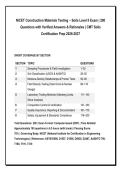
NICET Construction Materials Testing – Soils Level II Exam | 200
Questions with Verified Answers & Rationales | CMT Soils
Certification Prep 2026-2027
SHORT COVERAGE BY SECTION
SECTION TOPIC QUESTIONS
1 Sampling Procedures & Field Investigation 1–25
2 Soil Classification (USCS & AASHTO) 26–55
3 Moisture-Density Relationships & Proctor Tests 56–85
4 Field Density Testing (Sand Cone & Nuclear 86–110
Gauge)
5 Laboratory Testing Methods (Atterberg Limits, 111–140
Sieve Analysis)
6 Compaction Control & Verification 141–160
7 Quality Assurance, Reporting & Documentation 161–175
8 Safety, Equipment & Standards Compliance 176–200
Total Questions: 200 | Exam Format: Computer-based (CBT) | Time Allotted:
Approximately 165 questions in 6.5 hours (with break) | Passing Score:
70% | Governing Body: NICET (National Institute for Certification in Engineering
Technologies) | References: ASTM D698, D1557, D1556, D6938, D2487, AASHTO T99,
T180, T191, T310
,Section 1: Sampling Procedures & Field Investigation (Questions 1–25)
1. A field technician collects a bulk soil sample from a stockpile but only scoops from
the surface. What is the main issue with this sampling method?
a) Surface sampling produces better moisture consistency
b) The sample may not be representative of the full stockpile material
c) Surface material is always finer than deeper material
d) This method prevents contamination from equipment
b) The sample may not be representative of the full stockpile material
The primary concern with surface-only sampling is that it fails to capture the variability and
composition of the entire stockpile. Stockpiles can have segregated materials, with coarser
particles rolling to the bottom and fines remaining on top, making surface sampling non-
representative.
2. What is the recommended minimum depth for sampling a soil stockpile to obtain a
representative sample?
a) 2 inches
b) 6 inches
,c) 12 inches
d) 18 inches
c) 12 inches
A minimum depth of 12 inches is recommended to obtain a representative sample from a
stockpile, as the surface layer may be weathered, dried, or segregated from the material
below.
3. A split-spoon sampler is driven into soil to obtain a sample. What type of sample
does this produce?
a) Undisturbed sample
b) Disturbed but representative sample
c) Bulk sample
d) Surface grab sample
b) Disturbed but representative sample
A split-spoon (SPT) sampler obtains a disturbed but representative sample suitable for
classification and identification tests. It is not suitable for strength or consolidation testing
because the sample structure is altered during driving.
4. A Shelby tube is used to collect soil samples from a clay deposit. What is the
primary advantage of using a Shelby tube for sampling?
, a) Lowest cost
b) Preserves natural structure for strength tests
c) Fastest sampling method
d) Works best in gravel deposits
b) Preserves natural structure for strength tests
Shelby tubes are thin-walled tubes designed to collect undisturbed samples that preserve
the natural structure and fabric of the soil, making them suitable for strength and
consolidation testing on cohesive soils.
5. According to standard practice, disturbed soil samples obtained from test pits or
excavations for classification testing are typically taken from:
a) Only the top 6 inches of the exposed surface
b) The center of the undisturbed mass
c) The sidewall of the excavation at the desired depth
d) Representative portions of the material encountered
d) Representative portions of the material encountered
When obtaining disturbed samples from a test pit, the goal is to collect a portion that is
representative of the entire stratum or material being investigated, not just the surface or a
single location.
Questions with Verified Answers & Rationales | CMT Soils
Certification Prep 2026-2027
SHORT COVERAGE BY SECTION
SECTION TOPIC QUESTIONS
1 Sampling Procedures & Field Investigation 1–25
2 Soil Classification (USCS & AASHTO) 26–55
3 Moisture-Density Relationships & Proctor Tests 56–85
4 Field Density Testing (Sand Cone & Nuclear 86–110
Gauge)
5 Laboratory Testing Methods (Atterberg Limits, 111–140
Sieve Analysis)
6 Compaction Control & Verification 141–160
7 Quality Assurance, Reporting & Documentation 161–175
8 Safety, Equipment & Standards Compliance 176–200
Total Questions: 200 | Exam Format: Computer-based (CBT) | Time Allotted:
Approximately 165 questions in 6.5 hours (with break) | Passing Score:
70% | Governing Body: NICET (National Institute for Certification in Engineering
Technologies) | References: ASTM D698, D1557, D1556, D6938, D2487, AASHTO T99,
T180, T191, T310
,Section 1: Sampling Procedures & Field Investigation (Questions 1–25)
1. A field technician collects a bulk soil sample from a stockpile but only scoops from
the surface. What is the main issue with this sampling method?
a) Surface sampling produces better moisture consistency
b) The sample may not be representative of the full stockpile material
c) Surface material is always finer than deeper material
d) This method prevents contamination from equipment
b) The sample may not be representative of the full stockpile material
The primary concern with surface-only sampling is that it fails to capture the variability and
composition of the entire stockpile. Stockpiles can have segregated materials, with coarser
particles rolling to the bottom and fines remaining on top, making surface sampling non-
representative.
2. What is the recommended minimum depth for sampling a soil stockpile to obtain a
representative sample?
a) 2 inches
b) 6 inches
,c) 12 inches
d) 18 inches
c) 12 inches
A minimum depth of 12 inches is recommended to obtain a representative sample from a
stockpile, as the surface layer may be weathered, dried, or segregated from the material
below.
3. A split-spoon sampler is driven into soil to obtain a sample. What type of sample
does this produce?
a) Undisturbed sample
b) Disturbed but representative sample
c) Bulk sample
d) Surface grab sample
b) Disturbed but representative sample
A split-spoon (SPT) sampler obtains a disturbed but representative sample suitable for
classification and identification tests. It is not suitable for strength or consolidation testing
because the sample structure is altered during driving.
4. A Shelby tube is used to collect soil samples from a clay deposit. What is the
primary advantage of using a Shelby tube for sampling?
, a) Lowest cost
b) Preserves natural structure for strength tests
c) Fastest sampling method
d) Works best in gravel deposits
b) Preserves natural structure for strength tests
Shelby tubes are thin-walled tubes designed to collect undisturbed samples that preserve
the natural structure and fabric of the soil, making them suitable for strength and
consolidation testing on cohesive soils.
5. According to standard practice, disturbed soil samples obtained from test pits or
excavations for classification testing are typically taken from:
a) Only the top 6 inches of the exposed surface
b) The center of the undisturbed mass
c) The sidewall of the excavation at the desired depth
d) Representative portions of the material encountered
d) Representative portions of the material encountered
When obtaining disturbed samples from a test pit, the goal is to collect a portion that is
representative of the entire stratum or material being investigated, not just the surface or a
single location.

